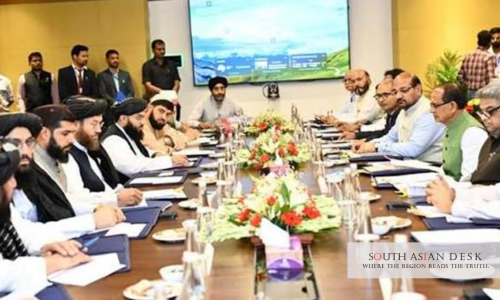
India Afghanistan agricultural cooperation was discussed in New Delhi as Indian officials met representatives of Afghanistan’s Taliban authorities to explore collaboration in farming, livestock, food security and agricultural research.
Afghanistan’s acting Minister of Agriculture, Irrigation and Livestock, Mawlawi Attaullah Omari, met Indian Agriculture Minister Shivraj Singh Chouhan on July 8 during a visit to India. The meeting focused on strengthening cooperation in agricultural research, education, extension services and capacity building.
The engagement marks another step in India’s cautious outreach to Afghanistan’s Taliban-run administration. New Delhi has not formally recognised the Taliban government, but it has continued limited engagement focused on humanitarian assistance, trade, development support and practical cooperation.
India Afghanistan agricultural cooperation focuses on farming and livestock
India Afghanistan agricultural cooperation is expected to focus on areas such as climate-resilient farming, horticulture, seed systems, natural resource management, digital agriculture and livestock development.
The Indian side said the talks also covered agricultural education, human resource development and extension services to improve farmers’ livelihoods and support sustainable agricultural growth.
Livestock cooperation was also discussed, including animal health, dairy development, veterinary sciences and fodder management. Both sides agreed to encourage closer engagement between scientific institutions and technical experts from the two countries.
The discussions are significant because agriculture remains central to Afghanistan’s economy, food security and rural livelihoods. Years of conflict, drought, weak infrastructure and economic isolation have damaged the country’s agricultural sector, making technical support and productivity improvement important policy priorities.
Joint working group proposed for long-term roadmap
India and Afghanistan agreed to work towards setting up a joint working group to prepare a long-term roadmap for cooperation in agriculture and livestock.
The proposed mechanism is expected to support regular engagement between officials, research institutions and technical experts. It may also help identify new areas for cooperation in seeds, irrigation, agricultural technology, livestock health, training and agri-trade.
A joint working group would give the discussions a more structured format. Without such a mechanism, cooperation may remain limited to diplomatic statements and occasional visits.
The two sides also discussed the role of institutional partnerships. Cooperation between the Indian Council of Agricultural Research and the Afghanistan National Agricultural Sciences and Technology University is expected to support research, training, exchange of scientists and students, and dissemination of agricultural technologies and best practices.
Food security remains central to Afghanistan’s needs
Food security in Afghanistan remains a major concern, making agriculture a practical area for international engagement.
Afghanistan’s rural economy depends heavily on farming and livestock. Any improvement in seeds, irrigation, crop management, animal health and market access could directly affect household incomes and food availability.
For the Taliban authorities, agricultural cooperation with India offers access to technical expertise, training and institutional support. For India, the engagement provides a relatively low-risk way to maintain influence in Afghanistan while framing cooperation around the welfare of the Afghan people.
India has historically supported development projects in Afghanistan across infrastructure, education, health and capacity building. Since the Taliban returned to power in 2021, India has adjusted its approach, maintaining contact on humanitarian and development-related issues while avoiding formal recognition of the Taliban administration.
India Taliban engagement remains cautious
India Taliban engagement has gradually increased, but remains politically sensitive.
India has maintained that its support is directed towards the Afghan people. Its engagement with Taliban officials has focused on areas such as humanitarian aid, trade, development cooperation, health, education and now agriculture.
A recent joint committee meeting led by foreign ministry officials also reviewed cooperation in humanitarian assistance, development partnership, food security, healthcare, capacity building, education, sports, trade, visas and connectivity.
The meeting was co-chaired by M Anand Prakash, Joint Secretary for Pakistan, Afghanistan and Iran in India’s Ministry of External Affairs, and Shuaib Baryalai, Director General of the First Political Division in Afghanistan’s Ministry of Foreign Affairs.
The talks show that India is broadening its functional engagement with the Taliban authorities without announcing a formal change in its recognition policy.
Connectivity and trade also part of wider talks
Agricultural cooperation is linked to wider discussions on trade and connectivity.
Afghanistan’s agricultural sector needs not only technical support, but also better access to markets, transport routes and processing facilities. Improved connectivity could help Afghan farmers export fruits, dry fruits, medicinal plants and other agricultural products to regional markets.
India has long viewed Afghanistan as part of its regional connectivity strategy, including through Iran’s Chabahar Port. That route has been important for India because it allows trade with Afghanistan while bypassing Pakistan.
The latest discussions therefore carry both developmental and strategic significance. Agriculture may be the immediate subject, but trade routes, market access and regional influence remain part of the broader India-Afghanistan relationship.
Taliban government seeks broader external support
The Taliban government of Afghanistan has been seeking expanded international engagement as the country remains economically fragile and diplomatically isolated.
Many countries have maintained contact with the Taliban authorities, but formal recognition remains limited because of concerns over governance, human rights and restrictions on women and girls.
India’s approach is pragmatic. It has security concerns and a complicated history with the Taliban, but it also wants to avoid losing influence in Afghanistan to regional rivals. At the same time, India continues to frame its engagement as people-centred and development-focused.
Agricultural collaboration offers a useful channel because it is less politically contentious than defence or formal diplomatic recognition. It also addresses a real need in Afghanistan’s rural economy.
Implementation will determine impact
The success of the latest India-Afghanistan agricultural discussions will depend on implementation.
The proposed joint working group must identify specific projects, timelines and institutional responsibilities. Practical cooperation could include seed improvement, farmer training, livestock vaccination, dairy development, digital advisory tools, irrigation efficiency, agricultural education and student exchanges.
If these programmes are developed seriously, they could support Afghan farmers and strengthen India’s role as a technical and development partner. If not, the talks may remain largely symbolic.
For now, the New Delhi meetings show that India is willing to expand practical cooperation with Taliban authorities in selected sectors while continuing to avoid formal recognition.
India Afghanistan agricultural cooperation is therefore not only about farming. It is also part of a broader diplomatic calculation in which New Delhi is trying to support Afghan livelihoods, maintain regional relevance and manage engagement with a government it has not formally recognised.
Published in SouthAsianDesk, July 13, 2026
Follow SouthAsianDesk on X, Instagram and Facebook for insights on business and current affairs from across South Asia.