Pakistan-Saudi Arabia economic cooperation is set to expand after ministers from both countries agreed to further strengthen economic ties and broaden collaboration in the energy sector.
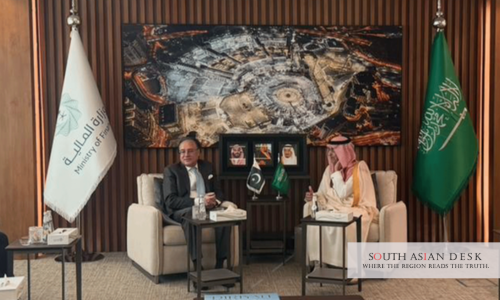
The understanding was reached during a meeting in Riyadh between Finance Minister Muhammad Aurangzeb, Minister for Power Sardar Awais Ahmad Khan Leghari and Saudi Finance Minister Mohammed bin Abdullah Al-Jadaan.
The meeting focused on enhancing the Pakistan-Saudi economic partnership, with particular emphasis on energy cooperation. Both sides also agreed to continue consultations and maintain close coordination on matters of mutual interest.
Pakistan-Saudi Arabia economic cooperation focuses on energy
Pakistan-Saudi Arabia economic cooperation has long been shaped by energy, investment, financial support and labour links. The latest meeting gives renewed attention to the energy sector at a time when Pakistan is trying to stabilise its power system, attract investment and reduce pressure on its external accounts.
Officials said the two sides expressed satisfaction over the growing partnership between the countries and reiterated their resolve to deepen economic and energy cooperation through sustained engagement and close bilateral coordination.
The statement did not announce a specific new project, financing package or investment agreement. However, the inclusion of Pakistan’s power minister in the meeting indicates that energy sector issues were central to the discussion.
For Pakistan, Saudi cooperation in energy is strategically important. The country remains dependent on imported fuel and continues to face high energy costs, circular debt, infrastructure constraints and the need for investment in generation, transmission and sector reform.
Saudi partnership remains important for Pakistan’s economy
Saudi Arabia remains one of Pakistan’s most important economic partners. The relationship includes oil supplies, financial support, worker remittances, investment discussions and cooperation through regional and multilateral forums.
Riyadh has repeatedly supported Pakistan during periods of external financing pressure. Earlier this year, Saudi Arabia pledged additional financial support to Pakistan as Islamabad worked to manage external repayments and maintain foreign exchange stability.
The latest meeting comes as Pakistan is trying to move from short-term stabilisation toward investment-led growth. The government has been seeking greater foreign investment in energy, mining, infrastructure, agriculture, information technology and other sectors.
Saudi Arabia has also shown interest in increasing economic engagement with Pakistan through investment and business-to-business cooperation. Previous discussions have focused on converting expressions of interest and memoranda of understanding into practical investment outcomes.
Energy sector remains central to reform agenda
Energy remains one of Pakistan’s most difficult reform areas.
The power sector has faced persistent financial stress because of high generation costs, distribution losses, delayed recoveries and circular debt. These pressures affect the federal budget, industrial competitiveness and household consumers.
Pakistan has also been trying to renegotiate energy costs, improve power transmission, reduce losses and attract private investment in cleaner and more reliable energy infrastructure.
In this context, Saudi engagement can matter in several ways. It may support investment in energy infrastructure, petroleum supply arrangements, renewable energy opportunities or cooperation with Saudi companies in power and fuel-related projects.
However, any meaningful progress will depend on whether high-level discussions lead to bankable projects, clear timelines and commercially viable agreements.
Bilateral coordination to continue
The two sides agreed to continue consultations and maintain close coordination on matters of mutual interest.
This phrasing suggests that the meeting was part of an ongoing process rather than a one-off engagement. Pakistan and Saudi Arabia have held several high-level economic interactions in recent months, reflecting a broader effort to deepen practical cooperation.
Separately, Saudi Arabia’s ambassador to Pakistan, Nawaf bin Saeed Ahmad Al-Malkiy, also met Deputy Prime Minister Ishaq Dar in Islamabad. The two sides discussed regional developments and reaffirmed their commitment to strengthening Pakistan-Saudi Arabia relations across areas of mutual interest.
Taken together, the engagements show that the relationship is moving on parallel tracks: economic cooperation, energy engagement and regional diplomatic coordination.
Pakistan seeks investment-backed growth
Pakistan’s immediate challenge is to turn improved macroeconomic stability into investment and growth.
The government has repeatedly argued that economic reforms, fiscal discipline and improved external indicators have created a better environment for investors. Saudi Arabia is central to that pitch because of its financial capacity, energy expertise and long-standing ties with Pakistan.
For Riyadh, Pakistan offers a large market, a strategic location and potential opportunities in energy, mining, infrastructure, agriculture and services. Saudi Arabia’s Vision 2030 also creates room for greater cooperation in technology, workforce development and investment partnerships.
Still, the key test remains implementation. Pakistan has often announced major investment interest from Gulf partners, but many commitments have taken time to reach financial close. Investors will look for policy certainty, regulatory clarity, contract enforcement, energy-sector reform and repatriation confidence.
No major project announced yet
The latest meeting should therefore be read carefully.
It signals continued commitment to cooperation, particularly in energy, but it does not yet amount to a new signed investment deal. The official statements refer to agreement on expanding cooperation and maintaining coordination, not to a finalised project or funding package.
That distinction matters because Pakistan’s economic diplomacy is often judged by whether meetings produce concrete outcomes. A useful next step would be the identification of specific energy projects, investment mechanisms or financing structures that can be taken forward by both sides.
For now, the meeting keeps Saudi Arabia firmly within Pakistan’s economic engagement strategy and confirms that energy remains a priority area in bilateral talks.
Strategic ties give economic talks added weight
Pakistan-Saudi Arabia relations are not limited to trade and energy. The two countries have long-standing political, defence, religious and people-to-people ties.
These broader links give economic discussions added weight. Millions of Pakistanis have worked in Saudi Arabia over the years, while remittances from the Gulf remain an important source of foreign exchange for Pakistan. Saudi Arabia also remains central to Pakistan’s religious diplomacy because of the annual Hajj and Umrah pilgrimage.
The economic relationship is therefore supported by a wider strategic partnership. However, both countries are now trying to give that relationship a more investment-driven and sector-specific direction.
The latest Riyadh meeting fits into that shift. It places energy and economic cooperation at the centre of official engagement, while keeping open channels for future consultations.
Pakistan-Saudi Arabia economic cooperation needs delivery
Pakistan-Saudi Arabia economic cooperation is entering another phase of high-level engagement, with energy sector collaboration again placed at the centre of the relationship.
The Riyadh meeting between Aurangzeb, Leghari and Al-Jadaan shows that both governments want to keep economic coordination active and expand cooperation in key sectors. For Pakistan, this is important because energy reform and foreign investment are essential to sustaining economic recovery.
The next stage will depend on whether the discussions produce concrete projects, financing arrangements or investment decisions. Without implementation, the latest agreement will remain a diplomatic statement. With follow-through, it could strengthen Pakistan’s energy sector and deepen one of its most important economic partnerships.
Published in SouthAsianDesk, July 13, 2026
Follow SouthAsianDesk on X, Instagram and Facebook for insights on business and current affairs from across South Asia.