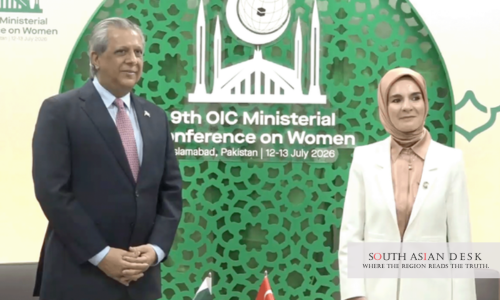
Pakistan-Turkiye social protection MoU has been signed in Islamabad to strengthen cooperation on family affairs, social services, social security, women’s rights and institutional collaboration.
The memorandum of understanding was signed during a meeting between Federal Minister for Law, Justice and Human Rights Azam Nazeer Tarar and Turkiye’s Minister for Family and Social Services Mahinur Ozdemir Goktas. The meeting took place on the sidelines of the 9th OIC Ministerial Conference on Women, which Pakistan is hosting in Islamabad.
Pakistan’s information ministry said both countries agreed to expand cooperation in family welfare, women’s rights, social security and joint institutional work. The two sides also agreed to exchange experiences and advance joint projects in areas linked to social protection.
Pakistan-Turkiye social protection MoU focuses on family welfare
Pakistan-Turkiye social protection MoU is aimed at creating a formal channel for cooperation in family affairs and social services.
The agreement covers cooperation in family welfare, social security and institutional coordination. It also includes a focus on protecting families, promoting the rights of women and children in the digital space, and developing joint policy initiatives.
The digital protection element is significant because women and children increasingly face online harassment, exploitation, misinformation, fraud and privacy risks. Cooperation between the two countries could help support policy learning, awareness campaigns and institutional capacity in this area.
The MoU does not announce a specific funding package or a detailed implementation timeline. Its immediate importance lies in setting a framework for future collaboration between relevant ministries and institutions.
Agreement signed during OIC women conference
The signing came as Islamabad hosted ministers, senior officials, OIC institutions, international organisations and development partners for the 9th OIC Ministerial Conference on Women.
The conference is being held under the theme: “Socio-Economic and Political Empowerment of Women in the OIC Countries: Challenges and the Way Forward.”
Delegates from OIC member states are attending the meeting to review progress on women’s rights, share national policies and consider new frameworks for cooperation. Pakistan is also expected to assume the chairmanship of the OIC Ministerial Conference on Women from Egypt for the next two years.
The Pakistan-Turkiye agreement fits within that broader agenda. It links bilateral cooperation with the conference’s focus on women’s empowerment, family systems and social protection across OIC countries.
Women and children’s rights included in talks
Tarar and Goktas also discussed cooperation on the rights of women and children.
Both sides agreed to strengthen coordination on protecting families and promoting rights in the digital space. This reflects a growing policy concern that social welfare frameworks must adapt to online risks as well as traditional forms of vulnerability.
For women and children, digital risks can include cyber harassment, identity misuse, blackmail, online abuse, illegal data sharing and exposure to harmful content. Governments are increasingly being pushed to respond through regulation, awareness, helplines, reporting systems and cross-border cooperation.
The MoU may allow Pakistan and Turkiye to exchange policy experience in these areas, particularly through their respective ministries and social service institutions.
Pakistan also holds meetings with Saudi Arabia and Iran
Alongside the Pakistan-Turkiye MoU, Tarar held separate meetings with other OIC delegates.
He met Dr Maimunah Al-Khalil, secretary general of Saudi Arabia’s Family Affairs Council. Pakistan and Saudi Arabia reaffirmed their commitment to promoting women’s empowerment, strengthening the family system and increasing cooperation through the OIC platform.
Tarar also met Iran’s Vice President for Women and Family Affairs Dr Zahra Behrouz Azar. The two sides discussed women’s rights and cooperation among OIC members, while agreeing to strengthen historical, religious and cultural ties.
Pakistan’s information ministry said the meeting with the Iranian official also included a decision to highlight the situation of women in Palestine and Afghanistan on the OIC platform, with the aim of developing a joint action plan for their welfare.
OIC platform gives agreement wider context
The OIC conference gives the Pakistan-Turkiye agreement wider diplomatic and policy relevance.
The Organisation of Islamic Cooperation has 57 member states, and its women’s ministerial conference provides a platform for governments to discuss policy approaches on women’s rights, family welfare, economic participation and social development.
For Pakistan, hosting the conference allows it to present itself as an active participant in OIC-level work on gender and social policy. For Turkiye, the MoU provides a route to deepen cooperation with Pakistan in areas already handled by its family and social services ministry.
The agreement also reflects the broader relationship between Pakistan and Turkiye, which has traditionally included political, defence, cultural and diplomatic cooperation. Social protection and family policy now appear to be part of that wider bilateral agenda.
Implementation will determine practical impact
The value of the Pakistan-Turkiye social protection MoU will depend on how it is implemented.
To produce practical results, the agreement would need follow-up through working groups, policy exchanges, training programmes, research cooperation and joint projects. Cooperation could focus on social security systems, family counselling, digital safety for children, women’s shelters, legal awareness, social welfare delivery and institutional capacity building.
The MoU is therefore best understood as a framework rather than an outcome by itself. It creates space for cooperation, but its impact will depend on whether both countries turn the agreement into concrete programmes.
For Pakistan, the agreement comes at a time when women’s rights, child protection, social welfare and digital safety remain major policy challenges. For Turkiye, it offers another channel to expand engagement with Pakistan through social policy and OIC cooperation.
The signing in Islamabad gives both countries a formal basis for working together. The next test will be whether the MoU leads to visible measures that improve protection, services and institutional coordination.
Published in SouthAsianDesk, July 13, 2026
Follow SouthAsianDesk on X, Instagram and Facebook for insights on business and current affairs from across South Asia.