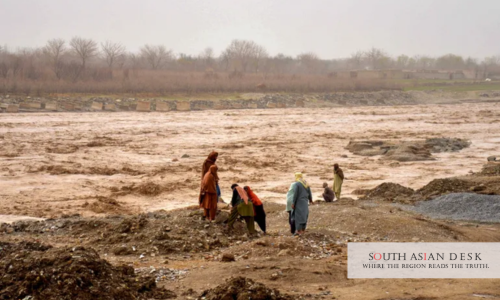
Flash flooding in Afghanistan has killed at least 20 people after monsoon-driven waters tore through the eastern province of Nuristan on Monday, destroying homes and shops and leaving more than 80 people injured. Disaster officials and the provincial governor’s office said the worst of the flash flooding in Afghanistan struck Parun, the provincial capital, reducing large parts of the town to rubble.
The Afghanistan National Disaster Management Authority said 20 bodies had been recovered so far, with search-and-rescue teams continuing to comb the debris for the missing. Among those unaccounted for are the mayor of Parun and several regional government employees, according to the governor’s office, underscoring how severely the Nuristan province floods have disrupted local administration as well as ordinary households.
Parun Flash Floods Level Provincial Capital
The Parun flash floods hit with little warning on Monday, sweeping large boulders through the town and burying streets and buildings under debris. Ashiqullah Safi, head of the local NGO Shpoul, said the flooding had effectively destroyed the municipality, with hotels and dozens of shops reduced to ruins. Residents were reported to be picking through the wreckage without proper equipment as they searched for survivors and salvaged belongings, a sign of how limited emergency resources remain in this remote corner of Nuristan province.
Nuristan, which borders Pakistan, is no stranger to seasonal flooding, but flash flooding in Afghanistan has become an increasingly frequent and destructive feature of the monsoon season in recent years. Provincial disaster management officials have launched dedicated search-and-rescue operations in Parun and surrounding districts, focused on recovering additional bodies and locating those still missing beneath collapsed structures.
Part of a Wider Pattern of Monsoon Rains in South Asia
The disaster in Nuristan is the latest in a string of deadly incidents linked to monsoon rains in South Asia this year. Floods and landslides were reported on the same day to have killed at least 25 people across northern and northeastern India, in a disaster zone roughly 465 kilometres from Parun near the city of Jammu. In neighbouring Nepal, monsoon-related floods, landslides and lightning strikes have killed 27 people, left one person missing and injured 69 others since mid-June, according to that country’s National Disaster Risk Reduction and Management Authority.
Taken together, the toll from flash flooding in Afghanistan, the floods in northern India and the ongoing disaster in Nepal illustrates how monsoon rains in South Asia have caused chaos across the region since June, overwhelming disaster response systems in multiple countries at once. Afghanistan, like its neighbours India and Pakistan, remains highly vulnerable to extreme weather events, particularly the flash floods that tend to follow intense seasonal rainfall in mountainous terrain.
Officials Warn of a Deepening Humanitarian Crisis
Earlier this month, Mawlawi Matiul Haq Khalis, head of Afghanistan’s environmental protection agency, said flooding across the country had increased in frequency, warning that worsening environmental conditions have contributed to a broader humanitarian crisis. The latest Nuristan province floods appear to bear out that warning, with the Afghanistan National Disaster Management Authority now coordinating relief efforts in a province where access remains difficult even in normal conditions.
With the monsoon season still active across the region, officials have not ruled out further flash flooding in Afghanistan in the weeks ahead. For now, the immediate priority remains locating the missing in Parun and delivering aid to residents left without shelter, as disaster management teams work to assess the full scale of the damage across Nuristan province.
Published in SouthAsianDesk, July 21, 2026
Follow SouthAsianDesk on X, Instagram and Facebook for insights on business and current affairs from across South Asia.