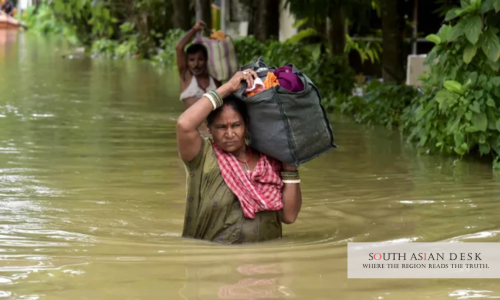
The Assam floods have killed at least 40 people and left dozens more missing, as torrential monsoon rains continue to batter India’s northeastern state. Officials said the disaster has affected more than 650,000 people across eleven districts in the past day alone, with authorities describing the scale of destruction as one of the most severe the region has faced in decades.
Rising Toll Across Upper Assam
The Assam flood death toll climbed sharply this week, with state officials reporting ten new fatalities in a single 24-hour period. The Assam State Disaster Management Authority said the latest deaths were recorded across five districts, bringing the confirmed total into the low forties, while several more people remain unaccounted for. Sivasagar, Charaideo, Jorhat and Dibrugarh have emerged as the districts bearing the brunt of the damage, with Sivasagar alone accounting for close to 400,000 affected residents.
Chief Minister Himanta Biswa Sarma said that cloudbursts and flooding had struck areas of the state that had rarely experienced such impact before, describing the current monsoon flooding in India’s northeast as unusually severe even by regional standards. He noted that all government departments had been instructed to maintain a continuous presence on the ground until every affected family had been reached and normal conditions restored.
Assam Floods Rescue Operations Expand
As water levels rose in low-lying villages, flood rescue operations expanded to include the Indian Army alongside the National Disaster Response Force, the State Disaster Response Force and local fire and emergency services. Officials said thousands of people had already been pulled from flooded villages, with rescue teams facing particular difficulty reaching remote hamlets in the Nazira subdivision, where floodwaters were reported to have reached depths of up to ten feet.
More than 33,000 displaced residents have taken shelter in over 140 relief camps set up across the affected districts. State authorities said upwards of 200 roads had been damaged or destroyed by the floodwaters, while more than 2,000 homes had collapsed under the pressure of the rising currents. Rail services in several parts of Upper Assam have also been disrupted, and numerous tea estates, a mainstay of the regional economy, have been submerged, affecting the livelihoods of thousands of tea garden workers.
Government Response and Continued Risk
Union Home Minister Amit Shah spoke with the Assam chief minister by phone and dispatched an inter-ministerial central team to assess the damage and report back to the federal government. Four state cabinet ministers have been stationed in the worst-affected districts to oversee relief efforts, while members of parliament and state legislators representing flood-hit constituencies have been directed to remain on the ground to coordinate the response.
The Brahmaputra river and several of its tributaries continue to flow above the danger mark, raising concerns that the situation could worsen before it improves. Meteorological authorities have warned that further heavy rainfall is likely in the coming days, which could hamper ongoing flood rescue operations and delay the return of displaced families to their homes.
A Recurring Seasonal Crisis
Assam experiences flooding most years during the monsoon season, as the Brahmaputra and its network of tributaries swell with heavy rainfall from June through September. However, officials this year have pointed to the unusual intensity and geographic spread of the flooding, noting that districts historically less prone to inundation have also been affected. The broader pattern of monsoon flooding in India has drawn renewed attention to the adequacy of embankments, drainage infrastructure and early warning systems in vulnerable river basins.
With casualty figures still being updated and search efforts ongoing for those reported missing, state officials have cautioned that the full human and economic toll of the disaster may not become clear for several more days. Relief agencies are continuing to prioritise the delivery of food, clean water and medical supplies to the hundreds of thousands of people currently displaced across the state’s flood-affected districts.
Published in SouthAsianDesk, July 24, 2026
Follow SouthAsianDesk on X, Instagram and Facebook for insights on business and current affairs from across South Asia.