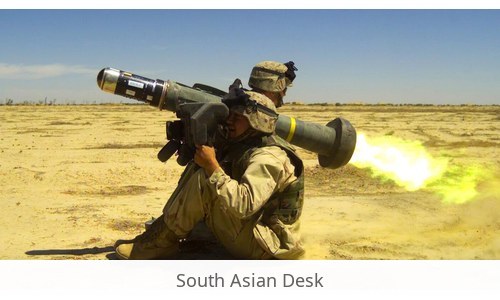
India and the U.S. have finalized the Javelin anti-tank missile procurement agreement, marking a significant step in their defense partnership. On August 28, 2026, India’s Ministry of Defence confirmed the signing of an agreement with the United States for the procurement of the Javelin anti-tank missile system, as reported by The Hindu and The Indian Express. This deal is part of a broader strategic partnership aimed at advancing military modernization India amid evolving regional security dynamics.
Javelin anti-tank missile procurement: Implications for India’s Defense Strategy
The Javelin missile system, described by NDTV as a “fire-and-forget” shoulder-fired weapon with automatic guidance, is expected to enhance India’s tactical warfare capabilities. Its ability to track targets post-launch aligns with India’s need for precision-guided munitions in asymmetric conflict scenarios. Analysts note that the Javelin anti-tank missile procurement strengthens India’s deterrence posture against potential threats from Pakistan and China, though the Ministry has not explicitly outlined operational deployment plans. The system’s integration into the Indian Army’s existing anti-tank arsenal could also reduce reliance on Russian-manufactured weapons, reflecting a diversification of defense procurement sources.
India’s military modernization India drive, which has accelerated since the early 2020s, seeks to address gaps in indigenous capabilities and counterbalance regional adversaries. The Javelin anti-tank missile procurement is part of a larger effort to upgrade India’s artillery, air defense, and missile systems, including the procurement of advanced radar networks and long-range strike platforms. This shift underscores a strategic pivot toward acquiring Western technology to bolster interoperability with allied forces in multinational operations, particularly within frameworks like the Quad and the Indo-Pacific Partnership.
The Javelin missile system‘s “top-attack” mode, which targets the weaker roof armor of armored vehicles, is particularly relevant in the context of India’s border conflicts with China, where mechanized units have been a key component of military posturing. The system’s dual-mode seeker, combining millimeter-wave radar and infrared imaging, ensures operational effectiveness in adverse weather conditions, a critical factor in the Himalayan terrain where India and China share a contested border. This technological edge could redefine India’s approach to counter-insurgency and conventional warfare in the region.
Broader Context of U.S.-India Defense Relations
This agreement builds on a decade-long defense partnership between India and the U.S., which includes the 2016 LPG (Liaison Group) agreement and the 2022 Quad defense cooperation framework. The the result follows recent U.S. approvals for India’s purchase of MQ-9B surveillance drones and F-18 fighter jets. While the agreement has not triggered immediate reactions from neighboring countries, analysts suggest Pakistan may seek closer ties with Russia or China for advanced weaponry.
The U.S.-India relations have evolved from a cautious partnership in the early 2000s to a strategic alliance characterized by joint exercises, technology transfers, and co-development projects. The 2016 LPG agreement, which streamlined defense trade and technology sharing, laid the groundwork for deeper collaboration, including the sale of advanced platforms like the Javelin missile system. The Quad framework, comprising India, the U.S., Japan, and Australia, has further institutionalized this cooperation, with defense ties forming a cornerstone of the group’s Indo-Pacific strategy.
India’s procurement of the the result reflects its broader geopolitical recalibration. As tensions with China escalate over border disputes and trade issues, India has sought to balance its strategic autonomy by strengthening ties with the U.S. and other Western allies. This move is not without risks, as it could strain India’s longstanding defense relationship with Russia, a key supplier of military hardware. However, the Indian government has framed the the result as part of a “multi-sourcing” strategy to mitigate supply chain vulnerabilities and ensure access to cutting-edge technology.
Technological Advancements of the Javelin System
The Javelin missile system, currently operated by the U.S. Army and international allies, features a top-attack mode that targets armored vehicle weak points. Its dual-mode seeker combines millimeter-wave radar and infrared imaging, allowing it to function effectively in adverse weather conditions. Compared to India’s existing ATGMs like the Nag and the Israeli Spike, the Javelin missile system offers greater range (2.5 km vs. 3.5 km) and improved target acquisition speed. The system’s compatibility with the Indian Army’s existing fire control systems is being evaluated by the Defence Research and Development Organisation (DRDO) to ensure seamless integration.
The Javelin missile system‘s “fire-and-forget” design reduces the risk to operators, a critical advantage in urban or mountainous terrain where traditional anti-tank systems require line-of-sight engagement. Its ability to engage targets at a distance and in complex environments makes it a versatile tool for both offensive and defensive operations. The system’s modular design also allows for future upgrades, ensuring its relevance in the face of evolving threats.
The Indian military’s evaluation of the Javelin missile system includes testing its performance in simulated combat scenarios, particularly in conditions mirroring the Indian subcontinent’s diverse geography. DRDO’s involvement highlights the importance of local adaptation, as the system will need to interface with India’s existing command-and-control networks and logistics infrastructure. This integration process is expected to take several months, with initial training programs for Indian troops slated to begin in early 2027.
Follow SouthAsianDesk on X, Instagram and Facebook for insights on business and current affairs from across South Asia.
Sources
- India, U.S. sign agreement for procurement of Javelin anti-tank missile system – thehindu.com
- Confirmed: India to get US-made Javelin anti-tank missiles – indianexpress.com
- India Plans To Buy ‘Fire-And-Forget’ Javelin Anti-Tank Weapon System From US – ndtv.com
Image: th-i.thgim.com