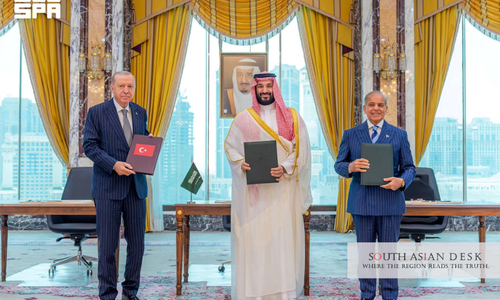
The Mecca Joint Defence Agreement moved from paper to practice on Monday, as senior officials from Turkey, Saudi Arabia and Pakistan gathered in Istanbul for the first committee meeting held under the pact. A Turkish foreign ministry source confirmed that foreign ministers, defence ministers and the chiefs of staff of all three countries were in attendance, marking the first formal working session since the agreement was signed earlier this month.
Background to the Turkey Saudi Arabia Pakistan Defence Pact
The three countries signed the Mecca Joint Defence Agreement on 7 August 2026, bringing together three Sunni Muslim allies of the United States at a moment of heightened regional anxiety. The agreement followed a period of intensified conflict in the Middle East, including Iranian missile strikes on Gulf oil exporters, and reflects a shared desire among the signatories to formalise their security cooperation rather than rely solely on informal alignment or bilateral understandings.
At its core, the pact is intended to strengthen collective deterrence against any act of aggression. It stipulates that an armed attack against any one of the three signatories will be treated as an attack on all three, a clause that closely mirrors NATO’s Article 5 collective defence provision. This structure places the agreement among a small number of formal multilateral defence arrangements in the region and signals an intent to move beyond symbolic solidarity toward a binding mutual commitment.
What the Istanbul Defence Pact Meeting Covered
According to the ministry source, international security issues topped the agenda at the Istanbul defence pact meeting. Discussions were expected to focus on three broad areas: enhancing the defence capabilities of each member state, improving interoperability among their respective armed forces, and deepening cooperation across the defence industry, including joint production and development initiatives.
The presence of foreign ministers, defence ministers and chiefs of staff from all three nations at a single sitting underlines the seriousness with which the signatories are treating the joint defence committee meeting. Rather than a ceremonial follow-up to the August signing, the Istanbul gathering appears designed to translate the agreement’s language into concrete operational planning, particularly around interoperability, a term that typically refers to the ability of allied militaries to operate together using compatible equipment, communications and procedures.
Shared Concerns Driving the Alliance
Turkey, Saudi Arabia and Pakistan share overlapping concerns about the military posture of Israel and about Iran, which remains under a Shi’ite revolutionary government. These concerns have sharpened considerably in the six months since the United States and Israel launched military action against Iran. Negotiations aimed at de-escalating that conflict remain at an impasse, and the current US administration under President Donald Trump has intensified financial pressure on Tehran through a campaign it has described internally as an economic offensive against the Iranian state.
Against that backdrop, the three countries appear to view formal defence cooperation as a hedge against continued regional volatility, including the disruption of energy markets that has followed sustained hostilities in the Gulf. Pakistan brings nuclear capability and a large standing military to the arrangement, Saudi Arabia contributes substantial financial resources tied to its position as a leading oil exporter, and Turkey offers NATO’s second largest military along with an increasingly self-sufficient domestic defence industry.
Room for Expansion
Officials in Ankara have indicated that the Mecca Joint Defence Agreement was designed with future growth in mind. Turkey has stated that the pact remains open to additional members, with Egypt named as a potential candidate for future accession. At the same time, Turkish officials have been careful to characterise the agreement as complementary rather than competitive, stressing that it does not seek to replace or undermine existing alliances such as NATO, of which Turkey is itself a long-standing member.
This framing is likely intentional. A defence pact explicitly positioned as an alternative to NATO would carry significant diplomatic risk for Turkey, given its formal treaty obligations to the alliance. By presenting the Mecca framework as additive rather than substitutive, Ankara appears keen to reassure Western partners while still pursuing closer security ties with Riyadh and Islamabad.
What Comes Next
The Istanbul session represents an early but important test of whether the three signatories can convert a signed political commitment into functioning defence infrastructure. Interoperability efforts, joint production arrangements and coordinated defence industry planning typically take years rather than months to mature, and the outcomes of Monday’s discussions are likely to shape the pace at which the agreement develops.
For now, the meeting confirms that the Mecca Joint Defence Agreement is being treated by its three members as an active and evolving framework rather than a one-off diplomatic gesture. Further committee meetings are likely to follow as the countries work through the practical details of enhancing their combined defence capabilities amid an unsettled regional security environment.
Published in SouthAsianDesk, August 31st, 2026
Follow SouthAsianDesk on X, Instagram and Facebook for insights on business and current affairs from across South Asia.