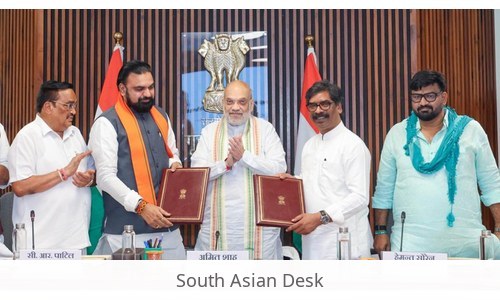
Sone River water sharing has taken a significant step forward with the signing of a memorandum of understanding (MoU) between Bihar and Jharkhand on August 31, 2026. Union Home Minister Amit Shah witnessed the historic agreement, which resolves a 25-year-old dispute over the allocation of the Sone River’s waters. This development underscores the growing importance of cooperative federalism India and effective water resource management in addressing inter-state water disputes.
Sone River water sharing: Historical Context of the Dispute
The Sone River water sharing dispute between Bihar and Jharkhand dates back to the early 2000s, rooted in conflicting claims over water allocation and usage rights. As a major tributary of the Ganges, the Sone River flows through both states, with Bihar relying heavily on its waters for irrigation, hydropower, and industrial use, while Jharkhand has long argued for equitable access to sustain its growing population and economic activities. Previous attempts at resolution, including judicial interventions and bilateral negotiations, failed to produce a binding agreement.
The lack of a formal framework led to periodic tensions, with disputes often flaring during dry seasons when water scarcity exacerbated regional competition. The absence of a clear legal mechanism for allocation had left both states in a state of uncertainty, affecting agricultural planning, industrial operations, and even political dynamics in the region.
Implications for Inter-State Relations and Cooperative Federalism
The Sone River water sharing MoU is expected to set a precedent for resolving inter-state water disputes through cooperative federalism, a principle that emphasizes collaboration between the central government and states to manage shared resources. By establishing a structured mechanism for water sharing, the agreement may encourage other states with similar disputes—such as those over the Cauvery, Narmada, or Krishna rivers—to adopt similar frameworks.
The central government’s role in facilitating this agreement underscores the importance of federal coordination in managing shared natural resources, particularly in a country where water scarcity and climate variability increasingly strain inter-state relations. The agreement also highlights the growing recognition of the need for institutionalized dialogue, as opposed to ad hoc negotiations, to address long-standing grievances.
The Sone River’s significance extends beyond its immediate geographical reach. As a critical water source for both states, its equitable distribution is vital for sustaining agriculture, which forms the backbone of Bihar’s and Jharkhand’s economies. The result MoU is likely to streamline water allocation, reduce conflicts over dam operations, and ensure that both states can plan for future infrastructure projects, such as irrigation canals or hydropower plants, with greater certainty. This could, in turn, attract investment and improve livelihoods in rural areas, where access to reliable water sources is a key determinant of economic stability.
Broader Context of Inter-State Water Disputes in India
Inter-state water disputes are a recurring challenge in India, with over 40 such disputes reported across the country. These disputes often arise due to the uneven distribution of water resources, population growth, and competing developmental needs. The legal framework for resolving these disputes includes the Interstate River Water Disputes Act, 1956, which provides for the establishment of tribunals to adjudicate conflicts. However, the process is often protracted, with resolutions taking decades to materialize.
The result MoU represents a shift toward preemptive, cooperative solutions rather than relying solely on judicial mechanisms. This approach aligns with the central government’s recent emphasis on strengthening cooperative federalism India, as seen in initiatives like the Jal Shakti Abhiyan (Water Conservation Mission) and the National Water Policy, which advocate for collaborative resource management.
The Bihar Jharkhand MoU is a landmark agreement that could inspire other states to adopt similar frameworks for water resource management. By addressing the result issue through structured dialogue and institutional mechanisms, the agreement demonstrates the potential of cooperative federalism India to resolve long-standing disputes. This model could be replicated in other regions facing similar challenges, fostering a more harmonious approach to inter-state water disputes.
Follow SouthAsianDesk on X, Instagram and Facebook for insights on business and current affairs from across South Asia.
Sources
- Bihar, Jharkhand sign MoU for sharing of Sone river water – indianexpress.com
- Bihar, Jharkhand Sign Sone Water Agreement, Resolving 25-Year-Old Dispute – ndtv.com
Image: images.indianexpress.com