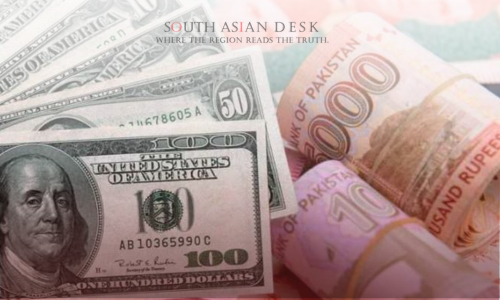
Foreign investors have withdrawn more than $1.5 billion from Pakistan’s treasury bills (T-bills) in the fiscal year 2025, marking a significant outflow driven by declining returns and heightened geopolitical risks. Data from the State Bank of Pakistan indicates that while foreign inflows into T-bills reached $1.279 billion, outflows surged 24% higher, with June 2025 recording the largest monthly withdrawal of $113 million against a mere $24 million in purchases.
The primary driver behind this trend is the sharp decline in T-bill yields following the State Bank of Pakistan’s decision to cut its policy rate from 22% in June 2024 to 11% by mid-2025. This reduction has diminished the attractiveness of T-bills, which previously offered yields above 21%. The benchmark 6-month T-bill yield fell to 11.4% in recent auctions, with financial analysts anticipating further declines as inflation continues to ease.
Geopolitical tensions, particularly between Pakistan and India, have further eroded investor confidence. The escalation in May 2025, marked by a four-day period of aggression and ongoing hostile rhetoric, has amplified risk perceptions, prompting foreign investors to pull back. The United Kingdom led the outflows, withdrawing $924 million against inflows of $750 million, followed by significant exits from the United Arab Emirates ($205 million) and the United States ($130 million).
Despite record remittance inflows of $38.3 billion in FY25, Pakistan faces challenges in maintaining foreign investment in its debt markets. Analysts highlight that low export growth and weak foreign direct investment could exacerbate concerns about the country’s external sector, which is burdened by $25 billion in annual debt servicing obligations. Posts on X reflect similar sentiments, noting consistent outflows from T-bills over recent months, underscoring investor caution amid economic and political uncertainties.
While some optimism persists due to a stable exchange rate and a low current account deficit of $171 million in the first two months of FY25, bankers warn that sustained foreign investment will depend on addressing political stability and securing external financing, such as a new IMF loan. For now, the outlook for T-bill investments remains cautious as yields continue to decline and regional tensions linger.
Published in SouthAsianDesk, July 12th, 2025
Follow SouthAsianDesk on X, Instagram and Facebook for insights on business and current affairs from across South Asia.