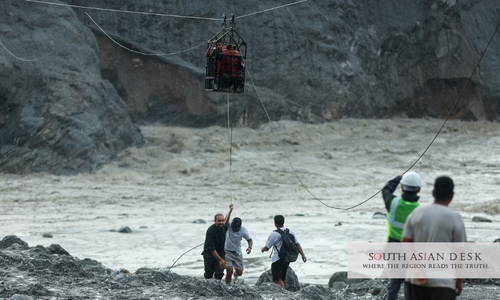
Nepal’s hydropower sector, which supplies almost all of the country’s electricity and earns it nearly $200 million a year through exports to India and Bangladesh, has been badly shaken by a wave of flash floods that has killed more than 1,300 people and left thousands more missing. The disaster has exposed how deeply the country’s energy security depends on infrastructure built in some of the most environmentally volatile terrain on earth.
Flash Floods Expose Vulnerabilities in Nepal’s Hydropower Sector
The flash floods destroyed entire villages near the border between Nepal and Tibet and severely damaged twelve hydropower plants in the Trishuli River basin, wiping out more than ten percent of the country’s total power generation capacity. Operators have told reporters they do not yet know whether any of the damaged facilities can be restored to service.
The state-owned Nepal Electricity Authority, which owns six of the twelve affected plants, has sought to reassure households that overall electricity supply remains adequate. Even so, its spokesman, Rajan Dhakal, acknowledged that as climate-related disasters become more frequent, the time has come for a fundamental rethink of the country’s hydropower policy.
From Chronic Power Cuts to Near-Total Reliance on Hydropower
Nepal’s dependence on hydropower is a relatively recent achievement. As recently as 2010, only two-thirds of the population had access to electricity, and even connected households endured power cuts of up to sixteen hours a day. A subsequent expansion of hydropower infrastructure, combined with efforts to tackle corruption within the sector and increased seasonal energy imports from India, meant that by 2018 most of the country enjoyed round-the-clock power supply.
Today, Nepal operates 225 hydropower plants with a combined installed capacity exceeding 3,900 megawatts, according to the Nepal Electricity Authority, enough to power roughly three million households at once. Hundreds more plants are either under construction or in the planning pipeline, most of them built high in the mountains to capture fast-flowing currents, with little or no water storage capacity built in.
Flash Floods Trace Back to a Warming Himalaya
That mountain-based model has left the sector exposed to a warming climate. The high-altitude regions of the Himalayas are warming roughly fifty percent faster than the global average, and preliminary investigations have pointed to a collapsed glacier and its surrounding bedrock as the trigger for last week’s flash floods.
While scientists caution it is still too early to draw firm conclusions about climate change’s precise role, Nepal’s Disaster Risk Reduction and Management Authority has previously found that more than nine in ten disaster events recorded between 2018 and 2024 were linked to climate factors.
Nepal’s former energy minister, Kulman Ghising, described the flooding as a once-in-a-century event that nonetheless carries lessons for how future plants are designed and sited. He said resilience to flooding, along with early-warning systems and robust evacuation measures, must now be built into every project.
Potentially hundreds of hydropower labourers, engineers and local residents are believed to remain trapped inside mud-filled tunnels since the floods struck. Dhakal said one option going forward could involve shifting toward reservoir-based plants that need not be sited high in the mountains, though such facilities carry significant economic and environmental costs of their own.
Calls Grow for Energy Diversification
The disaster has intensified longstanding questions about whether Nepal has become too reliant on a single power source. Renewable energy expert Kushal Gurung, founder of the clean technology firm WindPower Nepal, said the country should not be putting all its eggs in one basket and needs to seriously embrace alternatives such as solar and wind power, which would require revising an energy policy he described as heavily skewed toward hydropower.
Vivek Shastry, a researcher at Columbia University’s Center on Global Energy Policy, argued that meaningful additions of wind and solar capacity represent a resilience strategy capable of limiting single-point or interconnected failures across the electricity system. A report from the German development agency GIZ estimates that Nepal’s technical potential for solar power generation is roughly ten times larger than its hydropower potential.
Not everyone agrees diversification can go far enough to change the fundamental picture. Puspa Sharma, a senior research fellow at the National University of Singapore’s Institute of South Asian Studies, said Nepal does need to diversify its energy sources but only to a limited extent, since hydropower remains the resource that gives the country its most significant competitive advantage over its South Asian neighbours.
Investors and International Lenders Face Scrutiny
Large-scale investment in Nepal’s hydropower sector has continued even as climate risks have become better understood, drawing criticism from some campaigners. The Upper Trishuli-1 project, among Nepal’s largest foreign direct investment ventures at an estimated value of $647 million, was almost entirely destroyed in the floods. Its backers include the Asian Development Bank and the International Finance Corporation. The nearby Upper Trishuli 3A plant, funded by China’s Export-Import Bank, was also severely damaged.
Himanshu Thakkar, coordinator of the South Asia Network on Dams, Rivers and People, said international lenders were acutely aware of the extreme danger their own reports had repeatedly flagged, yet failed to demand stringent safeguards or prepare adequately for a disaster they knew could occur.
In response, the Asian Development Bank and the International Finance Corporation said the design of Upper Trishuli-1 reflected independent technical assessments of flood and landslide risk based on glacier studies and historical evidence available at the time, adding that its early-warning system had been strengthened following an earlier flood in 2024 and further risk assessments were carried out after another flood in 2025. They said the precise causes and consequences of the latest disaster were still being verified.
A History of Warning Signs Along the Trishuli
Thakkar noted that the Trishuli River basin has repeatedly demonstrated its volatility in recent years. In September 2024, an unprecedented cloudburst over the Trishuli and Bhote Koshi river basins triggered flash floods in the Rasuwa, Nuwakot and Dhading districts, the same areas hit hardest by the latest disaster.
Then in July 2025, a glacial lake burst in Tibet’s Gyirong county and swept down the same stretch of river into Nepal, killing at least eleven people, damaging critical infrastructure and shutting the vital Nepal-China border crossing for nearly six months before it reopened on 1 January this year.
Dhakal conceded that even where climate risk assessments had been carried out correctly, the design of the plants may not have accounted for them adequately, adding that improvements are needed in how hydropower facilities are built and operated going forward.
Private operators are already absorbing financial losses from the pattern of recurring floods. According to Uttam Bhlon Lama of the Independent Power Producers’ Association of Nepal, insurers have paid out around $40 million for flood-related damage to more than twenty privately owned plants over the past three years, a trend he warned is pushing insurance premiums sharply higher and making the cost of doing business increasingly unfeasible.
Nepal’s Contribution to a Global Problem
Manjeet Dhakal, a member of Nepal’s delegation to the UN Climate Change Conference, argued that the disaster demonstrates climate risks are inherently international and cannot be managed by Nepal alone, calling on governments and international organisations to jointly share data, assess impacts and develop early-warning systems. He pointed out that Nepal bears little responsibility for the greenhouse gas emissions driving these heightened risks, noting that its hydropower industry represents an attempt to keep the country’s own already minimal emissions low.
Conclusion
As reconstruction begins, the floods have placed Nepal’s hydropower sector at a genuine crossroads. Whether the country doubles down on mountain-based hydropower with stronger safeguards, or pursues faster energy diversification into solar and wind, the coming years are likely to determine how resilient its power supply proves to be as the Himalayan climate continues to change.
Published in SouthAsianDesk, September 6th, 2026
Follow SouthAsianDesk on X, Instagram and Facebook for insights on business and current affairs from across South Asia.