The measles outbreak in Bangladesh has grown into the worst the world is currently facing, according to a list maintained on the website of the United States Centers for Disease Control and Prevention. Since the outbreak emerged in March, the country has recorded more than 166,000 suspected measles cases, including 19,835 laboratory-confirmed infections, according to Health Ministry data. It has been linked to 999 suspected and confirmed deaths, including 100 confirmed measles fatalities, while more than 146,000 suspected patients have needed hospital treatment.
How the Measles Outbreak in Bangladesh Became the World’s Worst
Bangladesh once came close to eliminating measles altogether, maintaining vaccination coverage at or above the 95 percent level recommended by the World Health Organization for much of the past decade, with the exception of a dip during the Covid-19 pandemic. That progress has since unravelled. Professor Mahmudur Rahman, an epidemiologist and former director of the Institute of Epidemiology, Disease Control and Research, said Bangladesh missed its measles elimination target because of vaccination gaps in 2024 and 2025. Those gaps have now translated into hospitals struggling with overcrowding, supply shortages and a continuing influx of sick children.
Vaccination Gaps Trace Back to Political Turmoil
The vaccination gaps behind the outbreak trace back to a period of intense political upheaval. Bangladesh went through sustained turmoil after a deadly uprising against then prime minister Sheikh Hasina, and experts say routine immunisation services were disrupted during that period as the country’s health administration was consumed by the wider crisis. Health officials and experts said missed vaccinations and vaccine supply problems tied to the upheaval left many children, particularly infants under nine months who are still too young for routine vaccination, vulnerable to infection, helping the disease spread across age groups.
Routine Immunisation Disrupted During the Transition
Routine immunisation did not simply pause during the political transition, it was actively undermined by changes inside the health system itself. Experts blamed the outbreak on weak programme oversight, insufficient monitoring and procurement policy changes introduced under the interim government that replaced Hasina, all of which disrupted vaccine availability at a critical moment. Health Minister Sardar Md. Sakhawat Husain told parliament on Monday that changes to procurement had triggered a vaccine shortage, and that a 2024 postponement of a vaccination programme had compounded the problem, leaving a widening pool of unprotected children by the time the outbreak took hold.
A Nationwide Emergency Vaccination Campaign Struggles to Catch Up
The government launched a nationwide emergency vaccination campaign in April in response to the worsening outbreak, but the effort has so far failed to bring the crisis under control. Measles is one of the world’s most contagious diseases, typically causing fever and a distinctive rash, and while it can be prevented with two doses of vaccine, reaching every unvaccinated child quickly enough to break chains of transmission has proven difficult in a health system still recovering from the disruption of the past two years.
Infants and Overstretched Hospitals Bear the Brunt
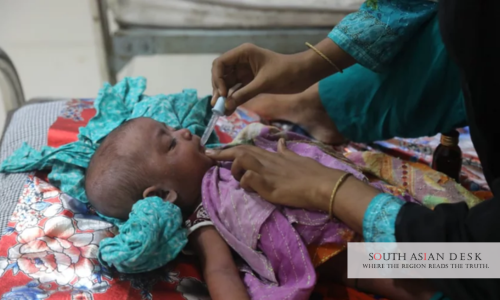
The human cost of the outbreak is visible in Bangladesh’s hospital wards, where sick children continue to arrive in large numbers. One mother, identified only as Ms. Begum, described her fear for her son’s recovery, saying she and her family were poor and could not afford treatment, and that she prayed no other mother would have to watch her child suffer or die from the disease. Her account reflects a broader strain on the health system, where facilities such as the state-run Shaheed Suhrawardy Medical College Hospital in Dhaka have had to absorb a steady stream of measles patients alongside their existing caseloads.
The Measles Outbreak in Bangladesh Adds to a Wider Health Burden
The measles outbreak in Bangladesh has not arrived in isolation. The country is simultaneously contending with a mosquito-borne dengue outbreak, an illness linked to warmer temperatures and rapid urbanisation, and the twin crises together illustrate the difficulty of maintaining routine health services while responding to two preventable but fast-moving infectious diseases at once. With vaccination gaps from 2024 and 2025 still working their way through the population, health officials face the task of both containing the current outbreak and rebuilding the routine immunisation coverage that once put measles elimination within reach.
This report touches on child illness and death. Readers who are personally affected by these issues, or who would like support, are encouraged to reach out to a local healthcare provider or a trusted support organisation.
Published in SouthAsianDesk, September 10th, 2026
Follow SouthAsianDesk on X, Instagram and Facebook for insights on business and current affairs from across South Asia.