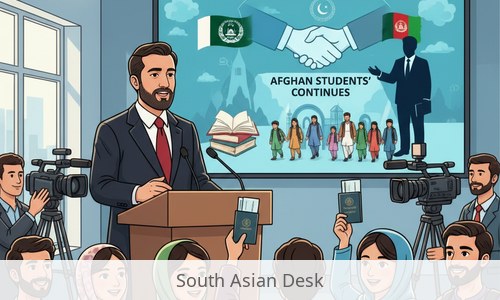
Afghan students in Pakistan: On September 10, 2026, Pakistan’s Foreign Ministry spokesperson Sajjad Haider Khan confirmed that Afghan students holding valid visas can continue their education in the country. This clarification follows reports that the Pakistan Medical and Dental Council (PMDC) had ordered medical universities to stop admitting Afghan students and expel those already enrolled. Human Rights Watch (HRW) had previously condemned the reported decision, warning that expulsions could deprive Afghan medical and dental students—particularly women—of critical educational opportunities.
Afghan students in Pakistan: Impact on Afghan Students
The PMDC’s initial directive, which reportedly targeted medical and dental students, raised concerns about the future of Afghan nationals studying in Pakistani institutions. While the Foreign Ministry’s statement reaffirms the right of students with valid visas to continue their studies, it does not explicitly address the PMDC’s orders. Afghan students and their families have expressed relief at the clarification, though some remain uncertain about the practical implementation of the policy.
Many students rely on Pakistani institutions for specialized training in healthcare, a field with limited infrastructure in Afghanistan. The lack of modern medical facilities, trained professionals, and academic resources in Afghanistan has long driven students to seek education in neighboring countries, particularly Pakistan. This dependency underscores the critical role of cross-border educational access in addressing regional healthcare challenges. However, the ambiguity surrounding the PMDC’s directive has created uncertainty, with some students fearing potential administrative hurdles or sudden policy reversals despite the Foreign Ministry’s assurance.
Role of International Organizations
Human Rights Watch Afghan students were at the center of international advocacy as HRW condemned the PMDC’s directive, emphasizing its potential to exacerbate Afghanistan’s healthcare crisis. The organization highlighted that expelling Afghan medical students would disproportionately affect women, who already face systemic barriers to education and employment.
The Foreign Ministry’s confirmation appears to have been influenced by such international pressure, though the extent of direct engagement remains unclear. International bodies like the United Nations High Commissioner for Refugees (UNHCR) and the World Health Organization (WHO) have historically shaped cross-border educational policies, though these groups were not explicitly mentioned in the dossier. The interplay between global advocacy and domestic policy decisions remains a key dynamic in this context.
Geopolitical Context
The issue reflects broader geopolitical implications for education, as tensions over the status of Afghan nationals in Pakistan persist. With Afghanistan’s political landscape remaining unstable, Pakistan faces balancing acts between its domestic policies and regional obligations. The education of Afghan students in Pakistani institutions has long been a sensitive issue, with periodic crackdowns and policy shifts.
For instance, in 2022, Pakistan temporarily suspended the issuance of new student visas to Afghan nationals amid rising security concerns, a move that drew criticism from international bodies. The current clarification may signal a temporary stabilization, though the long-term implications for bilateral relations remain unclear. Pakistan’s approach to Afghan students is often shaped by its strategic interests in maintaining regional stability, as well as domestic political considerations. The presence of Afghan students in Pakistani universities also raises questions about resource allocation, as institutions must balance the needs of local and international students amid limited funding and infrastructure.
Broader Implications for Regional Stability
Afghan students in Pakistan are not merely individuals seeking academic advancement; they represent a demographic that has historically contributed to cross-border cultural and professional ties. Their expulsion or marginalization could strain already fragile relations between the two countries, particularly as Afghanistan grapples with economic and political crises. Furthermore, the healthcare sector’s reliance on trained professionals from both nations highlights the need for collaborative policies that prioritize human capital development. The current policy clarification, while a step forward, does not resolve deeper systemic issues, such as the lack of investment in Afghanistan’s education and healthcare systems. Addressing these root causes would require sustained international cooperation and regional dialogue, which remain elusive amid competing priorities.
Follow SouthAsianDesk on X, Instagram and Facebook for insights on business and current affairs from across South Asia.
The wider context of this developing story also includes Pakistan education policy.