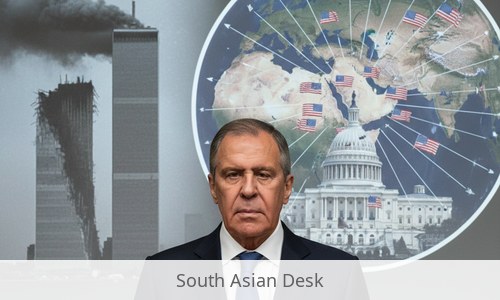
U.S. geopolitical influence in Afghanistan has been a focal point of international debate, as Russian Foreign Minister Sergei Lavrov claimed that the United States exploited the international response to the September 11 attacks to extend its geopolitical influence in Afghanistan and beyond. The statements, made during an interview with Russian media outlet RBC on September 11, 2026, coincide with the 21st anniversary of the attacks and raise questions about the motivations behind U.S. military interventions in the region.
U.S. geopolitical influence in Afghanistan: Implications for U.S.-Russia Relations
Lavrov’s assertions could signal a shift in diplomatic dialogue between Moscow and Washington. Historical tensions over Afghanistan have persisted since the Soviet invasion in 1979 and the U.S. military presence post-2001. Lavrov’s remarks may complicate ongoing negotiations on arms control, cybersecurity, and regional stability in South Asia, particularly as both nations navigate competing interests in Central Asia. The Russian minister’s comments come amid a broader recalibration of global power dynamics, with Moscow seeking to counter Western influence in post-Soviet states and Washington prioritizing strategic partnerships in the Indo-Pacific.
This tension is further exacerbated by divergent approaches to energy security, with Russia emphasizing its role as a key supplier to Europe and the U.S. advancing its own energy alliances in the region. Lavrov’s critique may also reflect Moscow’s efforts to reframe the narrative around U.S. interventions, positioning itself as a stabilizing force in a region it views as critical to its geopolitical interests.
Historical Context of U.S. Military Interventions
The U.S. military interventions in Afghanistan began in 2001 following the 9/11 attacks, with the stated goal of dismantling Al-Qaeda and removing the Taliban from power. However, the outcomes have been contentious, with prolonged conflict, significant civilian casualties, and the eventual withdrawal in 2021. Lavrov’s claims suggest a critique of these interventions as primarily serving U.S. geopolitical ambitions rather than purely counterterrorism objectives.
The 20-year military presence in Afghanistan, which included the establishment of a NATO-led coalition and the training of Afghan security forces, has been marked by shifting priorities and strategic recalibrations. Critics argue that the U.S. focused on securing its own strategic interests, such as access to Central Asian energy routes and countering Russian influence, rather than solely addressing the threat posed by extremist groups. This perspective aligns with broader debates about the long-term efficacy of U.S. military interventions in the region, which have often been criticized for failing to achieve lasting peace or stability.
Regional Perspectives
Afghanistan’s current government has not publicly commented on Lavrov’s statements, but regional analysts note that such claims could influence perceptions of foreign interference in South Asian affairs. Analysts at the South Asian Institute of Policy Studies suggest that Lavrov’s remarks may align with Russian efforts to reassert influence in the region, particularly as China and Pakistan deepen economic ties through the China-Pakistan Economic Corridor (CPEC). The CPEC, a flagship project of China’s Belt and Road Initiative, has significantly enhanced Pakistan’s infrastructure and economic connectivity, potentially altering the balance of power in South Asia.
Russia’s strategic interest in Afghanistan is also tied to its broader goals of maintaining influence in Central Asia, where it has historically maintained strong ties with countries like Kazakhstan, Uzbekistan, and Tajikistan. Lavrov’s comments may be part of a larger Russian strategy to position itself as a counterweight to both U.S. and Chinese influence in the region, leveraging its historical ties and energy exports to assert a more prominent role in regional affairs. The U.S. geopolitical influence in Afghanistan has been a contentious issue, with debates over whether it has contributed to or undermined regional stability in South Asia.
Broader Geopolitical Implications
The implications of Lavrov’s statements extend beyond bilateral relations between the U.S. and Russia. They highlight the complex interplay of regional and global powers in South Asia, where the U.S., China, Pakistan, and Russia all have competing interests. The U.S. has long viewed Afghanistan as a critical front in its broader strategy to counter extremism and maintain stability in the region.
However, the withdrawal of U.S. forces in 2021 and the subsequent Taliban takeover have raised questions about the sustainability of U.S. influence in the region. Meanwhile, China’s growing economic and strategic presence through initiatives like the CPEC has shifted the balance of power, prompting Russia to seek greater involvement in Afghan affairs.
This dynamic underscores the challenges of maintaining stability in a region characterized by shifting alliances and competing interests. Lavrov’s remarks may also serve as a reminder of the enduring legacy of the September 11 attacks, which continue to shape global security policies and regional dynamics decades later.
Follow SouthAsianDesk on X, Instagram and Facebook for insights on business and current affairs from across South Asia.
The wider context of this developing story also includes Sergei Lavrov statements.