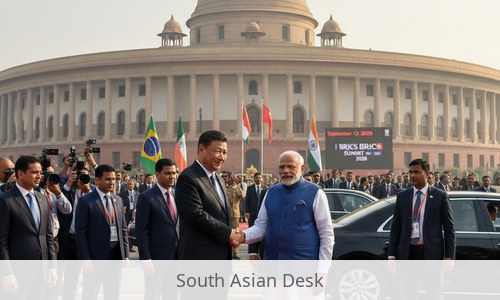
BRICS summit India: On September 12, 2026, Chinese President Xi Jinping arrived in New Delhi for the BRICS summit and talks with Indian Prime Minister Narendra Modi, as reported by Daily Mirror. The summit, which brings together leaders from Brazil, Russia, India, China, and South Africa, is set to address global challenges and strengthen cooperation among emerging economies amid rising geopolitical tensions. This year’s BRICS summit India marks a pivotal moment for multilateral dialogue, with a focus on reshaping global trade partnerships and fostering emerging economies cooperation.
BRICS summit India: Implications for India-China Relations
The visit comes amid ongoing geopolitical tensions between India and China, particularly over border disputes and trade imbalances. The Hindu confirms that Modi is holding bilateral meetings with leaders from Ethiopia and Malaysia during the summit, signaling India’s broader diplomatic engagement. Analysts note that Xi’s presence in New Delhi could provide an opportunity to recalibrate bilateral relations, though significant challenges remain in areas such as infrastructure development and regional security.
The India-China relationship has long been defined by a complex interplay of economic interdependence and strategic rivalry. While trade between the two nations has grown substantially over the past decade, with bilateral trade reaching over $100 billion annually, disputes over territorial boundaries—particularly in the Ladakh region—have periodically flared into military standoffs.
The 2020 Galwan Valley clash, which resulted in the deaths of 20 Indian soldiers and an unspecified number of Chinese troops, remains a sensitive point of contention. The BRICS summit India offers a rare platform for high-level dialogue, with both nations seeking to balance their strategic differences against shared interests in countering Western economic dominance and addressing global issues like climate change and digital governance.
Strategic Partnerships at BRICS
The BRICS summit serves as a critical platform for emerging economies cooperation, with discussions centered on trade policies, climate change, and technological innovation. Al Jazeera notes that the summit is opening amid global tensions and discussions on tariffs, with BRICS nations seeking to counterbalance Western-dominated economic frameworks. Potential partnerships discussed may include joint investments in green energy projects and digital infrastructure, which could reshape regional trade dynamics and reinforce global trade partnerships.
BRICS nations have increasingly positioned themselves as an alternative to Western-led institutions like the World Bank and IMF, advocating for a more multipolar global order. The New Development Bank (NDB), established by BRICS in 2015, has already funded infrastructure projects across member states, including India’s Mumbai-Ahmedabad High-Speed Rail and South Africa’s renewable energy initiatives.
This summit may see further alignment on initiatives such as the Digital Silk Road, which aims to expand digital connectivity and e-commerce across the Global South. Additionally, the group has emphasized the need for a unified stance on global trade policies, particularly in response to protectionist measures by major economies. The inclusion of South Africa and other African nations in BRICS discussions also highlights the bloc’s growing influence in shaping the future of international trade and investment flows.
Modi’s Bilateral Meetings
Prime Minister Modi’s meetings with Ethiopian Prime Minister Abiy Ahmed and Malaysian Prime Minister Anwar Ibrahim are expected to focus on expanding trade ties and addressing shared challenges in agriculture and technology. These engagements underscore India’s commitment to multilateralism and its role in fostering regional stability through economic collaboration.
India’s economic ties with Ethiopia and Malaysia have seen significant growth in recent years, driven by investments in infrastructure, technology, and agriculture. With Ethiopia emerging as a key player in Africa’s economic landscape, India has prioritized partnerships in sectors such as renewable energy and digital infrastructure. Similarly, Malaysia has become a strategic partner for India in Southeast Asia, with collaborations in maritime security and technology transfer.
Modi’s bilateral meetings are likely to explore avenues for deeper integration into regional supply chains, particularly in the context of India’s ‘Neighbourhood First’ policy, which emphasizes economic and strategic engagement with its immediate neighbors and broader South Asian partners.
Regional and Global Context
The BRICS summit India occurs at a pivotal moment in global geopolitics, with rising tensions between major powers and a reconfiguration of economic alliances. The ongoing Russia-Ukraine conflict, U.S.-China trade disputes, and the fragmentation of global supply chains have underscored the need for alternative economic frameworks. BRICS nations, representing nearly 40% of the world’s population and 30% of global GDP, are poised to play a more prominent role in shaping the future of international trade and development.
India’s participation in BRICS has also been influenced by its strategic balancing act between major powers. While maintaining strong economic ties with the U.S. and its Quad partners (Japan, Australia, and the U.S.), India has sought to deepen its engagement with China and other BRICS members to counterbalance Western influence. This summit may see further alignment on issues such as climate finance, digital governance, and the reform of international financial institutions to reflect the growing economic weight of emerging economies.
Follow SouthAsianDesk on X, Instagram and Facebook for insights on business and current affairs from across South Asia.
Sources
- China’s Xi lands in Delhi for BRICS summit and talks with Modi – dailymirror.lk
- BRICS Summit 2026 LIVE updates: Chinese President Xi arrives in Delhi – thehindu.com
- BRICS summit opens in New Delhi amid wars, global tensions, tariffs – aljazeera.com