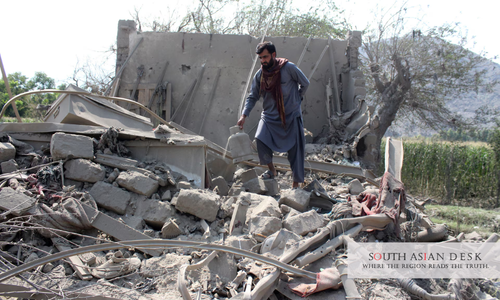
Pakistan Afghanistan air strikes reached a new phase this week after Islamabad said its forces struck ten locations inside Afghan territory that were allegedly being used to launch and store drones. Information Minister Attaullah Tarar confirmed the operation on Thursday, stating that some of the targeted sites had been used a day earlier to send unmanned aircraft across the border into Pakistan. The strikes mark the latest and most direct escalation in a conflict that has simmered between the two neighbours for much of the year.
Background to the Pakistan Afghanistan Air Strikes
Pakistan and Afghanistan, once regional allies, have grown increasingly hostile toward one another over the past several months. The strikes come as tensions escalate between the two countries, which have long been at odds over attacks by Islamist militants, disputes that also triggered their worst fighting in years in February. Islamabad has repeatedly accused Kabul of allowing militant groups to operate from Afghan soil and stage cross-border attacks into Pakistani territory. Afghanistan’s Taliban government has denied harbouring anti-Pakistani insurgents, insisting that militancy is Pakistan’s internal problem to resolve. U.S. News & World ReportU.S. News & World Report
A fragile ceasefire was reached in October 2025 following what had been the deadliest cross-border clashes between the two sides in years, brokered with the help of Qatari mediation. However, follow-up negotiations failed to produce a durable settlement, and sporadic incidents have continued to strain relations since.
Details of the Latest Pakistan Drone Attacks Response
According to Tarar, the operation targeted sites used to launch and store drones that had crossed into Pakistani airspace on Wednesday. Pakistan’s Information Minister said in a post on X that the country’s air defence systems detected, tracked and neutralised all intruding platforms before they could reach any of their intended targets. Officials described the retaliatory strikes as deliberate and proportionate, limited to sites connected to the alleged drone incursion. Bloomberg
Separate reporting indicates the strikes hit locations across the southern and eastern Afghan provinces of Kandahar, Paktia and Khost. An Afghan government spokesperson said the strikes killed four civilians, though Islamabad has not confirmed this figure. The Afghan Taliban administration has not issued a comprehensive account of the damage, and independent verification of casualty numbers from the border region remains limited. CP24
A Pattern of Repeated Cross-Border Strikes
This week’s action was not an isolated event. Earlier in the same week, Pakistan’s government said it had already carried out airstrikes in the Afghanistan-Pakistan border region, reporting that 28 militants had been killed, while Afghan Taliban officials accused Islamabad of killing three civilians in overnight raids on Afghan territory. Those earlier strikes followed a deadly assault on a police compound in Kohat in mid-September, which Pakistani authorities linked to militants operating from across the border. U.S. News & World Report
The broader Pakistan Taliban tensions trace back further still. The worst single incident occurred in March, when more than 400 people were killed in a Pakistani airstrike on Kabul, an attack the Afghan Taliban said had hit a drug rehabilitation centre. Islamabad denied the characterisation, maintaining that the strike had precisely targeted military installations and terrorist support infrastructure. That episode, along with the February fighting, has left the relationship between the two governments at one of its lowest points since the Taliban’s return to power. U.S. News & World Report
Reactions From Islamabad and Kabul
Pakistani officials have framed the latest round of cross-border strikes Afghanistan has witnessed as a necessary defensive measure rather than an act of aggression. Tarar’s public statements emphasised that the response was calibrated to the scale of the drone threat and directed solely at military and militant infrastructure. Kabul, for its part, has consistently rejected Islamabad’s justification, characterising the strikes as violations of Afghan sovereignty and pointing to the resulting civilian toll as evidence of indiscriminate targeting.
Neither side has signalled an immediate willingness to de-escalate. With previous ceasefire efforts having failed to hold, the current standoff raises questions about whether renewed international mediation, of the kind that produced the October 2025 truce, might again be required to prevent further military exchanges.
What Comes Next
The recurrence of Pakistan Afghanistan air strikes within the same month, following the September 21 operation and now the September 24 drone-related strikes, suggests that both governments are settling into a cycle of retaliation rather than resolution. For Pakistan, the priority remains dismantling what it describes as militant infrastructure operating from Afghan territory. For Afghanistan’s Taliban administration, the priority is defending its sovereignty while managing an increasingly strained relationship with a neighbour it depends on for trade and diplomatic recognition.
Until a more durable framework replaces the collapsed 2025 ceasefire arrangement, further rounds of cross-border strikes appear likely, with civilian populations along the border bearing much of the resulting risk.
Follow SouthAsianDesk on X, Instagram and Facebook for insights on business and current affairs from across South Asia.