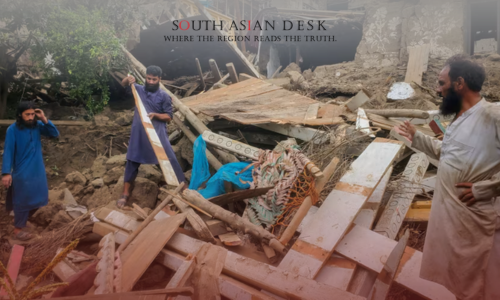
The Taliban issued a call for foreign aid after a 6.0 magnitude earthquake struck near Jalalabad, Afghanistan, on Sunday, August 31, 2025, at 11:47 PM, killing over 800 and injuring 2,800, as rescue teams struggle to reach survivors in Kunar Province. The Taliban’s call for foreign aid amid this earthquake underscores South Asia’s fragile disaster response systems and the region’s reliance on international support, amplifying Afghanistan’s ongoing humanitarian crisis.
Taliban Call for Foreign Aid
The Taliban’s call for foreign aid followed a devastating 6.0 magnitude earthquake that hit eastern Afghanistan, centered 27 km east-northeast of Jalalabad, flattening villages in Kunar and Nangarhar provinces. According to the Taliban’s Ministry of Defence, military teams conducted 40 helicopter flights by Monday, September 1, 2025, evacuating 420 casualties to Nangarhar Regional Hospital. The quake’s shallow depth of 8 km caused widespread destruction, with landslides and flash floods blocking access to remote areas like Mazar Dara in Kunar’s Nurgal District.
According to UNICEF on X, poor mobile connectivity has hindered damage assessments, particularly impacting children. The Taliban reported 610 deaths in Kunar and 12 in Nangarhar. The International Rescue Committee (IRC) noted 2,000 injuries within 12 hours, warning that the death toll may rise as rescuers reach isolated communities.
Rescue Operations Amid Challenges
Rescue efforts are central to the response, with helicopters airlifting the injured from villages where mud-brick homes collapsed. According to the United Nations, UN agencies are delivering medical supplies, tents, and clean water, with Secretary-General António Guterres pledging support at 2:15 PM on Monday, September 1, 2025. The Afghan Red Crescent Society has deployed teams to search rubble, while local volunteers in Nangarhar donated blood to support strained hospitals. Landslides and five aftershocks, including a 5.2 magnitude event, have complicated ground access, particularly along the Jalalabad-Kunar highway.
International Response to Taliban’s Appeal
The Taliban’s call for foreign aid earthquake relief prompted swift responses. By Tuesday, September 2, 2025, India delivered 1,000 tents and 15 tons of food to Kabul, with more aid planned, as stated by Foreign Minister Subrahmanyam Jaishankar. Iran and Japan pledged medical supplies, while Britain committed GBP 1 million through the UN Population Fund and Red Cross, ensuring funds bypass the Taliban. According to the US State Department’s Bureau of South and Central Asian Affairs, condolences were extended, but there was no immediate promise of aid. China expressed readiness to provide relief, per its foreign ministry.
The IRC highlighted a drastic aid shortfall, with 2025 humanitarian funding at USD 767 million, down from USD 3.8 billion in 2022, limiting response capacity. Sharafat Zaman, Taliban health ministry spokesperson, emphasized the need for aid, stating, “Lots of people lost their lives and houses.”
Background
Afghanistan’s location on the Hindu Kush fault line, where the Indian and Eurasian tectonic plates meet, makes it prone to seismic activity. A 6.3 magnitude earthquake in Herat Province in October 2023 killed 1000’s, exposing gaps in disaster preparedness. Since the Taliban’s 2021 takeover, foreign aid cuts—prompted by policies restricting women’s rights—have left over 23 million Afghans reliant on humanitarian support. The forced return of 2 million Afghans from Pakistan and Iran has further strained resources.
What’s Next
The Taliban’s call for foreign aid earthquake relief will test global willingness to support Afghanistan, with long-term recovery hinging on sustained international funding and infrastructure restoration to aid devastated communities.
Published in SouthAsianDesk, September 2nd, 2025
Follow SouthAsianDesk on X, Instagram, and Facebook for insights on business and current affairs from across South Asia.