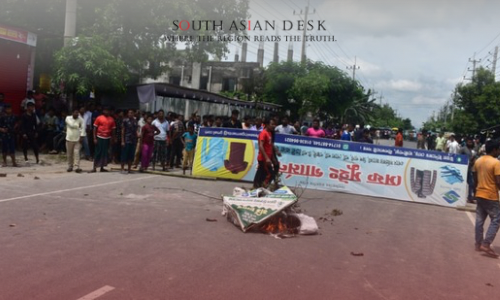
A worker was killed in EPZ clash and 11 injured in a clash with law enforcers at Uttara, Nilphamari, amid protests over factory closure and layoffs.
On Tuesday, September 2, 2025, a violent clash between workers and law enforcement at Uttara Export Processing Zone (EPZ) in Nilphamari, Bangladesh, left one worker dead and at least 11 injured, triggered by factory layoffs and an abrupt closure.
The incident highlights ongoing labour tensions in Bangladesh’s export-driven EPZs, raising concerns about worker rights and law enforcement responses in South Asia’s industrial hubs.
Fatal Clash at Uttara EPZ
At approximately 8:00 AM, workers gathered at the Evergreen factory in Uttara EPZ after authorities announced its indefinite closure without settling workers’ dues. The protest escalated when workers, denied entry, blocked the Nilphamari-Saidpur road. Police and army personnel attempted to disperse the crowd, leading to a violent confrontation.
The deceased, identified as Habib Islam, 20, an employee of Equ International, was pronounced dead at Nilphamari General Hospital around 9:00 AM. Dr Md Farhan Tanvirul Islam, a hospital physician, noted a chest wound on Habib’s body, with the exact cause of death pending a post-mortem. Workers alleged that law enforcers opened fire, claiming Habib was shot while leaving the EPZ after his night shift. This EPZ clash lead the nation into mourn.
Underlying Causes of Unrest
Tensions had been brewing following EPZ clash. The layoff of approximately 50 workers from Evergreen, a factory within the Uttara EPZ. The situation worsened when a closure notice was displayed at the factory gate, prompting workers to protest over unpaid dues and job losses. MR Sayeed, officer-in-charge of Nilphamari Sadar Police Station, confirmed the death but provided no further details on the use of force. Official information from police has not indicated the use of firearms.
Workers voiced frustration, alleging that EPZ authorities prioritise factory owners’ interests over their welfare. According to Prothom Alo, Habib’s brother, Ashiqur Rahman, stated that Habib was caught in the violence while exiting the EPZ after his shift.
Injuries and Medical Response on EPZ Clash
At least 11 workers were injured, with six rushed to the 250-bed Nilphamari General Hospital. Dr. Farhan reported that the injured claimed to have been shot, but X-rays were needed to confirm the nature of their injuries. As of now, all injured workers remain under treatment and their condition is being monitored; confirmation of gunshot wounds awaits completion of imaging and medical tests. The hospital response underscores the severity of the clash, with medical staff working to stabilize the wounded amid chaotic circumstances.
Background: Labour Issues in Uttara EPZ
Uttara EPZ, established in 2001 in Nilphamari’s Sangalshi area, is a key industrial hub in northern Bangladesh, employing around 30,000 workers, 66% of whom are women. It has been pivotal in alleviating poverty in the region, with factories producing garments, accessories, and other export goods. However, labour disputes are not uncommon. Previous incidents, such as protests by Sonic (Bangladesh) Ltd workers in 2021, reflect ongoing concerns over working conditions and job security.
The closure of Evergreen and the layoffs highlight broader challenges in Bangladesh’s export-driven economy, where workers often face precarious employment. The EPZ’s role in generating jobs is significant, but incidents like this expose gaps in labour protections and dispute resolution mechanisms.
Broader Implications
The EPZ clash with police, resulting in a worker killed, raises questions about the use of force by law enforcement and the management of labour disputes in Bangladesh. Similar incidents, such as the 2024 clash in Ashulia where a garment worker was killed, indicate a pattern of escalating tensions in industrial zones. This event could prompt scrutiny of EPZ governance and worker rights, particularly as Bangladesh seeks to maintain its position as a global garment export hub.
The involvement of both police and army personnel suggests heightened security measures, potentially linked to broader unrest in the region. Additional police, army, and Border Guard Bangladesh (BGB) personnel were deployed to the area during the clash at the Uttara EPZ, turning the site into a conflict zone. The blockade of the Nilphamari–Saidpur road by agitated workers further disrupted local activity, underscoring the economic ripple effects of such conflicts.
What’s Next
Authorities are expected to investigate the circumstances of Habib Islam’s death and the use of force during the EPZ clash with police, where a worker was killed. The incident may spur calls for better labour protections and dialogue between EPZ authorities, factory owners, and workers to prevent future confrontations.
Published in SouthAsianDesk, September 2nd, 2025
Follow SouthAsianDesk on X, Instagram, and Facebook for insights on business and current affairs from across South Asia.