

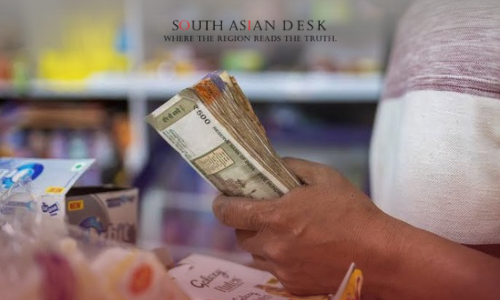
The Indian rupee fell to a record low of 88.36 against the US dollar, with likely Reserve Bank of India intervention preventing sharper losses.
Indian Rupee’s Record Decline
On Friday, September 5, 2025, the Indian rupee slumped to an all-time low of 88.36 against the US dollar in Mumbai, driven by ongoing concerns over steep US tariffs on Indian exports. The currency, which closed at 88.2750, down 0.1%, was supported by likely dollar-selling interventions by the Reserve Bank of India (RBI), according to traders. The decline follows heightened market anxiety after the US imposed a 50% tariff on Indian goods.
Why It Matters
The Indian rupee’s depreciation impacts South Asia’s largest economy, raising import costs, particularly for oil, and affecting millions of households and businesses. As India’s trade deficit widens, the rupee’s weakness could ripple across regional markets, influencing investor confidence and economic stability.
US Tariffs and Market Jitters
The Indian rupee breached its previous record low of 88.33, set on Sunday, September 1, 2025, as traders reacted to the US’s 50% tariffs on Indian exports, effective from Tuesday, August 27, 2025. These tariffs, comprising a 25% base rate and an additional 25% penalty, target key sectors like textiles, leather, and gems, which account for 55% of India’s $86.5 billion exports to the US in 2024-25. “The spike in USD/INR was caused by worries of higher tariffs on India, but state-run banks stepped in over 88.30 to cap losses, most likely on behalf of the Reserve Bank of India,” a senior trader at a Mumbai-based bank noted.
Foreign banks’ strong dollar buying, fueled by speculation over sustained tariff pressures, further weighed on the rupee. Merchant flows remained muted, skewing market activity towards dollar purchases, exacerbating the currency’s decline.
Foreign Portfolio Outflows
Foreign portfolio investors (FPIs) have withdrawn $1.4 billion from Indian equities in September 2025, contributing to a year-to-date outflow of over $16 billion. This capital flight, driven by tariff-related uncertainties and a slowing Indian economy, has intensified pressure on the Indian rupee. The BSE Sensex and Nifty 50 indices fell 1.2% and 1.5%, respectively, on Friday, reflecting broader market concerns.
Reserve Bank of India’s Role
The RBI’s likely intervention through state-run banks helped prevent the Indian rupee from falling further. Traders reported dollar sales by public sector banks when the rupee neared 88.30, a level the RBI appears to defend to curb excessive volatility. The central bank’s foreign exchange reserves, valued at $690.72 billion as of August 2025, provide ample capacity to manage sharp depreciations. However, analysts note the RBI’s cautious approach, allowing controlled depreciation to support export competitiveness. “The RBI has been actively monitoring the rupee to prevent disorderly depreciation beyond its comfort zone,” said Jigar Trivedi, Senior Research Analyst at Reliance Securities.
Limited Intervention Strategy
Despite its interventions, the RBI has emphasized it does not target a specific exchange rate. The central bank’s actions focus on smoothing volatility rather than pegging the rupee to a fixed level. On Wednesday, September 3, 2025, the rupee traded in a narrow range between 88.07 and 88.16, indicating limited RBI intervention after the 88-mark breach. According to the RBI on X, the bank remains vigilant to ensure orderly currency movements amid external pressures.
Economic Implications
A weaker Indian rupee benefits exporters by making Indian goods cheaper in global markets, partially offsetting the impact of US tariffs. However, it raises import costs, particularly for crude oil, as India is the world’s third-largest oil consumer. Economists estimate the tariffs could shave 60–80 basis points off India’s GDP growth, projected at 6.5% for the fiscal year ending March 31, 2026. A wider trade deficit and persistent FPI outflows could further strain the balance of payments, with India’s exports to the US accounting for 2.2% of GDP.
MUFG forecasts the Indian rupee could weaken to 89 by the first quarter of 2026 if tariffs remain at 50%, though a reduction to 25% next year could ease pressures. “A sustained 1% decline in the rupee could offset 2–3 basis points of the GDP drag from tariffs,” said Dhiraj Nim, forex strategist at ANZ.
Background
The US tariffs were imposed in response to India’s continued purchase of Russian oil, which the US claims funds Russia’s war in Ukraine. Trade talks between India and the US have stalled, with no agreement reached after five rounds of negotiations. The Indian rupee has been the worst-performing Asian currency in 2025, down 2.94% year-to-date, compared to gains of 6–10% for currencies like the Taiwanese dollar and Thai baht.
What’s Next
The Indian rupee’s trajectory will depend on US-India trade negotiations and the RBI’s intervention strategy. With the government planning support packages for exporters, as announced by Finance Minister Nirmala Sitharaman on Friday, September 5, 2025, efforts to stabilise the Indian rupee and mitigate tariff impacts will remain critical in the coming months.
Published in SouthAsianDesk, September 5th, 2025
Follow SouthAsianDesk on X, Instagram, and Facebook for insights on business and current affairs from across South Asia.
