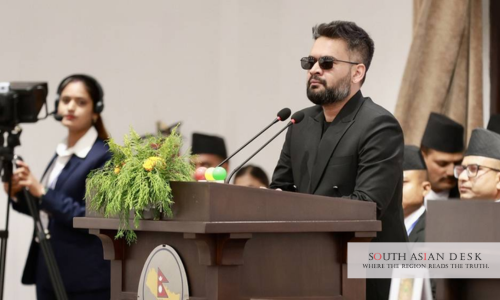
Nepal’s prime minister says border issues with India should be settled through dialogue, after remarks on mutual land encroachment drew political scrutiny in Kathmandu.
Nepal India border dispute returned to the centre of political debate after Prime Minister Balendra Shah told Parliament on Sunday, May 31, 2026, that both Nepal and India had issues of land encroachment along their border, prompting clarification from Nepal’s Foreign Ministry and renewed regional attention.
Nepal India border dispute returns to Parliament
Prime Minister Shah made the remarks while responding to lawmakers in Nepal’s House of Representatives, where questions were raised about border issues involving Lipulekh, Limpiyadhura and Kalapani. According to reports of the parliamentary exchange, Shah said that after becoming prime minister he had learned not only of Indian encroachment on Nepali land, but also of Nepali encroachment on Indian land in multiple places.
The statement immediately drew attention because Nepal’s official public position has traditionally focused on its claim over areas including Lipulekh, Limpiyadhura and Kalapani. Those areas remain among the most sensitive points in the Nepal India border dispute and have repeatedly affected political messaging in Kathmandu and diplomatic exchanges with New Delhi.
Shah also said the dispute would be addressed through diplomatic dialogue. He said Nepal had sent a diplomatic note to India and received a response, and that both sides would seek a resolution through talks involving historians, surveyors and experts familiar with the boundary.
The remarks matter for South Asia because the Nepal India border is not only a territorial question. It is tied to cross-border mobility, trade, pilgrimage routes, domestic nationalism, regional diplomacy and the wider balance between India, Nepal and China.
Nepal Foreign Ministry clarifies Shah’s comments
Following criticism of the prime minister’s words, Nepal’s Ministry of Foreign Affairs clarified that Shah’s remarks were linked to cross-border land use, no-man’s-land encroachment and technical boundary issues, rather than a new territorial claim by Nepal against India.
The clarification said the prime minister’s reference concerned areas where people on either side may be cultivating, occupying or using land across the demarcated boundary. It also referred to the technical concept of “cross-border occupation”, particularly in riverine areas where fixed boundary principles and changing ground realities can create practical disputes.
This distinction is important. A formal territorial claim is a state-level assertion of sovereignty. Cross-border occupation or land use may refer to local settlement, cultivation, missing boundary pillars, damaged markers or confusion caused by river movement and incomplete demarcation. By presenting the issue as technical, the Foreign Ministry appeared to limit the diplomatic fallout from Shah’s broader phrasing.
The ministry also indicated that technical teams and border-related mechanisms were working on boundary pillars, no-man’s-land encroachment and related field data.
India’s position on Lipulekh and boundary talks
India has not issued a separate public response to Shah’s latest parliamentary comments at the time of writing. However, New Delhi’s official position on related border issues was restated on Saturday, May 3, 2026, when India’s Ministry of External Affairs responded to Nepal’s comments on the Kailash Mansarovar Yatra through Lipulekh.
India said Lipulekh Pass had been a longstanding route for the Kailash Mansarovar Yatra since 1954 and that the route was “not a new development”. It also said India remained open to constructive interaction with Nepal on all issues in the bilateral relationship, including agreed outstanding boundary issues through dialogue and diplomacy.
Earlier official Indian records have acknowledged differences of perception in parts of the India-Nepal boundary. In a 2009 parliamentary reply, India’s external affairs ministry said strip maps covering about 96 percent of the boundary had been jointly finalised by the Joint Technical Committee, while differences remained in areas including Narsahi-Susta in Bihar and Kalapani in Uttarakhand.
Those records show that the dispute is not new, but Shah’s wording has revived political debate because it frames the problem as involving conduct on both sides of the border.
Background
The Nepal India border dispute is rooted partly in differing interpretations of historical boundary arrangements, including the Treaty of Sugauli of 1816. Nepal argues that areas east of the Mahakali River, including Limpiyadhura, Lipulekh and Kalapani, form part of its territory. India disputes Nepal’s expanded territorial claims and maintains that its position is consistent with historical facts and evidence.
The issue became more prominent in 2020 after Nepal adopted a revised political map including Limpiyadhura, Lipulekh and Kalapani. India rejected that move. Since then, the border issue has remained a recurring point in Nepal’s domestic politics, especially when questions arise over road access, pilgrimage routes, maps and diplomatic exchanges involving India and China.
Susta is another sensitive area because shifting river courses have complicated land use and claims along the border. Such riverine boundary disputes are common in South Asia, where settlement patterns and natural changes often outpace formal demarcation.
What’s next
The immediate question is whether Shah’s government will move beyond clarification and seek structured talks with India on the technical and political aspects of the border. Any formal negotiation is likely to require careful coordination between survey officials, foreign ministries and political leadership on both sides.
For Nepal, the challenge is to maintain a firm national position without escalating the dispute beyond diplomatic channels. For India, the issue is to manage a sensitive neighbourhood relationship while resisting what it calls unilateral enlargement of territorial claims.
Until both governments clarify the next steps, the Nepal India border dispute is likely to remain a politically sensitive test for Prime Minister Shah’s new administration.
Published in SouthAsianDesk, June 1, 2026
Follow SouthAsianDesk on X, Instagram and Facebook for insights on business and current affairs from across South Asia.