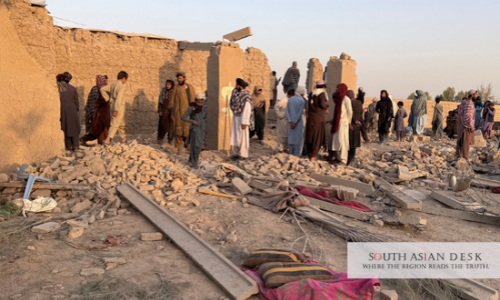
Pakistani airstrikes in Afghanistan killed at least 10 civilians, most of them children, in two provinces overnight, according to the United Nations Assistance Mission in Afghanistan (UNAMA). Islamabad says the same operation killed 22 militants. The strikes, which hit the Kunar and Helmand provinces, mark a sharp escalation after roughly three months of relative calm between the neighbouring countries.
Conflicting Accounts of the Pakistani Airstrikes in Afghanistan
Taliban chief spokesman Zabihullah Mujahid said the attacks took place late on Wednesday and killed at least nine people, wounded 11 others and destroyed three houses. He condemned the strikes as an act of aggression and a crime against accepted principles. UNAMA later put the toll higher, confirming that at least 10 civilians were killed and nine injured. Reporting on the strikes places them in Shultan district of Kunar and Garmser district of Helmand, and the difference between the Taliban and UN figures was not immediately explained.
Pakistan’s Ministry of Information gave a sharply different account. It said it had carried out “well planned and calibrated” strikes on camps and hideouts used by two armed groups, Tehrik-e-Taliban Pakistan (TTP) and the Balochistan Liberation Army (BLA), on the basis of credible intelligence. The ministry said initial reports indicated that 22 militants had been killed and that large quantities of weapons and ammunition had been destroyed. It also said precautions had been taken to avoid civilian harm. Al Jazeera, which first reported the exchange, noted that it could not independently verify the claims made by either side.
Civilian Casualties and the UN Response
UNAMA said civilians continue to be affected by cross-border hostilities and reiterated its call for de-escalation, dialogue, respect for international law and the prevention of further harm. The mission’s statement did not name the party responsible, although Pakistan has acknowledged carrying out the strikes. Last week, UNAMA said it had documented more than 1,100 civilian deaths and injuries in Afghanistan from cross-border violence so far this year. Civilian casualties on that scale underline the growing humanitarian cost of the confrontation.
Islamabad’s Position on Militant Sanctuaries
Pakistan accuses the Taliban authorities in Kabul of harbouring armed groups, including the TTP, and of enabling cross-border attacks on Pakistani territory. Kabul denies the allegation and says Pakistani strikes have hit civilian homes and killed women and children. Al Jazeera’s correspondent in Islamabad, Kamal Hyder, said the BLA has been responsible for a growing number of attacks in Balochistan province, while the TTP has carried out attacks in Khyber Pakhtunkhwa province. He added that a brief ceasefire between the TTP and the Pakistani government, mediated by the Taliban in Afghanistan, broke down in November 2022, and that militant attacks have increased since. In his assessment, Pakistan responds to attacks on its side of the border with air strikes.
A Widening Pattern of Cross-Border Hostilities
The latest Pakistani airstrikes in Afghanistan follow a series of earlier attacks. Reports indicate that strikes a little over a week ago in the Kandahar and Kunar provinces killed at least three people and injured four. Pakistan has also struck areas in Kandahar, Kunar, Paktika, Paktia and Khost during the recent escalation. The Associated Press reported that Pakistan has repeatedly carried out airstrikes inside Afghanistan since tensions rose dramatically earlier this year.
The diplomatic calendar adds further significance to the timing. Russia is due to host the eighth round of Moscow Format consultations on Afghanistan on Oct. 5, and the Russian Foreign Ministry has listed both Pakistan and a Taliban delegation among the expected participants. Whether the meeting produces any movement on the cross-border hostilities remains to be seen. For now, independent verification of events on the ground is limited, and both governments continue to give irreconcilable accounts of who is being targeted.
Follow SouthAsianDesk on X, Instagram and Facebook for insights on business and current affairs from across South Asia.