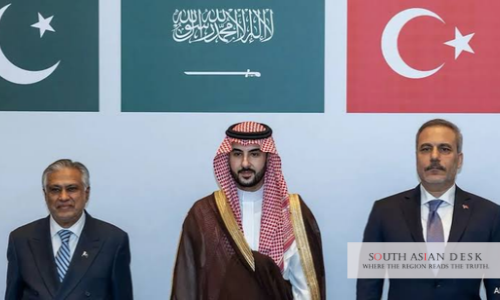
Saudi Arabia military deployment plans advanced on Monday, 5 October 2026, when Pakistan, Turkiye and Saudi Arabia agreed to put the collective defence commitments of their Makkah Joint Defence Agreement into immediate effect. The decision followed an emergency meeting in Riyadh and was taken in response to continuing Houthi attacks on the kingdom.
What Was Agreed in Riyadh
The three governments met at the Strategic Political and Defence Committee of the Makkah Alliance for Defence, the pact’s senior coordinating body. According to a joint statement published by Pakistan’s Foreign Office, the parties agreed to activate collective deterrence measures and to provide the agreed military forces and capabilities, ensuring their rapid deployment to Saudi Arabia. The statement added that any deployment would proceed under arrangements already approved and in line with the national laws of each country.
Pakistan’s delegation was led by Deputy Prime Minister and Foreign Minister Ishaq Dar and included Field Marshal Asim Munir, who serves as Chief of Army Staff and Chief of Defence Forces, and Defence Minister Khawaja Asif. The committee also appointed Lieutenant General (retired) Nauman Mahmood of Pakistan as the alliance’s first secretary general for a three-year term.
Background to the Makkah Joint Defence Agreement
The pact was signed on 7 August 2026 by President Recep Tayyip Erdogan, Crown Prince Mohammed bin Salman and Prime Minister Shehbaz Sharif. It provides that an armed attack on any one of the three states will be regarded as an attack on all. It builds on a bilateral Strategic Mutual Defence Agreement between Saudi Arabia and Pakistan, signed in September 2025. At the signing, President Erdogan described the arrangement as one based on collective deterrence, and Turkiye, which is a NATO member, stated that the agreement is not directed at any country, including Iran.
The latest step also follows an urgent meeting of the three countries’ military chiefs in Riyadh on 25 September, convened in light of Houthi attacks on Saudi Arabia.
Clarifying the Scope of the Saudi Arabia Military Deployment
Reporting on the decision has sometimes suggested that Pakistani troops are arriving in the kingdom for the first time. That is inaccurate. Pakistan has long maintained forces in Saudi Arabia, and one report in August put the number of Pakistani troops, along with fighter jets and air defence systems, at over 8,000. Pakistan’s Foreign Office said on 10 September that its forces were present in the kingdom for training and logistical purposes and that more time was needed to implement the trilateral pact.
On the operational role of Pakistan and Turkiye, Defence Minister Asif said both countries had a “presence in theatre,” but that only Saudi troops were involved in combat operations. He also told Geo News that the agreement would become operational in the event of unprovoked aggression or a spillover of the conflict in Yemen into Saudi territory. He further stated that Saudi Arabia had made gains in Yemen and recovered some areas in its fighting with the Houthis.
Analysts Urge Caution on Troop Numbers
Analysts had cautioned before the latest decision that large deployments were unlikely. Hamish Kinnear of the risk intelligence firm Verisk Maplecroft said in August that token deployments were possible but that it was doubtful Ankara and Islamabad wished to become heavily involved in an anti-Houthi operation. The joint statement itself offers few specifics on troop numbers or timelines, and the question of how far each partner’s obligations extend remains open. Pakistan and Turkiye have also been described by analysts as reluctant to abandon their roles as mediators in the wider regional conflict involving Iran.
Regional Implications
The decision tests whether a pact signed less than two months ago can translate into operational readiness. For Pakistan, which also holds a bilateral defence commitment to Riyadh, the activation adds to the pressure of balancing its obligations to Saudi Arabia against its diplomatic role in the region. For Saudi Arabia, the public commitment of two partners strengthens deterrence against further Houthi attacks on its cities and infrastructure. In this regard, the coming weeks will show how the Saudi Arabia military deployment is structured, and whether it remains confined to defensive and support functions or extends beyond them.
Follow SouthAsianDesk on X, Instagram and Facebook for insights on business and current affairs from across South Asia.