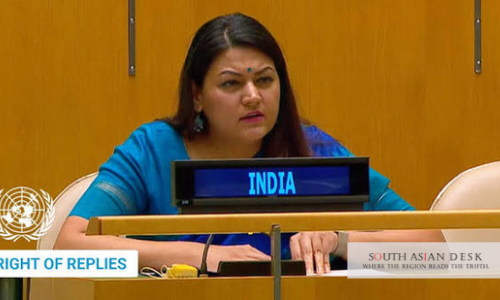
India’s response to Pakistan at the UN came on Wednesday, October 7, 2026, when First Secretary Raghoo Puri exercised India’s Right of Reply at the UN General Assembly’s Sixth Committee. The committee, which handles legal affairs, was considering the agenda item on measures to eliminate international terrorism. The reply followed remarks by Pakistan’s Deputy Permanent Representative, Usman Jadoon. revoirevoi
India’s Response to Pakistan at the UN: The Raghoo Puri Statement
The Raghoo Puri statement centred on a single theme: that the world remembers major terrorist attacks and expects accountability for them. Puri said the world had not forgotten 9/11, 26/11 or the Pahalgam attack. He also argued that terrorism cannot be defeated by declarations alone and requires action against perpetrators, organisers, financiers and sponsors. revoiindiatvnews
Puri accused Pakistan of presenting itself as both a frontline state against terrorism and a victim of it. In his account, this masked the fact that militant groups created by the Pakistani state, and since beyond its control, had turned their violence on Pakistan itself. He also criticised Islamabad for announcing enhanced rewards for the capture of Masood Azhar, the UN-listed head of Jaish-e-Mohammed, which he said glossed over state support for terrorism. In a second reply, he rejected what he called Pakistan’s “circular economy” of narratives. World has not forgotten 9/11, 26/11 and Pahalgam: India at UN – Revoi.in +2
India’s Response to Pakistan at the UN: The Significance of the 9/11 and 26/11 Attacks
The 9/11 and 26/11 attacks serve different purposes in India’s argument. The September 2001 attacks in the United States killed nearly 3,000 people and reshaped global counter-terrorism cooperation. Puri’s reference was specific: he noted that Osama bin Laden, the mastermind of 9/11, was eventually found in Abbottabad, Pakistan. Bin Laden was killed there in a 2011 raid by US Navy SEALs. Pakistan has long denied that its authorities knew of his presence. shabariseva
The 26/11 attacks struck Mumbai in November 2008 and killed 166 people. India has consistently attributed the assault to Pakistan-based militant groups and cites it as a central example of cross-border terrorism. By placing the two events side by side, India sought to frame Pakistan’s claims of counter-terrorism leadership as inconsistent with the record. These are India’s assertions, and Pakistan has repeatedly rejected such characterisations.
Context Behind India’s Response to Pakistan at the UN
India’s response to Pakistan at the UN did not occur in isolation. Right of Reply exchanges between the two countries have become a recurring feature of UN meetings. At the Human Rights Council in September 2025, for instance, an Indian diplomat cited the Pulwama, Uri, Pathankot and Mumbai attacks, along with the recent Pahalgam attack. newsonair
The timing also drew notice. Reports observed that India’s remarks came ahead of the next Financial Action Task Force plenary and working group meetings, scheduled for Paris from October 26 to 30. The FATF is the global body that monitors terrorist financing, a subject Puri raised directly when he said the world was aware of Pakistan’s financial support to terrorism. revoi
Shaping the International Terrorism Discussion
The exchange fits into a wider international terrorism discussion in which states compete over how responsibility is assigned. India’s position is that statements of condemnation carry little weight without concrete action against those who organise, finance and shelter attackers. It has used the Sixth Committee to argue that accountability, rather than competing narratives, should guide collective efforts.
The reports reviewed for this article describe India’s remarks in detail but do not set out the full text of Pakistan’s statement or the reactions of other delegations. Readers should therefore treat the characterisations of Pakistan’s position as those of the Indian delegation.
Persistent South Asia Geopolitical Tensions
The episode underlines how South Asia geopolitical tensions continue to surface in multilateral forums. The two countries disagree sharply on terrorism, Kashmir and responsibility for past attacks, and the UN has become one of the main stages for those disputes. With the FATF meetings approaching, the Right of Reply exchange suggests that the argument over terrorism financing and accountability is likely to continue.
Ultimately, India’s response to Pakistan at the UN reflects a deliberate diplomatic strategy. By invoking the 9/11 and 26/11 attacks, India seeks to keep the focus on accountability and to remind the international community that, in its view, rhetoric must be matched by action.
Follow SouthAsianDesk on X, Instagram and Facebook for insights on business and current affairs from across South Asia.
Sources
- India exposes Pakistan’s doublespeak at UN, says world has not forgotten 9/11, 26/11, Pahalgam attacks – thehindu.com
- ‘Pak’s Frankenstein Monster Of Terrorism Returned To Haunt It’: India At UN – ndtv.com
Image: th-i.thgim.com