Pakistani troops in Saudi Arabia have been publicly confirmed by the head of the country’s military media wing, days after Pakistan, Saudi Arabia and Türkiye agreed to put their joint security commitments into practice. Lieutenant General Ahmed Sharif Chaudhry, the Director General of Inter-Services Public Relations (DG ISPR), made the confirmation in an interview with CNN this week. He said the troops serve in the kingdom across multiple domains.
The disclosure follows an emergency meeting in Riyadh on October 5, 2026, and comes as Saudi Arabia faces sustained missile and drone attacks from Yemen’s Houthi group. It marks the first detailed acknowledgement from Pakistan’s military spokesperson of the country’s presence on Saudi soil under the new alliance framework.
What the Makkah Defence Pact Requires
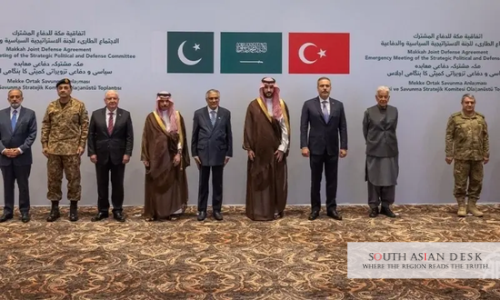
The Makkah Defence Pact, formally known as the Makkah Joint Defence Agreement, was signed by Pakistan, Saudi Arabia and Türkiye on August 7, 2026. Its central provision is a principle of collective defence: an armed attack against one member is treated as an attack against all three.
The agreement is recent, and it builds on an earlier bilateral arrangement between Islamabad and Riyadh. The full text has not been made public, which has left room for debate over how far its obligations extend.
On October 5, the alliance’s Strategic Political and Defence Committee met in Riyadh. According to Pakistan’s Foreign Office, the committee decided to move immediately to the practical implementation of the collective defence commitments. It also agreed to provide the agreed military forces and capabilities and to ensure their rapid deployment in the kingdom. The Foreign Office said this would proceed in accordance with approved arrangements and the national legislation of each state. The three countries did not announce troop numbers, deployment schedules or the precise nature of the forces involved.
Why Pakistani Troops in Saudi Arabia Are Not a New Development
One of the most important points in the DG ISPR’s remarks is that Pakistani troops in Saudi Arabia predate the alliance. Lieutenant General Chaudhry said Pakistani contingents have been present in the kingdom for decades, and that the personnel now serving there under the Makkah framework belong to different domains. He described a sustained diplomatic, political, military and people-to-people relationship between Pakistan, Saudi Arabia and Türkiye.
Pakistan’s military involvement in the kingdom has long included training and advisory deployments. What has changed is the legal and political framework around that presence. The Makkah Joint Defence Agreement gives it a formal trilateral structure, and the October 5 decision signals that the commitments are now being acted upon.
Numbers and Roles Remain Undisclosed
Pakistan has declined to say how many personnel are in the kingdom or what capabilities they bring. A Reuters report published on October 2, citing a Pakistani official, claimed that between 30,000 and 40,000 Pakistani troops had been sent to help defend the kingdom’s land borders and assist with drone and missile interceptions. Pakistan’s information ministry described that report as speculative. Pakistan has also rejected a separate American media report claiming that Pakistan Air Force jets were being used against Houthi targets, calling it fake and fabricated.
Islamabad has consistently described the arrangement as defensive. Asked about an operational role, the DG ISPR reportedly said Pakistan and Türkiye both have a presence in the theatre, but that only Saudi forces are involved in combat. Defence Minister Khawaja Asif has said Pakistan will stand by Saudi Arabia practically and diplomatically if the situation escalates, and will meet its obligations under the alliance.
Türkiye has taken a more cautious public line. Dawn reported that Ankara called the accord purely defensive and ruled out sending troops.
The Security Backdrop in Saudi Arabia
The activation of the pact comes during an intense period for the kingdom. Houthi forces have fired ballistic missiles at Riyadh’s airport and at airbases in the south, and an Aramco facility south of Riyadh was targeted over the weekend before the Riyadh meeting. Several international airlines, including Lufthansa and Air India, have suspended flights to the Saudi capital. Meanwhile, the Saudi-led coalition has launched a major campaign to recapture Houthi-held territory in Yemen.
The United States has also signalled support. US Secretary of State Marco Rubio backed Saudi Arabia’s right to self-defence and said Washington intends to honour its own security agreement with the kingdom.
Regional Implications
Analysts will be watching how the Makkah Defence Pact develops. A key question is whether it remains a framework for defending Saudi territory or evolves into a vehicle for wider military participation in Yemen. The pact does not automatically commit Pakistani forces to offensive operations beyond Saudi territory, and Islamabad has said it wants to avoid speculation on how its forces might be used.
For now, the confirmation of Pakistani troops in Saudi Arabia has clarified one point: the alliance is not starting from zero. It rests on decades of military cooperation, and its first real test is already under way.
Related Posts
- Pakistan and Saudi Arabia Strengthen Ties Amid Regional Tensions
- Trilateral Defence Agreements in the Middle East: A New Era
- Regional Security Dynamics: A South Asian Perspective
Follow SouthAsianDesk on X, Instagram and Facebook for insights on business and current affairs from across South Asia.