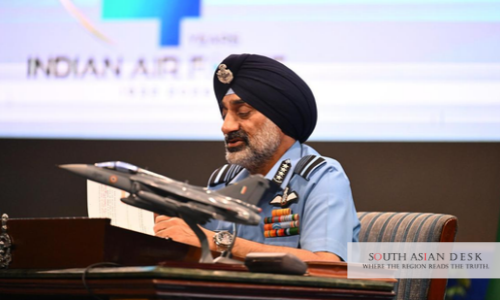
IAF chief AP Singh has said that the success of Operation Sindoor should not become a reason for complacency, and that the Indian Air Force must keep deepening and widening its capabilities to meet future security challenges. The Chief of Air Staff made the remarks in an exclusive interview with PTI on Sunday, in which he reviewed the lessons of the four-day operation and set out where he believes the force should head next.
What the Air Chief Marshal Said
Air Chief Marshal Singh described Operation Sindoor as a validation of the IAF’s capability-centric approach, a way of planning that treats aircraft, sensors, weapons and networks as parts of one integrated system and not as separate platforms. He said the combined effect of such a system is far greater than the sum of its parts.
“Operationally, one lesson stands out,” he said, pointing to the need to keep multiple options and to adapt quickly when an adversary changes tactics. A force built around capability, he argued, can draw on many tools rather than depend on one, and that flexibility allowed the IAF to calibrate its response and keep control of escalation.
He also said the operation’s success did not come from any single weapon or platform. According to the interview, it came from accurate intelligence, networked operations, stand-off and precision weapons, electronic warfare, layered air defence and counter-drone capabilities working together.
Precision Strikes and Indigenous Weapons
The IAF chief said some indigenously developed weapon systems performed exceptionally, delivering heavy blows deep into enemy territory, and that the force kept its commitment to zero collateral damage. PTI reported that the strikes across the western front spanned 1,200 kilometres in breadth and 200 kilometres in depth, and described the remarks as an apparent warning to Pakistan that no target is beyond the IAF’s reach.
India launched Operation Sindoor on 7 May 2025 in response to the Pahalgam attack of 22 April that year. According to PTI, it involved precision strikes on nine terror-linked sites in Pakistan and Pakistan-occupied Kashmir, including facilities linked to Jaish-e-Mohammed at Bahawalpur and Lashkar-e-Taiba at Muridke. PTI called it India’s most daring cross-border military action since the 1971 war.
These accounts reflect the Indian side. Pakistan has offered a different account of the May 2025 conflict, and the claims made by each government about targets, damage and outcomes have not been independently verified.
Why IAF Chief AP Singh Warns Against Complacency
Singh said the way forward is to build on the operation, not to rest on it. He said the IAF would continue on the path it has chosen with greater resolve so that, if the nation calls on it again, it can respond more swiftly, precisely and decisively. He described air power as both the country’s primary responder and its strategic deterrent.
The theme is consistent with his earlier public statements. At the Air Force Academy in Dundigal, he told graduating cadets that the character of warfare is evolving fast and that the Indian Air Force is developing into an aerospace force. On Air Force Day in October 2025, he said the operation had restored offensive air action to its rightful place in the national consciousness. At an industry summit, he said no operation on land or at sea could be conducted without air power.
A Wider Push to Modernise
His comments come as India weighs how to modernise its military after the operation. Defence analysts have long pointed to the IAF’s shortfall in fighter squadrons and its reliance on ageing aircraft as a challenge, though the interview as reported did not set out specific procurement plans or timelines. Singh also did not address the cost of the capabilities he described, nor how the force would balance imports with indigenous production.
The emphasis on integration, networked warfare and counter-drone systems reflects trends seen in recent conflicts, in which cheap drones, electronic warfare and long-range missiles have changed how air forces operate. Singh’s argument is that a force which invests only in individual platforms will struggle to keep pace.
Outlook
The Air Chief Marshal’s message is likely to shape the debate over defence spending and procurement in the coming months. For the IAF, the immediate task is to translate the lessons of Operation Sindoor into concrete acquisitions, training and doctrine. The remarks of IAF chief AP Singh also serve as a signal to Pakistan and to other regional rivals, while leaving open the question of how a future crisis would unfold.
Follow SouthAsianDesk on X, Instagram, and Facebook for insights on business and current affairs from across South Asia.