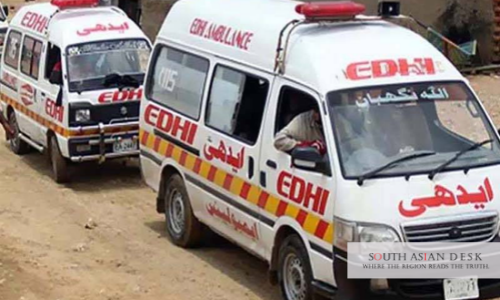
A Thar hospital ambulance fire has killed seven people and left five others with severe burns in Sindh’s Tharparkar district, according to rescue officials and police cited by Dawn. The blaze erupted after an oxygen cylinder exploded inside an ambulance at a hospital in Dano Dhandhal, in Nagarparkar taluka, as staff were preparing patients for transfer.
How the Fire Started
Rescue personnel told Dawn that hospital staff were connecting an oxygen cylinder inside the ambulance when it exploded, setting the vehicle ablaze. Seven people were burnt to death, while five others, including hospital employees, suffered serious burn injuries and were referred to Mithi, the district headquarters, for treatment.
Police attributed the incident to an oxygen cylinder explosion and said that patients and hospital staff were among both the dead and the injured. They added that they were also investigating other possible angles, which suggests the cause has not been formally determined.
Victims Yet to Be Fully Identified
Rescue workers identified three of the dead as Jaswant, ambulance driver Ishaq Thebo and Pandhi Rajar. The identities of the remaining victims had not been confirmed because the bodies were badly charred. The condition of the bodies is likely to complicate identification, and authorities may need to rely on relatives or other means to confirm who was in the vehicle.
Questions Over Facilities at the Hospital
The hospital is run by the Peoples Primary Healthcare Initiative, a public-private arrangement that manages health facilities in Sindh. Local residents alleged to Dawn that inadequate facilities at the hospitals operated by the Peoples Primary Healthcare Initiative in Tharparkar had contributed to the incident. These claims have not been verified, and the reports reviewed did not include a response from the organisation or from the provincial health authorities.
In remote districts such as Tharparkar, small facilities often act as the first point of care and rely on ambulances to move patients to larger hospitals over long distances. That makes the safe handling of equipment inside ambulances especially important, since a fire in a confined vehicle leaves occupants with very little time to escape.
The Risks of Oxygen Cylinders
Oxygen does not burn on its own, but it makes other materials ignite more easily and burn far more fiercely. As a matter of general safety practice, oxygen cylinders must be kept secure, connected only by trained staff using the correct fittings, and kept away from oil, grease and sources of ignition. Damaged valves, leaks or improper connections can turn an everyday medical procedure into a serious hazard. The investigation will need to determine whether such factors were present in this oxygen cylinder explosion, including the condition of the equipment and the training of those handling it.
A Pattern of Fire Incidents in Health Facilities
The tragedy follows other fatal fires linked to health services in Pakistan this year. On May 31, a 45-year-old woman was burnt to death and four others were critically injured when an ambulance belonging to a rural health centre caught fire in Toba Tek Singh district in Punjab, with Rescue 1122 and police attributing that blaze to an electrical short circuit, as Dawn reported. In August, a fire in the nursery of the Pakistan Institute of Medical Sciences in Islamabad killed 14 newborns. A preliminary report shared by the hospital’s spokesperson at the time said a spark inside the nursery had spread quickly because of oxygen points at the incubators.
Each case has its own circumstances, but together they point to the importance of routine safety checks, staff training and emergency preparedness in settings where oxygen and electrical equipment are used daily.
Thar Hospital Ambulance Fire: What Needs to Happen Next
A full investigation is needed to establish how the cylinder exploded, whether proper procedures were followed and whether the ambulance and equipment had been inspected. Families of the dead and injured will also expect clarity on compensation and treatment for the survivors in Mithi.
Beyond the immediate inquiry, the incident raises a broader question for the provincial health authorities and the organisations that run primary care facilities. Until clear safety standards are enforced for ambulances and oxygen handling, particularly in under-resourced districts, the risk of another Thar hospital ambulance fire will remain.
Follow SouthAsianDesk on X, Instagram and Facebook for insights on business and current affairs from across South Asia.