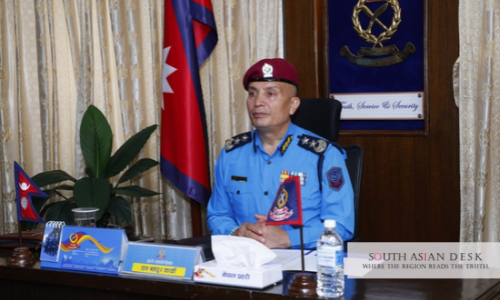
The Nepal Police chief, Inspector General Dan Bahadur Karki, called an emergency meeting of senior officers on Thursday as rumours spread that the government was preparing to remove him from office. The gathering at the police headquarters in Naxal, Kathmandu, ran from 2pm to 7pm, far longer than the force’s usual sessions, according to a report by The Kathmandu Post.
A five-hour session at Naxal
The meeting was held under the force’s policy coordination committee and brought together senior superintendents of police, deputy inspectors general and other high-ranking officials posted in the Capital. Officers said the session stretched on because participants repeatedly raised questions and offered their views. Deputy Inspector General Abi Narayan Kafle, the central police spokesperson, told Kantipur that the discussion covered the current state of law and order, contemporary issues and matters circulating on social media.
Kafle said officers had expressed concern over what they regarded as deliberate efforts to spread misleading information and damage the force’s reputation, professionalism and performance. A statement released after the meeting said the organisation would investigate and pursue legal action against anyone attempting to draw the security agency into controversy, adding that any action would proceed in accordance with prevailing laws.
Why the Nepal Police chief faces pressure
The meeting followed reports that the government wanted Karki to step down. Some officials at the Prime Minister’s Office are reportedly dissatisfied with the way he has handled investigations involving high-profile figures, in particular his insistence that arrests follow due legal procedure.
Karki has also faced public allegations from Khagendra Sunar, a lawmaker from the ruling Rastriya Swatantra Party, concerning alleged irregularities in the purchase of uniforms for temporary recruits deployed for the March 5 election. The Public Accounts Committee has since formed a subcommittee, led by party lawmaker Manish Jha, to examine the procurement.
Separate reports have also surfaced about conversations between Karki and Inam Sapkota, a middleman under investigation over alleged money laundering and banking offences. Sapkota is reported to have cultivated ties with judges, senior officials of the Nepal Police and the Armed Police Force, lawyers and ruling party leaders, while claiming close links to the prime minister and the United States embassy. These claims have not been established, and the investigation is ongoing.
What Karki told his officers
According to an officer who attended, Karki told colleagues that the force was under attack and urged them to remain united. He reportedly named certain suspects outside the organisation and cautioned officers against carrying internal matters beyond the institution. Participants debated whether the force should approach the Prime Minister’s Office to clarify the issues raised in public. Most agreed that officers should act collectively when the institution’s standing was at stake, while others argued that individuals should answer allegations concerning them personally and that the organisation should respond only to matters affecting the force as a whole.
When one senior officer asked directly whether anyone in the government had asked him to resign, Karki replied that the reports were untrue and that nobody had requested his departure, a participant said. The officer added that the meeting concluded with a decision that everyone would stand together to protect the organisation’s image and reputation and ensure that law and order was not disrupted.
The Thursday session followed a virtual meeting on Wednesday, in which Karki addressed police chiefs from the Kathmandu Valley, provincial police offices, training centres and district offices, extending his remarks down to inspector-level office chiefs. He warned officers not to turn against one another and reportedly objected to the public disclosure of matters under investigation.
Background on Karki’s tenure
Karki was promoted to inspector general on November 10, 2025, by the government led by Sushila Karki. Additional Inspectors General Rajan Adhikari, Manoj KC and Siddhi Bikram Shah had also been in contention for the post. Karki, Adhikari and KC joined the force as inspectors in 1997, while Shah was transferred from the National Investigation Department. If the 30-year service limit remains in place, his term as head of the force will end in mid-April 2028.
For now, the government has made no public move against him, and Karki has denied that he has been asked to resign. How the Prime Minister’s Office responds to the police leadership’s show of unity, and whether the allegations around uniform procurement and the Sapkota investigation deepen, will likely determine whether the speculation fades or grows.
Follow SouthAsianDesk on X, Instagram and Facebook for insights on business and current affairs from across South Asia.
Read More: