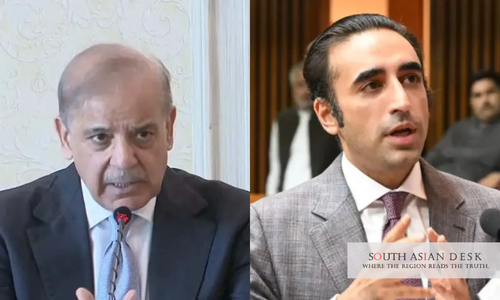
KP governor’s rule was the central subject of a consultative meeting between the ruling Pakistan Muslim League-Nawaz (PML-N) and its main ally, the Pakistan Peoples Party (PPP), in Islamabad on Tuesday. The two parties reviewed the situation in Khyber Pakhtunkhwa following the imposition of emergency and governor’s rule in the province, and also discussed the proposed Parliamentary Committee on Electoral Reforms.
Who Attended the Consultative Meeting
The meeting was convened by Prime Minister Shehbaz Sharif and attended by PPP Chairman Bilawal Bhutto-Zardari, who was accompanied by a delegation comprising Senate Chairman Yousuf Raza Gilani, Senator Sherry Rehman and Raja Pervez Ashraf. Governor Faisal Karim Kundi of Khyber Pakhtunkhwa and Balochistan Chief Minister Sarfraz Bugti were also present, along with some federal cabinet members and senior officials, according to Dawn.
Separately, the prime minister held a meeting with Chief of Defence Forces Field Marshal Asim Munir to discuss the overall situation in the country, a source in the Prime Minister’s Office told the newspaper. A source privy to the discussions described it as a long-overdue meeting in which the situation in all provinces was reviewed.
Briefings on the Security Situation
During the consultation, Governor Faisal Karim Kundi briefed the prime minister on the latest developments in Khyber Pakhtunkhwa, with particular attention to administrative measures and the issue of terrorism. The Balochistan chief minister similarly apprised participants of the security situation in his province.
The emphasis on security reflects the justification the federal government gave when it acted against the provincial administration. The federal cabinet recommended emergency rule on October 11, citing a deteriorating security situation and what it described as the provincial government’s deliberate disengagement from the fight against terrorism, according to The Express Tribune. The president then approved the measures under Articles 232 and 234 of the Constitution, which deal with the proclamation of emergency and governor’s rule respectively, on the advice of the prime minister.
How KP Governor’s Rule Came About
The decision suspended the Pakistan Tehreek-e-Insaf (PTI) government led by Chief Minister Sohail Afridi and transferred executive powers to the governor, who is running the province with an interim cabinet. Local reporting noted that it was the fourth time governor’s rule had been imposed in the province’s history.
The move was contested. PTI leader Gohar Ali Khan condemned it as undemocratic, arguing that peace could not be established by weakening provincial autonomy. Other parties also expressed reservations before the decision was taken, with the Jamiat Ulema-e-Islam (F) warning the government against either measure. The PPP, by contrast, had reportedly agreed with the government on the need for emergency and governor’s rule, which helps explain why the party is now closely involved in reviewing its consequences. Soon after the imposition, an official coordinator to the prime minister said the arrangement could remain in force until elections, though no timeline has been formally announced.
Electoral Reforms Come Into Focus
The second item on the agenda was the proposed Parliamentary Committee on Electoral Reforms. A source told Dawn that the prime minister expressed the desire for the committee to be constituted without further delay. Mr Bilawal Bhutto-Zardari informed him that the PPP would soon submit the names of its nominees to National Assembly Speaker Sardar Ayaz Sadiq.
Dawn’s editorial on the subject, published the same day, argued that the real problem lay in the gulf between the statute book and what happens on polling day rather than in the laws themselves. The committee will therefore be watched for whether it addresses practical implementation as well as legislative change.
KP Governor’s Rule: What Lies Ahead
The Tuesday meeting suggests that the coalition partners intend to coordinate closely on both the administration of Khyber Pakhtunkhwa and the parliamentary reform agenda. Much will depend on how the security situation evolves in the province and on whether the federal government can balance its stated counterterrorism objectives with the political concerns raised by PTI and other parties. For now, KP governor’s rule remains in effect, and the formation of the electoral reforms committee is the next visible step on the coalition’s agenda.
Follow SouthAsianDesk on X, Instagram and Facebook for insights on business and current affairs from across South Asia.