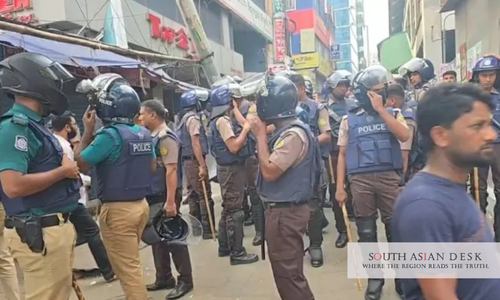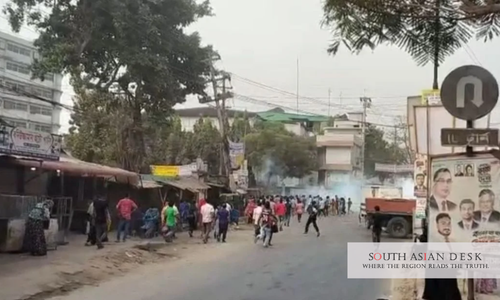
Clashes during garment protests left at least 50 people injured on Wednesday, among them police personnel, workers and passersby, as demonstrations over pay spread across several industrial areas around Dhaka. The violence also forced more than 200 factories in Savar and Ashulia to declare holidays, according to Dhaka Tribune, deepening the disruption to one of Bangladesh’s most important export industries.
Violence in Hemayetpur and Ulail
The worst of the unrest was reported in Savar, where garment workers demanding a minimum monthly wage of Tk30,000 clashed with police. The confrontation began around 8:15am in the Padma Mor area of Hemayetpur and later spread to Ulail, where workers confronted police in front of a factory belonging to the Al-Muslim Group at about 9am.
Workers threw bricks and stones at police, who responded with tear gas shells, sound grenades and rubber bullets. A police vehicle belonging to the officer-in-charge of Savar Model Police Station was set on fire during the violence. Dhaka District Superintendent of Police Shamima Parveen said at least 50 people were injured, and that the officer-in-charge, Saiful Alam, suffered serious injuries. She told reporters that police had detained one person in Hemayetpur in possession of a crude bomb and another in connection with the torching of the police vehicle. Police also estimated that tens of thousands of workers had gathered on both sides of the road near Padma Mor, a figure that underlines the scale of the mobilisation.
Garment Factories Close Across the Industrial Belt
As the confrontations unfolded, many garment factories in Hemayetpur, Ulail and surrounding areas declared a general holiday. Dhaka Tribune reported that more than 200 factories in Savar and Ashulia had shut, although earlier counts published during the day by other outlets were lower, reflecting how quickly the situation was changing. In Ashulia, police said workers from several factories gathered on the Baipail-Abdullahpur road and hurled bricks, prompting officers to fire tear gas and sound grenades.
The closures extend beyond the capital’s western fringe. Industry officials said around 50 factories in Gazipur were shut amid fears of a backlash following the death of an injured worker. Dhaka Tribune reported that the worker, Taufiq Sheikh, who had been hurt during unrest in Gazipur, died at a hospital in Uttara on Tuesday while undergoing treatment.
Protests Spread Beyond Savar
The unrest has continued since Monday, with workers staging demonstrations and blocking roads in Mirpur, Gazipur, Savar, Ashulia and Narayanganj. In Narayanganj, garment workers from several factories in Fatullah took to the streets for the third consecutive day on Wednesday. Police fired tear gas shells and sound grenades to disperse them after a series of chases and counter-chases, and five people were detained.
Tuesday’s protests had also ended in running battles with police, leaving around 10 officers injured and four workers detained, according to Dhaka Tribune. In Mirpur, where police have been on high alert, the situation was calmer on Wednesday, with traffic moving normally.
Security Response and the Wage Question
The authorities have strengthened their response. Reports citing the state news agency BSS said 24 platoons of the Border Guard Bangladesh had been positioned in the industrial belts around Dhaka, covering Savar, Ashulia, Gazipur and Narayanganj, and that the force had set up a monitoring centre at its Pilkhana headquarters using drones and body-worn cameras.
At the heart of the dispute is the gap between current pay and workers’ demands. The Associated Press and other outlets have reported that the government has formed a six-member wage board to review wages, though workers have continued to protest while it works. Reports differ on the timing of any new wage structure, with some pointing to January and others suggesting it could be brought forward to December 1.
Clashes During Garment Protests: A Test for the Industry and the Government
The events of Wednesday show how quickly demonstrations over wages can turn violent and halt production. The garment sector is a mainstay of Bangladesh’s economy, and prolonged closures of factories carry costs for owners, buyers and the workers who depend on daily earnings.
With police and paramilitary forces deployed and workers still pressing for a minimum monthly wage of Tk30,000, the coming days will show whether talks and the promised wage review can restore calm. For now, the clashes during garment protests have underlined how much depends on a credible and timely resolution of the pay dispute.
Follow SouthAsianDesk on X, Instagram and Facebook for insights on business and current affairs from across South Asia.