Imported fruit prices in Bangladesh have risen to levels that place staples such as sweet oranges and apples out of reach of many households, with some items selling for as much as seven times their price in neighbouring countries. A report by the Bangladesh Trade and Tariff Commission attributes the gap to heavy duties, inflated customs valuation, cartel-like behaviour among sellers and a policy decision to treat fruit as a luxury product.
The findings, reported by Dhaka Tribune, come as the government seeks to stabilise the market and as consumers face the added burden of rising prices during a period of seasonal illness.
A Wide Gap With Regional Markets
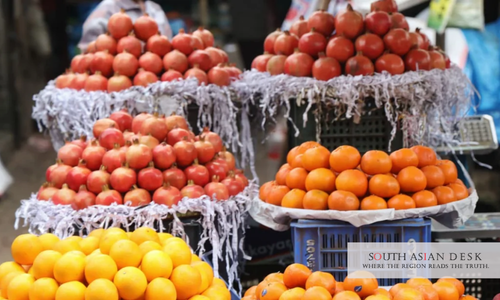
The disparity is most visible in the sweet orange, known locally as malta. In Dhaka’s markets, one kilogram currently sells for between Tk520 and Tk550. During the same period, the fruit sells for Tk100 to Tk160 in India, Tk80 to Tk130 in Pakistan, Tk130 to Tk180 in Nepal and Tk300 to Tk400 in Sri Lanka.
The pattern extends beyond a single fruit. According to the commission’s report, apples sell for Tk350 to Tk450 per kilogram in the domestic market. In India the price is only Tk220, in Pakistan Tk170 and in Nepal Tk240, while in Sri Lanka it reaches a maximum of Tk450. The report observed a similar pattern in the prices of oranges, grapes and dates.
Why Imported Fruit Prices in Bangladesh Have Surged
The commission identifies several overlapping causes. High customs duties and the practice of valuing consignments above the actual booking prices in the international market are described as central factors. The report also points to the behaviour of sellers, noting that a limited group of importers handles these shipments and that the wider market remains dependent on them.
There is also a widespread tendency among importers, wholesalers and retailers to pursue excessive profit margins, the report states. Together, these conditions have made foreign fruit, once regarded as an essential part of the diet for patients, a heavy financial burden for ordinary consumers.
The Classification as Luxury Goods
A policy decision made roughly two years ago lies at the heart of the problem. In early September 2024, a circular from the Policy and Regulation Department of Bangladesh Bank categorised these fruits as luxury goods. The circular also required imports to be conducted with a 100 per cent margin requirement, with the stated aim of protecting the domestic fruit market. From that point, prices began to rise unchecked.
The tax burden that followed is considerable. The commission states that import duties on these fruits currently range from 96.10 per cent to 121.78 per cent. These charges combine customs duty, supplementary duty, value added tax, advance income tax, regulatory duty and advance tax, meaning that almost every category of levy applies to fruit imports.
Bangladesh Bank partly reversed course in the middle of last month, issuing a circular that waived the 100 per cent margin requirement for fruit importers in view of urgent public health needs. The heavy tariff rates, however, remain in force.
Recommendations From the Commission
To address the situation, the commission has proposed rationalising the tariff structure. Its central recommendation is that fresh fruit and dates be removed from the list of luxury goods and reclassified as essential commodities, with regulatory and supplementary duties withdrawn.
It also advises that customs valuation be assessed in line with international market rates and that clearance be expedited through a Green Channel, given how quickly fresh fruit perishes. Further suggestions include easing letter of credit facilities for small and medium traders and expanding cold storage coverage.
Traders, Consumers and the Government Respond
On Saturday, October 3, Commerce Minister Khondokar Abdul Muqtadir held a meeting with traders and representatives of relevant government agencies to secure adequate supply and steady prices. Expressing dissatisfaction, he asked fruit traders to explain how the retail price of a kilogram of sweet oranges reaches Tk520 once import costs, duties, taxes and other expenses are accounted for.
Traders cited supply shortages, pointing to high duties, transport costs, shipping and port complications, and losses from earlier shipments, which led many to reduce sweet orange imports. A leader of the Bangladesh Fresh Fruits Importers Association told Dhaka Tribune that the government’s calculations exist only on paper, adding that importers face real losses and that excessive profit-seeking among wholesalers and retailers has gone uncontrolled for want of proper monitoring.
Consumer representatives offered a different view. SM Nazer Hossain, vice president of the Consumers Association of Bangladesh, said some traders exploit dengue outbreaks to create artificial shortages and raise prices, a recurring seasonal pattern. He noted that although the government reduced duties on fresh fruit imports as recently as March, prices rose rather than fell, and he urged the National Board of Revenue and other agencies to enforce strict oversight.
The competing explanations leave the question of responsibility unresolved. What the data make plain, however, is that imported fruit prices in Bangladesh remain well above regional norms, and that lasting relief will depend on both tax reform and effective market supervision.
Follow SouthAsianDesk on X, Instagram and Facebook for insights on business and current affairs from across South Asia.
Read More: