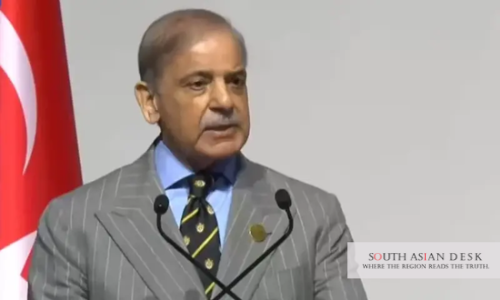
Pakistan climate finance emerged as a central issue at the 31st United Nations Climate Change Conference (COP31) as Prime Minister Shehbaz Sharif called on the international community to provide grant-based financial assistance and significantly increase funding for climate resilience and adaptation. Addressing world leaders in Antalya, Türkiye, on Thursday, November 12, the prime minister stressed that developing countries facing the consequences of climate change require timely financial support that does not further increase their debt burdens.
Speaking at the COP31 Leaders’ Summit, Shehbaz argued that national efforts to address climate change must be accompanied by a fair and coordinated international response. He emphasised that countries with limited contributions to global greenhouse gas emissions were increasingly bearing the consequences of environmental degradation, extreme weather events and climate-related disasters.
The prime minister called for grant-based climate finance, including public-private partnerships, alongside a substantial expansion of resilience and adaptation funds. He described these resources as essential survival funds, particularly for developing economies struggling to recover from increasingly destructive climate events.
COP31 Climate Summit Highlights Demand for Climate Resilience Funding
The prime minister’s address placed particular emphasis on the financial difficulties confronting climate-vulnerable countries. While international climate commitments frequently focus on reducing emissions and transitioning towards cleaner energy, Shehbaz maintained that adaptation and disaster resilience must receive comparable attention.
For developing countries, access to affordable and predictable climate financing remains a significant challenge. Loans, although capable of supporting large-scale infrastructure and development projects, can increase the financial pressure on governments already struggling with economic instability. Grant-based climate finance offers an alternative by allowing vulnerable countries to invest in disaster preparedness, infrastructure protection and environmental adaptation without assuming additional repayment obligations.
Shehbaz’s remarks also highlighted the importance of public-private partnerships in mobilising resources for climate action. Greater cooperation between governments, international financial institutions and private investors could help expand the availability of funding for renewable energy, climate-resilient infrastructure and sustainable development initiatives.
The demand for increased adaptation funding reflects a broader concern among developing nations that international climate finance has not sufficiently addressed the immediate consequences of global warming. For countries facing recurring floods, heatwaves and water shortages, resilience funding is necessary not only for long-term environmental protection but also for safeguarding livelihoods and economic stability.
Pakistan’s Climate Crisis and the Human Cost of Extreme Weather
Recalling Pakistan’s experience with climate-related disasters, the prime minister referred to the devastating floods of 2022, which caused widespread destruction, displaced millions and resulted in economic losses exceeding $30 billion. More than 1,700 people lost their lives during the catastrophe, demonstrating the scale of the country’s vulnerability to extreme weather events.
He also recalled the August 2025 flash floods in Buner, Khyber Pakhtunkhwa, describing the tragic death of a young man who was only days away from his wedding when floodwaters swept through his village. The incident illustrated how climate disasters can destroy individual lives and entire communities within moments.
Shehbaz argued that the consequences of climate change extend far beyond national borders. The countries and communities that have contributed relatively little to global emissions are often among those most severely affected by its consequences. He reiterated that climate change requires collective international action, warning that no country can effectively confront the crisis in isolation.
Pakistan’s experience has repeatedly demonstrated the economic and social consequences of insufficient climate preparedness. Flooding, agricultural losses, damaged infrastructure and displacement place considerable pressure on public finances, making international climate adaptation funding particularly important for developing economies.
Shehbaz Highlights Pakistan’s Clean Energy Transition
Alongside his demands for international assistance, Shehbaz highlighted Pakistan’s domestic efforts to expand renewable energy and reduce its dependence on conventional energy sources.
He stated that clean energy sources accounted for nearly 55 per cent of Pakistan’s energy needs. The country has also been advancing electric mobility and pursuing a target of reducing projected emissions by approximately 50 per cent by 2035.
The prime minister’s remarks followed his participation in a high-level dialogue on clean energy transition earlier in the summit, where he highlighted the rapid expansion of rooftop solar power across Pakistan. According to his address, the country had added nearly 22 gigawatts of rooftop solar capacity in just two years, reflecting growing public demand for affordable and more reliable electricity.
Pakistan’s renewable energy transition nevertheless requires substantial investment in electricity infrastructure, energy storage and technological development. The expansion of solar power must be supported by improvements in electricity grids and storage capacity to ensure that renewable energy can be integrated reliably into the national energy system.
Shehbaz maintained that domestic initiatives alone could not substitute for a fair international response. His argument was that developing countries should not be expected to shoulder the financial costs of climate mitigation and adaptation without adequate support from the international community.
Pakistan Climate Finance: Water Security and International Climate Cooperation
The prime minister also raised concerns about the weaponisation of water, stressing that countries must respect existing water-sharing arrangements and avoid actions that place downstream populations at risk.
He maintained that water-sharing agreements must be honoured in both letter and spirit, highlighting the importance of cooperation over shared natural resources. The issue is particularly significant for countries such as Pakistan, where agriculture, food security and the livelihoods of millions depend on reliable water availability.
Water scarcity, changing rainfall patterns and the melting of glaciers present interconnected challenges for the region. Effective water management and international cooperation are therefore essential components of broader climate resilience strategies.
On the sidelines of COP31, Shehbaz also met several international leaders, including the presidents of Sudan, Finland and Iraq. His meeting with Finnish President Alexander Stubb included discussions on climate resilience, disaster risk reduction and environmental cooperation. The prime minister expressed interest in Finland’s technical expertise in flood forecasting, water management, climate-resilient agriculture, glacier monitoring and early-warning systems.
COP31 Places Climate Finance at the Centre of Global Responsibility
COP31, being held in Antalya from November 9 to 20, has brought together representatives from nearly 200 countries to discuss international climate action and the transition towards a low-carbon future. The conference comes amid continuing concerns over rising global emissions, increasingly destructive climate events and the difficulties of translating international commitments into practical results.
Pakistan’s position at the summit reflects a wider demand among developing countries for a more equitable climate financing framework. While commitments to reduce greenhouse gas emissions remain important, countries already experiencing severe climate impacts require resources to protect communities, rebuild infrastructure and strengthen their capacity to withstand future disasters.
Shehbaz concluded his address by urging world leaders to measure the success of climate negotiations through tangible outcomes rather than declarations and promises. His message was that international solidarity must translate into financial assistance, effective cooperation and sustained action.
For Pakistan, the demand for grant-based climate finance is closely connected to its economic and environmental priorities. The country must simultaneously invest in renewable energy, strengthen disaster preparedness, protect its water resources and support communities exposed to increasingly unpredictable weather patterns.
Whether the commitments discussed at COP31 translate into meaningful financial assistance will remain a critical test of international climate cooperation. For climate-vulnerable countries, the effectiveness of global climate policy will ultimately depend not only on the promises made at international summits but also on the resources delivered to those facing the greatest risks.
Follow SouthAsianDesk on X, Instagram and Facebook for insights on business and current affairs from across South Asia.
Read More: