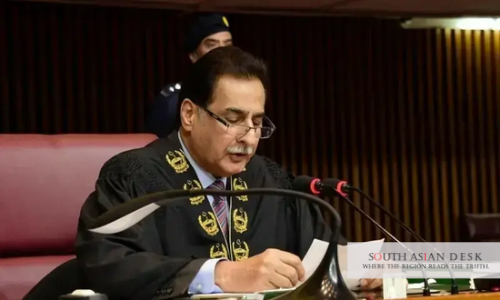
National Assembly speaker Sardar Ayaz Sadiq has declared that no member of parliament will be permitted to use the floor of the National Assembly to speak against Pakistan’s state institutions, judiciary or armed forces. Speaking to journalists in Sahiwal on Wednesday, November 11, he acknowledged that elected representatives had a constitutional right to express their views and raise public concerns in parliament, but maintained that this freedom could not be used to make statements against state institutions.
The remarks came during a media interaction following his visit to the residence of the late former member of the National Assembly, Chaudhry Muhammad Ashraf, where he offered condolences to the deceased politician’s family. His comments have renewed attention on the boundaries of parliamentary freedom of expression and the role of the National Assembly speaker in regulating political debate within the legislature.
Ayaz Sadiq maintained that parliament should remain a forum for democratic participation, where both government and opposition members could contribute to legislative proceedings. However, he drew a distinction between legitimate political criticism and statements directed against the state, judiciary and armed forces, reiterating that the latter would not be permitted on the parliamentary floor.
National Assembly Speaker Defends Restrictions on Parliamentary Debate
During his interaction with journalists, Ayaz Sadiq emphasised that every elected representative had the right to speak in parliament and present the concerns of their constituents. He also rejected the perception that the National Assembly was merely a rubber stamp for government decisions, describing it instead as an active democratic institution responsible for strengthening parliamentary traditions and ensuring political representation.
The speaker stated that the opposition was being provided with adequate opportunities to participate in parliamentary proceedings. He specifically referred to an increase in speaking time during important occasions, explaining that the duration had been extended from eight to thirteen hours to facilitate broader participation and ensure fairness in the House.
He also expressed concern over the limited participation of some opposition lawmakers in parliamentary committees, arguing that elected representatives should make use of these platforms to contribute to policymaking and legislative scrutiny.
Ayaz Sadiq reiterated that he wanted to maintain a non-controversial position as speaker, stressing the importance of treating parliamentary responsibilities independently of political affiliations. His comments reflected his stated intention to preserve parliamentary decorum while allowing elected representatives to perform their legislative functions.
Parliamentary Freedom of Speech and the Role of the Speaker
The speaker’s remarks have brought renewed attention to the relationship between parliamentary privileges and the authority of the presiding officer to regulate proceedings. In Pakistan, parliamentary freedom of expression is an important component of the constitutional framework governing the legislature.
Article 66 of the Constitution of Pakistan provides members of parliament with freedom of speech in the House, subject to the Constitution and the rules regulating parliamentary proceedings. It also provides immunity from court proceedings in respect of anything said or any vote given in parliament, as well as certain protections relating to parliamentary publications.
However, parliamentary freedom of speech operates alongside procedural rules governing conduct within the House. The Rules of Procedure and Conduct of Business in the National Assembly regulate how members participate in debates, including restrictions concerning irrelevant speeches, discussion of sub judice matters and comments on the conduct of judges in the discharge of their judicial duties.
The speaker is responsible for maintaining order and ensuring that proceedings are conducted in accordance with parliamentary rules. This authority gives the presiding officer an important role in determining whether members’ contributions remain within the procedural framework governing debates.
Ayaz Sadiq’s latest remarks nevertheless raise broader questions about how restrictions on parliamentary speech should be defined and applied, particularly when discussions concern state institutions and their role in public affairs. The distinction between criticism of institutional conduct and statements considered contrary to the interests of the state remains an important issue in debates surrounding parliamentary accountability and democratic representation.
Ayaz Sadiq Rejects Claims of Attempts to Remove the Government
Commenting on recent political developments, the National Assembly speaker dismissed claims that efforts were underway to remove the incumbent government. He suggested that such narratives were often promoted by individuals and groups that had failed to obtain public support through the electoral process.
He maintained that democratic institutions should be strengthened through constitutional and parliamentary mechanisms rather than political speculation or actions outside established democratic procedures.
His comments came amid continuing political tensions between the government and opposition parties, particularly over the role of parliament, the conduct of political opposition and the relationship between elected representatives and state institutions.
The opposition has repeatedly raised concerns over the political environment and the space available for dissent within parliamentary proceedings. Meanwhile, government representatives have emphasised the importance of maintaining institutional stability and ensuring that political disagreements remain within constitutional boundaries.
The speaker’s rejection of claims about a possible change in government therefore formed part of a wider discussion about political stability and the functioning of democratic institutions in Pakistan.
Opposition Participation and Parliamentary Committees
Another significant aspect of Ayaz Sadiq’s remarks concerned the participation of opposition lawmakers in parliamentary committees. He argued that opposition members should take advantage of the opportunities available to them rather than limit their involvement to speeches during National Assembly sessions.
Parliamentary committees play an important role in examining legislation, scrutinising government policies and providing lawmakers with opportunities to investigate matters in greater detail. They also allow members from different political parties to participate in legislative discussions beyond the proceedings of the main House.
The speaker’s reference to increased speaking time was intended to demonstrate that opposition members were being given opportunities to express their positions. However, meaningful parliamentary participation also depends on the ability of lawmakers to raise questions, scrutinise government decisions and contribute to the development of legislation.
The effectiveness of these mechanisms is particularly important in a parliamentary democracy, where opposition parties perform an oversight function and provide alternative perspectives on government policy.
Ayaz Sadiq urged opposition lawmakers to make greater use of committee proceedings, suggesting that their involvement would strengthen parliamentary institutions and improve the quality of legislative work.
Debate Over State Institutions and Democratic Accountability Continues
The latest statement by the National Assembly speaker reflects an ongoing debate in Pakistan about the limits of political expression within parliament and the relationship between democratic institutions and other state institutions.
While the speaker has emphasised the importance of preventing statements against the state, judiciary and armed forces, parliamentary proceedings also serve as an important platform for holding public institutions accountable. The ability of elected representatives to discuss governance, public policy and institutional conduct remains central to the legislature’s representative and oversight functions.
Maintaining an appropriate balance between parliamentary order and freedom of expression is therefore an important responsibility for the speaker. The application of parliamentary rules must allow meaningful political debate while ensuring that proceedings remain consistent with constitutional requirements and established parliamentary procedures.
Ayaz Sadiq concluded his interaction by reiterating his commitment to maintaining a non-controversial position and strengthening democratic traditions. He also paid tribute to the late Chaudhry Muhammad Ashraf, recalling his association with the Pakistan Muslim League-Nawaz leadership during difficult political periods.
As political disagreements continue in Pakistan, the speaker’s remarks have once again placed parliamentary conduct, opposition participation and the boundaries of freedom of speech at the centre of public discussion. The extent to which these principles can be balanced will remain significant for the functioning and credibility of the country’s democratic institutions.
Follow SouthAsianDesk on X, Instagram and Facebook for insights on business and current affairs from across South Asia.
Read More: