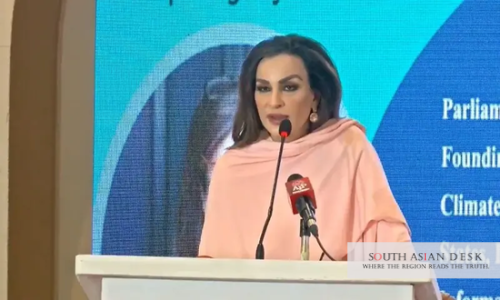
Climate justice, rather than another round of declarations, must be the outcome of COP31 in Antalya, Senator Sherry Rehman said on Friday. In a statement issued in Islamabad, she called on the conference to deliver a credible, accessible and equitable climate financing framework, warning that Pakistan and other climate-vulnerable countries are being pushed into a dangerous cycle of disasters, debt and declining development opportunities.
Appreciation for Turkiye’s Presidency of COP31
Senator Rehman expressed appreciation for Turkiye’s hosting of the conference and its Presidency of the global climate summit. She recognised the role Turkiye has played in bringing the international community together at a time of growing geopolitical divisions and escalating climate emergencies.
Describing Turkiye as a close friend and longstanding partner of Pakistan, she said Ankara understands the human and economic costs of climate disasters. In her view, the Presidency offers an important opportunity to bridge divisions between developed and developing countries and to restore confidence in multilateral climate action. She expressed the hope that the Antalya conference would be remembered not merely for renewed pledges, but for turning climate solidarity into concrete financial commitments and meaningful outcomes for vulnerable nations.
Climate Justice and the Question of Climate Financing
Referring to the address by the UN Secretary-General at the COP31 Leaders’ Summit, in which he warned that fossil fuels must go the way of the dinosaurs, Senator Rehman stressed that the world can no longer afford the contradiction between climate commitments and continued support for fossil fuels.
She argued that governments cannot keep subsidising the industries that drive the climate crisis while pleading scarcity of resources whenever vulnerable countries request climate financing. Global fossil fuel subsidies, she said, are estimated at approximately $7 trillion. She described this as an extraordinary misallocation of resources at a time when countries on the climate frontlines are struggling to pay for basic adaptation, resilience and recovery. The real question, in her words, is not whether the world has the resources, but whether it has the political will to redirect them.
For Pakistan, the argument rests on fairness as much as finance. Senator Rehman said the country is not seeking charity. It is demanding climate justice, financial accountability and a fair international system.
A Warming Trajectory That Threatens Vulnerable Economies
The senator also warned that the global temperature trajectory is becoming increasingly alarming, with the 1.5 degrees centigrade goal slipping further out of reach. She cited Climate Action Tracker, which estimates that current policies put the world on course for roughly 2.7 degrees centigrade of warming by the end of the century, up from its previous estimate of 2.6 degrees centigrade.
In her assessment, the 1.5 degrees centigrade threshold is no longer alive. A trajectory of 2.7 degrees centigrade, she cautioned, would have devastating consequences for countries such as Pakistan, where climate extremes are already undermining livelihoods, food security, water availability and economic stability. She said the cost of inaction would be measured in lost lives, displaced communities and development reversed by decades.
Pakistan’s Experience of Recurring Climate Disasters
Senator Rehman pointed to Pakistan’s own record to illustrate the scale of the problem. She recalled that the devastating floods of 2022 affected 33 million people and caused approximately $30 billion in damages and losses. Agricultural losses from the floods of 2025 alone have been estimated at $1 billion.
These events, she said, are not isolated disasters. She described them as a recurring assault on the country’s economy, food security, infrastructure and development prospects, and she maintained that such repeated shocks make access to predictable and fair financing a necessity rather than a favour.
What Pakistan Expects From the Antalya Conference
The senator’s message to negotiators in Antalya was direct. Pledges that are not matched by delivery, she suggested, do little for communities that have already lost homes, crops and livelihoods. A financing framework that is credible, accessible and equitable would, in her view, allow climate-vulnerable countries to plan for adaptation and recovery without sinking deeper into debt.
As COP31 continues, her intervention adds to a growing chorus of voices from the developing world demanding that the summit move from rhetoric to results. Whether delegates are prepared to redirect public money from fossil fuel subsidies toward adaptation and resilience remains the central test of the conference, and, as Senator Rehman framed it, of the international community’s commitment to climate justice.
Follow SouthAsianDesk on X, Instagram and Facebook for insights on business and current affairs from across South Asia.