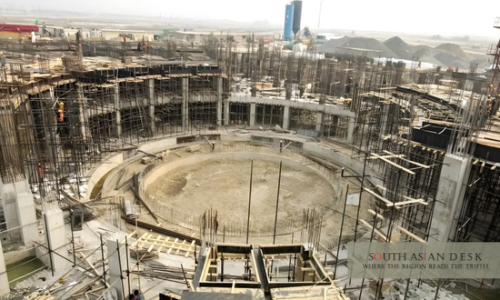
The Punjab Climate Observatory will be a milestone in the province’s efforts to address climate change, Chief Minister Maryam Nawaz Sharif said on Sunday. Describing the under-construction facility as the first project of its kind in Pakistan, she said the centre would monitor air quality, water, soil and weather conditions in real time, supported by a climate intelligence system powered by artificial intelligence.
The chief minister made the remarks in a post on the social media platform X, where a photograph shared on Nov 15 showed construction in progress at the site in Lahore.
How the Punjab Climate Observatory Took Shape
The project was approved in May 2025 after a review of its feasibility plan, which covered budgetary requirements, equipment procurement and land acquisition. The University of Engineering and Technology (UET), Lahore, had also submitted a report on the technical aspects of the facility. In June, the chief minister directed the authorities to expedite work on the project, and construction is now under way.
The sequence suggests a project that has moved through the usual stages of planning and technical review before reaching the building phase. The government has not yet announced a date for completion in the statement reported on Sunday.
Strengthening Early Warning Systems and Flood Prediction
According to the chief minister, the observatory would strengthen weather forecasting, early warning systems and flood prediction. Together, these capabilities are intended to improve the province’s preparedness for climate-related disasters.
Punjab has faced repeated pressure from floods and extreme weather in recent years, which has made reliable forecasting and timely alerts a pressing administrative concern. By combining continuous environmental monitoring with an artificial intelligence-based analytical system, the observatory is expected to give authorities a clearer picture of changing conditions as they develop. Real-time data on air, water, soil and weather could also help officials respond more quickly when conditions deteriorate.
A Hub for Research and Young Climate Scientists
Beyond forecasting, the facility will house environmental data resources and research laboratories. Maryam Nawaz said these would provide young climate scientists with opportunities for learning and research, positioning the centre as an academic as well as an operational institution.
The chief minister also expressed the hope that the project would bring international scientific cooperation and research partnerships under one roof. She said the observatory would support evidence-based policymaking and public awareness, suggesting that the data it produces is meant to inform both government decisions and public understanding of environmental risks.
Wider Goals for Resilience and Resource Management
In her statement, the chief minister said the Punjab Climate Observatory would contribute to disaster resilience, water conservation, sustainable resource management, climate-resilient agriculture and forest protection. These areas are closely tied to the province’s economy and to the livelihoods of its residents, particularly in farming communities that depend heavily on stable weather and reliable water supplies.
She added that the ambition behind the project is to empower the next generation of climate scientists and to position Punjab as a regional leader and an international partner in climate innovation. The stated aim is to protect the environment, communities and future generations from the effects of a changing climate.
What to Watch as the Project Advances
The announcement places the observatory among the more concrete climate initiatives to emerge from the provincial government, as it involves physical infrastructure, a defined technical role and a link with an academic institution. Several questions will matter as the project nears completion. These include how the observatory will share its data with other agencies, how its forecasts will be integrated into existing disaster management arrangements, and how quickly the planned research partnerships can be established.
For now, the Punjab Climate Observatory remains under construction, and its performance will only become clear once the monitoring systems are operational. If it delivers on the commitments outlined by the chief minister, the facility could give the province a stronger scientific basis for managing the risks posed by climate change and for planning its response in the years ahead.
Follow SouthAsianDesk on X, Instagram and Facebook for insights on business and current affairs from across South Asia.
Read More: