The Gopalganj bomb attacks have led to a criminal case against leaders and activists of the banned Awami League and its affiliated organisations, according to Dhaka Tribune. The case, filed under the Explosives Act, names 28 people and accuses another 20 to 25 unidentified individuals, bringing the total number of accused to as many as 53. The allegations remain unproven, and the case is at an early stage.
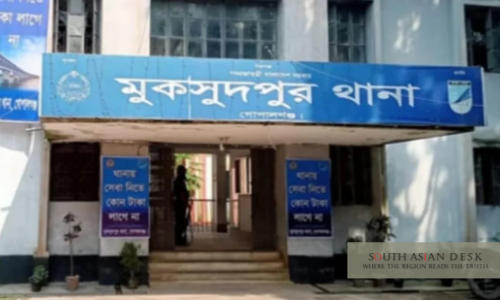
Case Filed at Muksudpur Police Station
The case was lodged at Muksudpur Police Station on Saturday afternoon by Abdul Qaiyum Sharif, office secretary of the Muksudpur upazila unit of the Bangladesh Nationalist Party (BNP). It alleges that the accused carried out crude bomb attacks in the area with the intention of creating panic among the public.
The complaint was filed under the Explosives Act, a law that deals with offences involving explosive substances. The accused are described in the report as leaders and activists of the Awami League and its affiliated organisations, whose activities are currently banned in Bangladesh.
What the Case Statement Alleges
According to the case statement, the complainant was returning home from Muksudpur Sadar at around 10pm on November 9 when the alleged incident took place. The statement says that Awami League leaders and activists exploded crude bombs in front of Muksudpur Government College. The purpose, it claims, was to create panic as part of a nationwide programme announced by the party.
The statement further alleges that a second explosion followed later. When another police patrol team approached the area, the accused allegedly detonated another crude bomb near the entrance to Dasherhat Road, on the opposite side of a mill, before fleeing the scene. No details were reported in the available coverage about casualties or damage caused by the explosions.
Wider Unrest Across Gopalganj
The Muksudpur case is one of several legal actions linked to recent tension in the district. Dhaka Tribune separately reported that a case was filed under the Anti-Terrorism Act, 2009, over vandalism and an arson attack on a police vehicle. That case names 2,224 accused, including 224 identified individuals and 2,000 unidentified people. Police and local sources told the newspaper that leaders and activists of the Awami League and its affiliated organisations carried out widespread violence across Gopalganj on November 10.
Local sources also said that Awami League supporters staged processions and rallies across Gopalganj on Sunday, carrying traditional weapons including machetes, Chinese axes, spears and sticks. The newspaper has additionally reported attacks on the properties of BNP leaders in the district, as well as the transfer of the deputy commissioner and the superintendent of police. These accounts reflect a period of heightened political tension in the area, although the specific circumstances behind each incident are still being established.
Legal Position and Next Steps
A case filed under the Explosives Act sets in motion a police investigation, during which officers typically collect evidence, record statements and identify suspects. As the case also accuses 20 to 25 unidentified people, the final number of those formally charged may change once the investigation progresses. Inclusion in a first information report does not establish guilt, and any accused person has the right to a fair trial.
The Gopalganj bomb attacks case also reflects the broader legal environment surrounding the Awami League, whose activities are banned, and which police across several districts have been accused of targeting with cases over alleged sabotage and violence. Authorities have so far presented these cases as part of efforts to prevent disorder, while the party has previously rejected similar allegations elsewhere as politically motivated.
Outlook for the Investigation
Much will depend on how quickly police can identify the unnamed suspects and whether physical evidence from the two reported blast sites is presented. The location of the first alleged explosion, outside a government college, and the reported involvement of a police patrol in the second incident are likely to draw close attention to how the inquiry is conducted.
For residents of Muksudpur and the wider district, the immediate concern is the restoration of calm. As the investigation continues, the outcome of the Gopalganj bomb attacks case will be watched as an indicator of how authorities handle political violence in the area and how the courts treat the growing number of cases filed against banned party activists.
Follow SouthAsianDesk on X, Instagram and Facebook for insights on business and current affairs from across South Asia.
Read More: