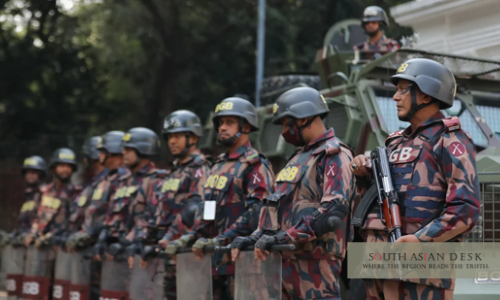
The BGB deployment in Gopalganj has been expanded to a total of 10 platoons, as authorities seek to maintain law and order in the district following a day of unrest. Border Guard Bangladesh (BGB) personnel have been stationed at key locations across the district, supported by armoured personnel carriers (APCs), to ensure public security and to respond quickly if the situation deteriorates.
Ten Platoons and APCs Stationed at Key Locations
According to Dhaka Tribune, the 10 platoons have been placed in important areas of Gopalganj district. The APCs have been deployed to deal with any untoward situation and to carry out riot control operations if necessary. A statement issued by BGB headquarters on Monday, as reported by bdnews24, said that four more platoons had been added to an initial deployment of six, bringing the total to 10.
The administration also deployed the BGB alongside other law enforcement agencies on Monday as part of what it described as increased vigilance. The reports available do not specify the exact locations where each platoon has been stationed.
Body-Worn Cameras and Headquarters Monitoring
To keep a close watch on how the force operates, body-worn cameras have been attached to the maximum possible number of deployed personnel. According to the BGB, this allows the activities of its members to be monitored and coordinated directly from the field. The BGB headquarters has set up a monitoring cell that is closely overseeing these activities and the wider security situation, so that prompt action can be taken if any untoward incident occurs.
BGB members have also been instructed to carry out their responsibilities with professionalism, discipline, restraint and patience, according to Daily Sun. The force has been told to ensure that people’s normal movement and daily activities remain uninterrupted.
The Legal Basis Under In Aid to Civil Power
The personnel have been deployed under the In Aid to Civil Power framework, following a directive from the Ministry of Home Affairs. Under this arrangement, BGB members are performing duties at key locations in line with the requests and advice of the district magistrate. In practice, this means the force is supporting the civil administration rather than acting independently.
The BGB is a paramilitary force that operates under the Ministry of Home Affairs and is mainly responsible for protecting and monitoring the country’s land borders. It can also be called upon to assist the administration in maintaining internal law and order when required, which is the role it has been assigned in Gopalganj.
BGB Deployment in Gopalganj: What Led to the Deployment
The deployment follows a period of tension in Gopalganj, the ancestral home district of former prime minister Sheikh Hasina. Dhaka Tribune reported that leaders and activists of the Awami League and its affiliated organisations, whose activities are banned, staged a major show of force in the district on Sunday. The newspaper said they marched openly with sharp weapons, vandalised a police vehicle and public installations, and set fire to the July Memorial. The government subsequently transferred the district’s deputy commissioner and superintendent of police.
The unrest followed earlier violence in the district. Police and local sources have said that widespread violence took place across Gopalganj on November 10, and a case under the Anti-Terrorism Act was filed over the vandalism and arson attack on a police vehicle. That case names 2,224 accused, including 224 identified individuals and 2,000 unidentified people. Separately, a case under the Explosives Act has been filed in connection with alleged crude bomb attacks in Muksudpur. The allegations in these cases remain unproven.
Outlook for Security in the District
The scale of the BGB deployment in Gopalganj reflects the seriousness with which the government is treating the situation. The addition of four platoons within a short period suggests that authorities judged the initial force of six to be insufficient, though no official explanation of that decision was included in the reports.
Much will now depend on whether the heightened presence is enough to prevent further clashes and whether the administration can restore normal public life. The use of body cameras and a central monitoring cell may help to ensure accountability in how the force conducts itself, which is likely to attract attention given the sensitivity of the political situation in the district. For residents, the immediate priority is a return to calm, and officials have so far given no indication of how long the BGB will remain on duty.
Follow SouthAsianDesk on X, Instagram and Facebook for insights on business and current affairs from across South Asia.