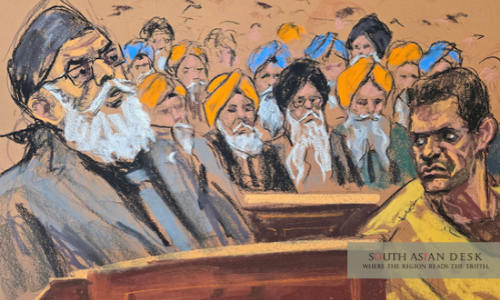
The Nikhil Gupta sentencing concluded on Friday in a Manhattan federal court, where an Indian man received a prison term of more than 19 years for orchestrating a failed plot to kill a Sikh separatist in New York City. US District Judge Victor Marrero handed down a sentence of 235 months, or 19 years and seven months. US and Canadian authorities have linked the case to what they describe as a broader effort to target Indian dissidents, an allegation India has denied.
Details of the Nikhil Gupta Sentencing
Gupta, 55, pleaded guilty in February to murder-for-hire, conspiracy to commit murder-for-hire and conspiracy to commit money laundering. Prosecutors with the Manhattan US Attorney’s office had recommended a sentence of about 24 years, so the term imposed by the court was shorter than what the government sought.
According to court papers, Gupta arranged a murder-for-hire plot with an Indian government official, Vikash Yadav, to have $15,000 in cash delivered to a man they believed was a hitman. The supposed hitman was in fact an undercover US law enforcement officer, which allowed American authorities to disrupt the plan before any attack took place. The US Justice Department has said that Yadav recruited Gupta in May 2023 and directed the scheme from India.
The Target: Gurpatwant Singh Pannun
The intended victim was Gurpatwant Singh Pannun, a dual US-Canadian citizen and a lawyer with the group Sikhs for Justice in New York. Pannun has long advocated for a sovereign Sikh state in northern India, a position that Indian authorities have strongly opposed. Prosecutors said the plot was aimed at silencing him because of his political views.
Speaking in court, prosecutor Ashley Nicolas said the case went to the heart of American values and stressed that violence to silence voices in the United States would never be tolerated. Pannun also addressed the court. He said he was grateful to the United States for prosecuting Gupta and that he would continue to campaign for Sikh self-determination, which he described as his lifetime goal for his people and for Punjab, his homeland.
Gupta Expresses Regret in Court
Before the sentence was imposed, Gupta addressed the court and said he regretted straying from the nonviolent example set by Mahatma Gandhi. He apologised to Pannun, to the communities he said he had harmed and to his own family. His guilty plea in February had already ended the prospect of a trial, leaving the sentence as the final major step in his case.
India’s Position and the Fate of Vikash Yadav
The case has tested relations between Washington and New Delhi. India’s government has dissociated itself from any plot against Pannun, saying such an act would be against government policy. Its denial has stood alongside the findings of US prosecutors, who allege that an Indian government official was directly involved.
Yadav is also charged in the case but is not in US custody, and it is unclear whether he has hired a defence lawyer. US authorities have described him as an Indian government employee, and the Justice Department has said he worked for India’s Cabinet Secretariat. His continued absence from US custody means that the legal proceedings against the alleged organiser of the scheme remain unresolved, even as the man who carried out its arrangements has now been sentenced.
Wider Implications of the Case
The discovery of alleged assassination plots against Sikh separatists in the United States and Canada has put pressure on India’s relations with both countries. US officials have previously said they expected India to cooperate with the investigation, while Indian authorities have maintained that they are not responsible for the plan.
The outcome of the Nikhil Gupta sentencing marks the most significant conviction so far in the American case, yet it leaves several questions open. The role of Indian officials remains a matter of allegation rather than a court finding against any government, and Yadav has not faced trial. For Pannun and for the Sikh diaspora communities in North America, the sentence is a notable moment in a long-running dispute. For diplomats in Washington and New Delhi, it is a reminder that the fallout from the murder-for-hire plot is likely to remain part of the bilateral conversation for some time.
Follow SouthAsianDesk on X, Instagram and Facebook for insights on business and current affairs from across South Asia.
Read More: