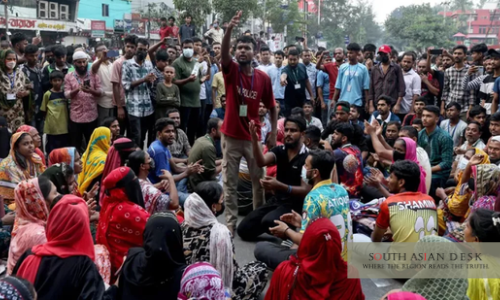
The Minimum Wage Board meeting scheduled for Monday is expected to mark a decisive stage in efforts to set a new pay structure for ready-made garment (RMG) workers in Bangladesh, as factory owners prepare to submit their long-awaited wage proposal. According to Dhaka Tribune, the third sitting of the board will review recommendations before it determines a new wage structure for the sector.
Minimum Wage Board Meeting: What the Board Will Consider on Monday
The meeting is due to begin at 11:30am in Dhaka and will be presided over by Board Chairman and Judge Syed Azad Subhani. The board is expected to review the opinions of worker and employer representatives, along with related issues, as it moves towards drafting its minimum wage recommendations. At its first meeting on November 4, the board instructed both sides to prepare and submit their respective wage structure proposals at the next sitting. Reports indicate that the agenda for the third meeting includes the submission of a written proposal by the owners’ representatives, followed by discussion on formulating recommendations for all categories of workers and employees in the sector.
The government formed the six-member Minimum Wage Board on November 1, with Dhaka University Public Administration Professor Dr Mosleh Uddin Ahmed serving as the neutral member. The board includes representatives of owners, workers and the government.
Workers Seek a Steep Increase From Tk12,500
The current minimum monthly wage for RMG workers stands at Tk12,500. That figure was announced in November 2023 and took effect in December of that year, replacing the Tk8,000 rate set in 2018. Workers’ representatives are now seeking a substantial rise. Dhaka Tribune reports that workers want a starting wage of Tk48,000 for the top grade, while other outlets have reported that their representatives tabled a demand of Tk32,000 as the minimum monthly wage during the board’s second meeting. The unrest in the sector began on October 31, when workers initially demanded a minimum monthly wage of Tk30,000.
The gap between the current rate and the workers’ demands underlines the scale of the negotiation that lies ahead. The board’s task is to reconcile these positions with the industry’s view of what it can sustain.
Owners’ Wage Proposal and Annual Adjustment Plan
Leaders of the Bangladesh Garment Manufacturers and Exporters Association (BGMEA) and the Bangladesh Knitwear Manufacturers and Exporters Association (BKMEA) have said that the owners’ wage proposal will be accompanied by a plan for regular wage adjustments linked to a set benchmark. According to The Business Standard, the aim is to replace the periodic and often volatile review process, which takes place every three to five years, with a more predictable system.
The owners have not officially disclosed the figure they intend to propose. BGMEA sources have indicated to the press that a proposal in the range of Tk15,000 to Tk16,000 was under consideration, and BGMEA leaders speaking anonymously earlier said that a minimum wage above Tk14,000 would be unsustainable for the industry. These figures have not been confirmed by the association, and the actual proposal will become clear only once it is presented to the board.
Timeline and Pressure on the Garment Industry
The Monday sitting follows an earlier delay. The third meeting had been scheduled for November 16 but was postponed after a workers’ representative fell ill and was admitted to hospital. Owners’ associations urged the authorities to announce a new date quickly, noting that December 1 had already been set as the effective date of the new wage structure. Under the arrangement agreed at the first meeting, workers would receive the increased pay in January.
Pressure on all sides has been considerable. Demonstrations were reported in Ashulia, Savar and Gazipur, and the BGMEA said that some factories had been closed or had halted production during the unrest. Industry owners favour an early announcement of the new wage so that stability can return to the garment industry, and several sources have said that the board aims to finalise a proposal through negotiations between workers and owners within the week.
What Happens After the Meeting
Much will depend on how far the owners’ proposal narrows the distance from the workers’ demands. If the two sides can agree on a figure, the board can finalise its recommendation in time for the December 1 effective date. If not, negotiations may continue beyond Monday, prolonging uncertainty for factories and for the workers whose wages are at stake. The outcome of the Minimum Wage Board meeting will therefore be closely watched by workers, employers and the government alike.
Follow SouthAsianDesk on X, Instagram and Facebook for insights on business and current affairs from across South Asia.