

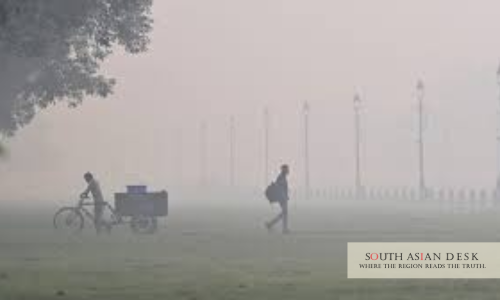
Delhi air pollution quality improved slightly on Sunday, November 30, 2025, with the average Air Quality Index (AQI) dropping to 268 at 9am, according to Central Pollution Control Board (CPCB) data. This marks a decline from Saturday’s 305 but keeps the city in the poor zone. The dip ends a 24-day streak of very poor or worse levels, the second longest since 2019. Civil society organisations, including My Right to Breathe and Warrior Moms, issued a call for a peaceful protest at Jantar Mantar on Wednesday, December 3, starting at noon, to demand stronger action on Delhi air pollution. How? Organisers cite government inaction and the recent withdrawal of Graded Response Action Plan (GRAP) Stage III measures despite ongoing hazards.
The Commission for Air Quality Management (CAQM) revoked GRAP Stage III on November 27, 2025, after AQI levels hovered around 327, shifting to less stringent Stage II curbs. This decision, empowered by a Supreme Court order allowing proactive measures when AQI exceeds 350, has drawn criticism from activists who argue it exposes residents to unnecessary risks. Delhi air pollution affects over 30 million people in the National Capital Region (NCR), contributing to respiratory illnesses and reduced visibility that disrupts daily life. Why now? Winter inversion traps emissions from vehicles, industries, and stubble burning, amplifying the crisis across northern India.
Delhi AQI Poor Zone Persists Despite Marginal Relief
Data from the CPCB shows Delhi’s overall AQI at 268 on Sunday morning, a 12 per cent improvement from the previous day. Stations in central Delhi recorded the worst readings: Shadipur at 331, RK Puram at 303, and Jahangirpuri at 323, all in the very poor category (301-400). Nehru Nagar logged 316, Dilshad Garden 304, Anand Vihar 282, and Patparganj 280. NCR areas fared slightly better, with Faridabad at 174 (moderate), Noida at 266 (poor), and Ghaziabad at 260 (poor).
The AQI measures pollutants like PM2.5 and PM10, fine particles that penetrate lungs and bloodstream. PM2.5 levels averaged 150 micrograms per cubic metre in Delhi, far above the World Health Organisation’s daily safe limit of 15. This places the city firmly in the Delhi AQI poor zone, where prolonged exposure risks asthma attacks, bronchitis, and cardiovascular issues. The CAQM’s November 2025 press release on GRAP implementation noted that calm winds and low temperatures exacerbated trapping of pollutants, with meteorological factors playing a key role in the episode.
Official data underscores the severity. The Delhi government’s Air Pollution Mitigation Plan 2025, released on June 16, outlines dust control from roads and open areas, including water sprinkling and innovation challenges for startups. Yet, enforcement gaps persist. The Department of Environment’s ambient air quality report highlights that the entire National Capital Territory is a pollution control area under the Air Act, with rising PM2.5, PM10, and NO2 levels drawing court scrutiny. A Public Information Bureau (PIB) update from November 2025 reinforces that CAQM monitors daily, but critics point to delays in invoking stricter stages.
Health experts warn of immediate impacts. Hospitals in Delhi reported a 20 per cent rise in respiratory cases last week, per routine surveillance shared in CAQM briefings. Children and the elderly face heightened vulnerability, with low ventilation coefficients slowing pollutant dispersion. The slight dip offers temporary respite, but forecasts predict stagnation until mid-December without rain.
Delhi Smog Protest Gains Momentum at Jantar Mantar
Frustration over Delhi air pollution boiled over into organised action. Civil society groups announced the December 3 gathering via a joint statement on Saturday, November 29. “Delhi is still choking on hazardous air. Even band-aid measures like GRAP have been withdrawn,” the statement reads. “Many citizen groups of Delhi have now called for a peaceful protest at Jantar Mantar on Wednesday, December 3, 12pm onwards! Every concerned citizen, every caring mother, youth, and elders should join.”
The event, supported by the Congress-backed National Students’ Union of India (NSUI), targets Jantar Mantar air pollution as a symbol of civic demand. NSUI national president Varun Choudhary affirmed participation: “I stand with the call by the citizens’ groups of Delhi to protest at Jantar Mantar.” Organisers from My Right to Breathe and Warrior Moms emphasise non-violence, focusing on demands like permanent clean air policies and Ridge forest protection. The Ridge, a critical green lung, faces encroachment that worsens Delhi smog protest narratives.
This follows recent unrest. On November 23, 2025, 15 protesters were detained at India Gate after a demonstration turned tense, with allegations of pepper spray use against police. Another rally on November 9 drew hundreds, highlighting government inaction amid AQI spikes to 500. The Hindu reported the December 3 call on November 29, noting AQI at 305 that day. Such events remain rare in Delhi, where apathy often meets seasonal haze, but rising death tolls, India accounted for 30 per cent of global air pollution fatalities in 2023, per the State of Global Air report, fuel urgency.
CAQM’s response to protests includes a 27-point Stage I action plan invoked earlier in November, covering road sweeping and coal bans. A PIB release on November 25 detailed GRAP Stage III reimposition when AQI hit severe levels, banning non-essential construction and restricting diesel buses. Schools up to Class 5 closed briefly, with 50 per cent office staffing advised. Yet, rollback to Stage II on November 27, as AQI fell to 327, sparked backlash. DD News reported on November 16 that AQI surged to 341, entering very poor territory due to smoggy conditions.
Background: A Recurring Crisis in Northern India
Delhi air pollution traces to multi-source emissions: 40 per cent from vehicles, 20 per cent industries, and seasonal stubble burning in Punjab and Haryana. The 2025 winter episode mirrors 2024, when AQI exceeded 400 for weeks. Supreme Court interventions, including empowering CAQM for AQI over 350, aim to break the cycle. The Delhi Pollution Control Committee (DPCC) runs a WhatsApp helpline (9717593501) for waste burning complaints, part of broader ambient monitoring.
Meteorological data from the India Meteorological Department (IMD) predicts mild rain in early December, potentially aiding dispersion. Historical streaks, like 23 days above 300 until November 29, rank this as the second worst since 2019. NCR-wide efforts, per the mitigation plan, include electric vehicle pushes and dust suppression, but implementation lags.
What’s Next: Eyes on GRAP and Protest Outcomes
The December 3 Jantar Mantar air pollution protest could pressure authorities to reinstate GRAP Stage III if AQI climbs past 350. CAQM monitors hourly, with potential for school closures and bus bans. IMD forecasts stable winds through Tuesday, November 30, keeping Delhi AQI poor zone risks elevated. Residents should limit outdoor time and use masks.
Long-term, the Air Pollution Mitigation Plan 2025 calls for innovation in dust control and stricter enforcement. As northern India braces for peak winter haze, Delhi air pollution demands sustained regional cooperation to avert health emergencies.
Published in SouthAsianDesk, November 30th, 2025
Follow SouthAsianDesk on X, Instagram, and Facebook for insights on business and current affairs from across South Asia.
