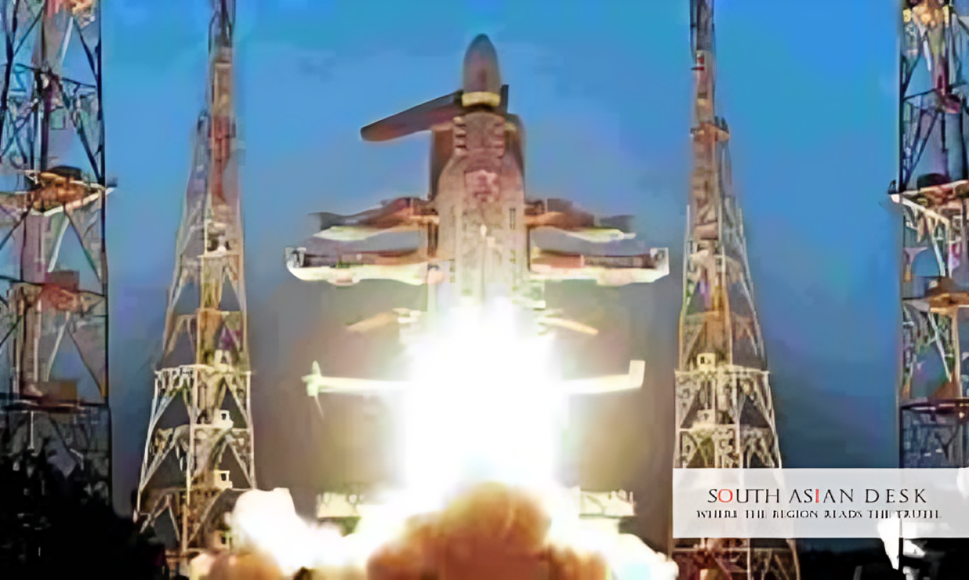
The Indian Space Research Organisation (ISRO) will conduct the ISRO LVM3 launch on Wednesday, December 24, 2025, deploying the BlueBird Block-2 satellite for US firm AST SpaceMobile. The LVM3 M6 mission lifts off at 08:54 IST from Sriharikota, marking the heaviest payload ever carried by this rocket to low Earth orbit. This commercial venture targets direct-to-mobile broadband worldwide.
The launch underscores India’s growing role in global space commerce, particularly for South Asian nations grappling with digital divides. With over 50 mobile operators partnered with AST SpaceMobile, the satellite could enhance connectivity in remote areas of India, Pakistan, Bangladesh and beyond, supporting economic growth and emergency communications.
Details of the LVM3 M6 Mission
The LVM3 M6 mission involves ISRO’s heavy-lift rocket, proven in prior flights like Chandrayaan-2 and Chandrayaan-3. This iteration carries the BlueBird Block-2 satellite, into low Earth orbit. The satellite features a 223 square metre phased array antenna, making it the largest commercial communications platform deployed there.
According to ISRO’s announcement, the launch occurs from the Second Launch Pad at Satish Dhawan Space Centre in Sriharikota. Public viewing is available via an online registration for the gallery. The mission follows the recent LVM3-M5/CMS-03 success on Sunday, November 2, 2025.
AST SpaceMobile describes the BlueBird Block-2 satellite as part of its constellation for space-based cellular broadband. It enables 4G and 5G services directly to standard smartphones, without need for specialised hardware. The firm aims to eliminate gaps for nearly six billion mobile subscribers globally.
Partnership and Commercial Aspects
The ISRO LVM3 launch stems from an agreement between NewSpace India Limited (NSIL), ISRO’s commercial arm, and AST SpaceMobile. NSIL handles such dedicated commercial missions, expanding India’s space economy.
AST SpaceMobile, based in Texas, has secured deals with operators including Vodafone and AT&T. The BlueBird Block-2 satellite builds on the firm’s September 2024 deployment of five Block-1 satellites, which provide coverage in the US and select regions.
In a statement on its website, AST SpaceMobile said: “We are on a mission to eliminate the connectivity gaps faced by today’s nearly six billion mobile subscribers and bring broadband to the billions who remain unconnected.”
This AST SpaceMobile launch via ISRO highlights strengthening Indo-US ties in technology. For South Asia, it means potential access to seamless data in underserved areas, aiding education, healthcare and agriculture.
Technical Specifications and Objectives
The BlueBird Block-2 satellite offers up to 10 times the bandwidth of its predecessors. It supports voice calls, video streaming and high-speed data, functioning as a space-based cell tower.
ISRO notes the LVM3 M6 mission as a milestone, with the rocket’s cryogenic upper stage ensuring precise orbital insertion. The vehicle has a lift capacity of 4 tonnes to geostationary transfer orbit, but this flight targets low Earth orbit for optimal satellite performance.
The AST SpaceMobile launch plan includes 45 to 60 satellites by end of 2026, with launches every 45 days on average. This constellation will enable 24/7 global coverage.
Background on ISRO’s LVM3 Programme
ISRO developed the LVM3, formerly GSLV Mk-III, as its most powerful launcher. First flown in 2014, it has completed six operational missions. Key achievements include placing 36 OneWeb satellites in two flights and lunar missions.
The programme reflects India’s self-reliance in space technology, reducing dependence on foreign launches. NSIL has marketed LVM3 internationally, securing contracts worth millions.
AST SpaceMobile, founded in 2017, focuses on low Earth orbit networks. Its Block-1 satellites demonstrated direct smartphone connectivity in tests across multiple continents.
Challenges and Preparations
ISRO has prepared extensively for the ISRO LVM3 launch, with vehicle integration completed weeks ago. Weather conditions at Sriharikota are monitored closely.
Potential delays could arise from technical checks, but current timelines hold firm. The mission’s success will boost confidence in LVM3 for future heavy payloads.
In South Asia, where internet penetration varies widely, India at 50 per cent, Pakistan at 35 percent this technology could level the field. Governments in the region eye satellite broadband to meet UN sustainable development goals.
What’s Next for the ISRO LVM3 Launch Series
Post-launch, ISRO plans more commercial flights, including potential OneWeb follow-ups. AST SpaceMobile targets additional Block-2 deployments, with BlueBird 7 already en route to another site.
The constellation’s expansion could see full operational capability by 2027, transforming mobile access in South Asia.
This ISRO LVM3 launch paves the way for broader space collaborations, positioning India as a key player in global telecommunications.
Published in SouthAsianDesk, December 22nd, 2025
Follow SouthAsianDesk on X, Instagram and Facebook for insights on business and current affairs from across South Asia.