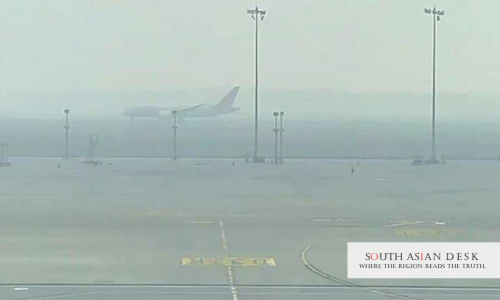
The Delhi fog chaos has continued for the seventh consecutive day as of December 22, 2025. Dense fog in Delhi dropped visibility to near zero in many areas. Delhi flights and trains were disrupted due to fog, with over 500 flights delayed or cancelled in the past week. The Delhi haze is expected to persist for two days, according to meteorological forecasts.
Visibility reduced sharply during morning hours. Commuters faced hazardous conditions on roads. Drivers reported difficulty seeing beyond a few metres.
Delhi Flights, Trains Disrupted as Fog Hits Peak Operations
Flights and trains in Delhi were disrupted due to severe fog at Indira Gandhi International Airport. Operators cancelled more than 100 flights on peak days. Delays affected over 300 others across major carriers.
IndiGo reported the highest impact. The airline operates a large share of domestic routes. Air India and Vistara also faced significant disruptions.
Low-visibility procedures are activated early each morning. CAT III instrument landing systems enabled operations for aircraft equipped with them. Many regional jets lacked the capability and had to divert to nearby cities.
Passengers were stranded for hours. Airports provided limited facilities during extended waits. Airlines issued travel advisories repeatedly.
Rail services encountered parallel issues. Northern Railway delays over 68 trains daily. Premium services, such as Vande Bharat and Shatabdi, ran hours late.
Fog restricted train speeds to 30-60 kmph in affected sections. Crew changes and signalling adjustments added delays.
Delhi fog chaos extended to the highways. National Highway authorities reported slow movement. Accidents increased due to poor visibility.
Dense Fog Delhi Visibility Low Triggers Alerts
Dense fog in Delhi, with visibility low, has been recorded between 50 and 200 metres at key observatories. Safdarjung logged 125 metres at peak hours. Palam station near the airport reported even lower figures.
The India Meteorological Department maintained yellow alerts. Moderate to dense fog is expected in the mornings and evenings.
Cold north-westerly winds contributed to persistence. No significant western disturbance approached the region.
The Delhi haze persists for two days with a partial cloud cover forecast. Drizzle is possible in isolated areas, but it is unlikely to clear the conditions.
The air quality index remained in the inferior category. AQI readings crossed 380 consistently. Stagnant air trapped pollutants alongside moisture.
Residents reported respiratory discomfort. Doctors advised masks and limited outdoor activity.
Delhi Haze Persists Two Days Amid Winter Chill
Delhi haze persists for two days as calm winds dominate. IMD scientists noted inversion layers trapping fog near the ground.
Minimum temperatures hovered around 9 degrees Celsius. Day maxima struggled below 20 degrees. Cold day conditions were declared at several stations.
The Delhi fog chaos significantly impacted daily life. Schools adjusted timings in some areas. Outdoor events postponed.
Construction activities slowed. Dust control measures are challenged by low visibility.
Power demand rose for heating. Delhi Discoms reported a stable supply despite an increase in load.
Background: Recurrent Winter Disruptions in North India
Delhi fog chaos forms part of the annual winter phenomenon. Dense fog envelops the Indo-Gangetic plains from mid-December.
Radiation fog develops under clear skies and calm winds. Moisture from rivers and canals enhances density.
Historical data shows increasing frequency. Urban heat islands and pollution contribute to prolonged spells.
Airports invested in advanced systems. Runway visibility instruments are upgraded regularly.
Railways deploy GPS-based signalling. Fog safety devices are installed on locomotives.
North India states coordinate responses. Punjab and Haryana report similar conditions.
Past seasons witnessed comparable disruptions. January 2023 saw over 1,000 flight cancellations in one week.
The Delhi haze persists for two days, mirroring previous patterns. Relief typically arrives with weather systems.
What’s Next
Conditions may ease slightly after December 24. Westerly winds are expected to strengthen gradually.
Intermittent fog is likely through early January. Peak winter season continues.
Travellers should monitor updates closely. Extra buffer time recommended for journeys.
Airlines plan contingency measures. Railways adjust schedules proactively.
Authorities urge road safety precautions. High beam usage is discouraged.
Delhi flights and trains disrupted, fog highlights infrastructure resilience needs. Long-term solutions include improvements to regional weather modeling.
Delhi fog chaos tests operational preparedness annually. Coordinated efforts minimise impacts.
Ongoing monitoring provides real-time guidance. Public cooperation is essential for safety.
The Delhi haze persists for two days, underscoring seasonal challenges. Adaptation strategies evolve continuously.
Future forecasts indicate variable intensity. Preparedness remains key to managing disruptions.
Delhi fog chaos serves as a reminder of winter realities in the capital region. Community awareness grows with each spell.
Published in SouthAsianDesk, December 22nd, 2025
Follow SouthAsianDesk on X, Instagram and Facebook for insights on business and current affairs from across South Asia.