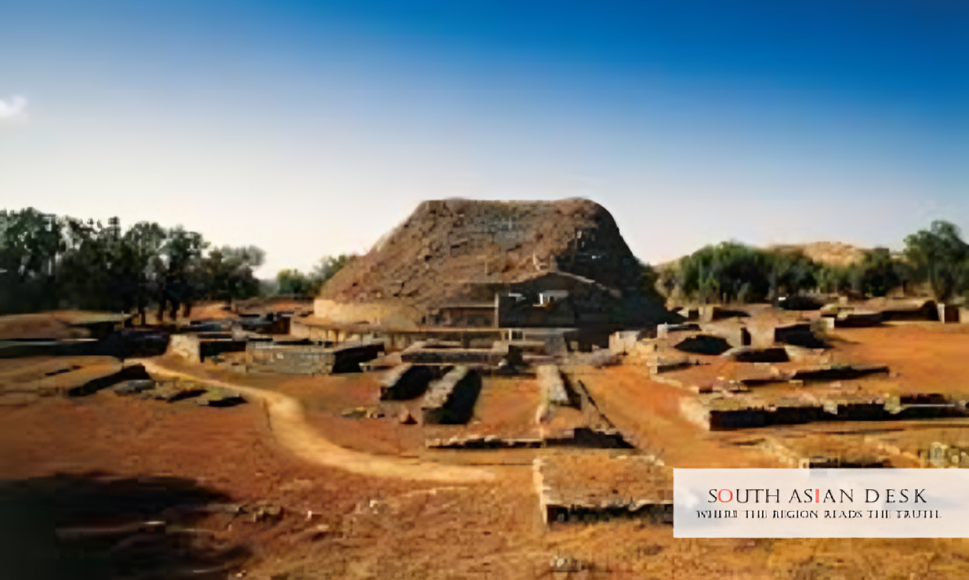
Archaeologists have uncovered evidence of a Taxila forgotten city at Bhir Mound in Pakistan’s Punjab province. The Punjab Department of Archaeology team found structures and artefacts predating the sixth century BC during a Taxila excavation. This breakthrough occurred on Friday, December 26, 2025.
The findings challenge established timelines for urban development in South Asia. They suggest Taxila hosted advanced societies before Achaemenid or Greek eras. This could link the site to broader regional histories like Harappa.
Bhir Mound Discovery Reveals Early Urban Life
Excavation at Bhir Mound has exposed stone and mud-brick walls. Streets show planned layouts. An advanced drainage system indicates organised civic planning. These elements point to a sophisticated community.
Artefacts include pottery with intricate designs. Coins and seals date to the second century BC. Stone and metal tools suggest daily life and construction practices. Storage jars and beads of semi-precious stones were also recovered.
Aasim Dogar, deputy director of the Punjab Department of Archaeology, stated: “Evidence of second century, fourth century and sixth century culture deposits are found, and the further deep trench may lead to discovery beyond the sixth century.”
The team used GPS technology and scanners. Drones aided geo-mapping. Japanese and Chinese software supported data analysis. This marks the first use of such tools in Taxila excavations.
Officials confirm continuous habitation. The site ties to Achaemenid, Greek, and Mauryan periods. It was active during Alexander the Great’s arrival in 326 BC.
Ancient Settlement Taxila Links to Broader History
The ancient settlement Taxila predates known phases. Stratigraphy shows layers from multiple centuries. Deeper digs may connect to Gandhara grave culture.
Bhir Mound spans early historic periods from 600 BC to 190 BC. It represents Taxila’s first city. The discovery places it among South Asia’s earliest urban centres.
Previous work provides context. Sir John Marshall excavated from 1918 to 1934. He established initial chronology. Sir Mortimer Wheeler dug in 1944-1945. He introduced stratigraphic methods.
After decades, Punjab authorities resumed efforts. The project aims to rediscover origins scientifically.
Background
Taxila sits in Punjab’s Potohar plateau. It gained UNESCO World Heritage status in 1980. Known for Gandhara art and Buddhist sites. Bhir Mound is its oldest layer.
Early accounts date settlement to sixth century BC. New evidence pushes this back. It suggests indigenous growth without external dominance.
The Punjab Department of Archaeology oversees 412 heritage sites. This includes three World Heritage locations. Funding comes from provincial budgets, estimated at PKR 100 million for current digs.
Taxila Excavation Uses Modern Methods
Drones captured site layouts. Scanners documented artefacts in 3D. GPS ensured precise mapping. These tools enhance accuracy over past manual methods.
The team uncovered wells and household items. Toys and toilet trays reflect daily culture. Metal objects show trade links.
Dogar added: “This is just the tip of the iceberg. There are likely many more layers of history buried beneath Bhir Mound waiting to be uncovered.”
The Bhir Mound discovery aligns with regional patterns. Similar sites in Indus Valley show urban traits. This strengthens South Asia’s archaeological narrative.
Excavations continue at multiple trenches. Deeper levels may yield pre-sixth century BC items. Carbon dating is planned for key finds.
What’s Next in Taxila Forgotten City Discovery
Plans include an open-air museum at Bhir Mound. This will allow public access. Conservation efforts target monument preservation.
International collaboration is sought. Scholars from Japan and China may join. The site could attract tourism, boosting local economy.
Further Taxila excavation will focus on stratigraphic analysis. Goals include clarifying timelines to Harappan links.
The Taxila forgotten city promises more insights into ancient South Asian life.
Published in SouthAsianDesk, December 27th, 2025
Follow SouthAsianDesk on X, Instagram and Facebook for insights on business and current affairs from across South Asia.