Bangladesh environment crisis has become a development crisis, experts said on Friday, June 5, 2026, as the country marked World Environment Day amid worsening air pollution, polluted rivers, shrinking green spaces and climate-linked threats to health, migration and livelihoods.
Bangladesh environment crisis exposes enforcement gap
Bangladesh is no longer facing only a shortage of environmental awareness, but a shortage of implementation, according to environmental experts and planners cited in public discussions around World Environment Day.
More than five decades after the 1972 Stockholm Conference helped shape the modern global environmental movement, Bangladesh has adopted climate strategies, environmental laws and policy commitments. Yet the gap between those commitments and conditions on the ground remains wide.
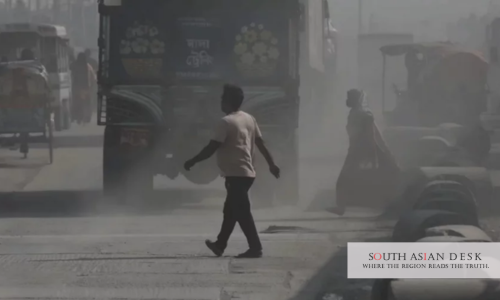
Dhaka continues to rank among cities with poor air quality, while rivers around the capital and industrial zones face pressure from untreated waste, encroachment and sewage. Coastal districts are also facing rising salinity, erosion and extreme weather, which are putting pressure on agriculture and pushing vulnerable families towards urban centres.
The challenge is now broader than conservation. Pollution, climate stress and unplanned urbanisation are affecting economic productivity, public health, housing, food security and the liveability of cities.
Air pollution drives health and productivity losses
Air pollution remains one of the most immediate threats. Bangladesh’s National Air Quality Management Plan 2024-2030, prepared by the Ministry of Environment, Forest and Climate Change and the Department of Environment, says available data show that air pollution in Bangladesh is “bad and increasing”. It says annual average PM2.5 levels in many parts of the country exceed World Health Organisation air quality guidelines by a factor of 10 or more.
The plan identifies a wide range of pollution sources, including power plants, industries, households, vehicles, waste burning and agriculture. It also stresses that air quality management requires action from multiple government agencies, not only the environment ministry and the Department of Environment.
The World Bank’s Bangladesh Country Environmental Analysis 2023 found that air pollution, unsafe water, poor sanitation and hygiene, and lead exposure cause more than 272,000 premature deaths and 5.2 billion days of illness annually. It estimated that these environmental issues cost the equivalent of 17.6 percent of Bangladesh’s GDP in 2019.
The World Bank also said household and outdoor air pollution had the most damaging health effects, causing nearly 55 percent of premature deaths linked to environmental risks and costing 8.32 percent of GDP in 2019.
These figures show why the environment is no longer a narrow policy sector. Pollution is reducing human capital, raising healthcare costs and cutting productivity.
Rivers and cities under development pressure
The environmental burden is also visible in Bangladesh’s rivers and rapidly expanding cities. Rivers such as the Buriganga, Turag and Shitalakkhya have faced long-running pressure from industrial discharge, domestic sewage and encroachment.
Urban planning experts warn that unplanned expansion is worsening flood risk, traffic congestion, heat stress and pressure on drainage systems. Shaikh Muhammad Mehedi Ahsan, vice-president of the Bangladesh Institute of Planners, told the competitor outlet that an estimated 75 percent to 80 percent of urbanisation in Bangladesh remains unplanned.
“Without science-based planning and properly designed development projects, Bangladesh cannot build climate-resilient and livable cities,” he said.
The warning is significant because Bangladesh’s development model depends heavily on dense cities, export-led industrial zones and infrastructure expansion. Without stronger environmental safeguards, growth itself may deepen exposure to pollution and climate risk.
Climate risks threaten livelihoods
Bangladesh is among the countries most exposed to climate change because of its low-lying geography, high population density and dependence on climate-sensitive sectors. The National Adaptation Plan of Bangladesh 2023-2050 says the country is highly vulnerable to climate-induced disasters, including floods, cyclones, salinity intrusion, drought and river erosion.
The plan sets six national adaptation goals, including protection from climate variability and disasters, climate-resilient agriculture, climate-smart cities, nature-based solutions, stronger governance and capacity-building for adaptation.
Coastal districts face especially acute pressure. Rising salinity can damage crops, drinking water sources and fisheries, while erosion and cyclone damage can force households to relocate.
World Environment Day 2026 is focused globally on climate change. The United Nations Environment Programme says this year’s campaign highlights the urgent signals the Earth is sending and the choices governments and societies make in response.
Government points to environmental action
Bangladesh’s government says it is taking action through afforestation, river restoration, renewable energy work, adaptation projects and air quality planning. Environment Minister Abdul Awal Mintoo highlighted a plan to plant 250 million trees over the next five years and expand canal excavation projects, according to the competitor report.
The National Air Quality Management Plan also reflects a more coordinated official approach. It says the National Committee on Air Pollution Control, chaired by the Cabinet Secretary, is intended to coordinate air pollution control across agencies and impose emergency measures during heavy pollution episodes.
The plan also refers to the Air Pollution Control Rules 2022 as a foundational step, setting national air quality standards and coordination mechanisms. However, the plan acknowledges institutional limits, including gaps in organisational structure, limited budget and human resources, coordination challenges and weaknesses in data management.
Those constraints help explain why experts continue to argue that Bangladesh’s central challenge is enforcement rather than policy design.
Background
Bangladesh has built a large climate policy framework over the past two decades. It has adopted the Bangladesh Climate Change Strategy and Action Plan, the National Adaptation Plan 2023-2050, the Mujib Climate Prosperity Plan, updated nationally determined contributions and sector-specific environmental rules.
The World Bank says Bangladesh has also made major gains in disaster preparedness, including a sharp reduction in cyclone deaths over several decades. But the newer development challenge is different. It involves chronic pollution, urban exposure, heat, unsafe water, chemicals and ecosystem degradation, all of which affect everyday life and long-term growth.
The World Bank’s 2023 analysis recommends stronger environmental governance, better data, improved enforcement, more economic and market-based policy tools, stronger waste management, WASH investments and a national air quality management programme.
What’s next
Bangladesh’s next task is to turn existing environmental commitments into measurable results. That means stronger monitoring, enforcement against polluters, cleaner urban transport, safer industrial discharge, better waste systems, stronger river protection and climate-resilient city planning.
It also means linking environmental governance directly to economic planning. If pollution and climate risk continue to reduce productivity, damage health and push migration, development gains will become harder to protect.
The Bangladesh environment crisis is therefore no longer only an ecological warning. It is a test of whether the country can protect growth, public health and climate resilience at the same time.
Published in SouthAsianDesk, June 5, 2026
Follow SouthAsianDesk on X, Instagram and Facebook for insights on business and current affairs from across South Asia.