

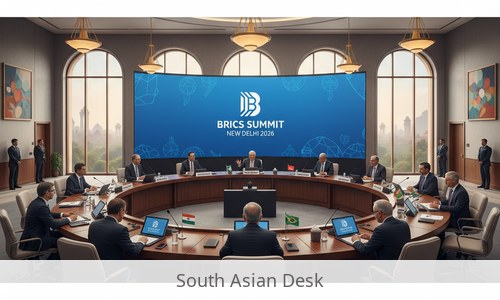
The BRICS summit 2026 commenced in New Delhi, India, on September 11, 2026, with leaders convening to discuss strategies for enhancing cooperation in trade, defense, and energy. This pivotal moment for emerging economies aims to reshape the global order through collective action.
South Asian participation, particularly from India and Iran, underscores the region’s growing influence in international economic and geopolitical frameworks. As the host nation, India’s role in BRICS has grown significantly over the years, reflecting its strategic position as a bridge between South Asia geopolitics and the broader global economy. The summit’s focus on energy security and critical minerals aligns with India’s broader economic goals, including its push for self-reliance in key sectors.
BRICS summit 2026: Modi and Putin: A Strategic Partnership
Indian Prime Minister Narendra Modi engaged in discussions with Russian President Vladimir Putin, focusing on bolstering bilateral trade relations and defense cooperation. The two leaders emphasized the importance of energy security and the strategic significance of critical minerals. Modi highlighted India’s commitment to strengthening ties with Russia, while Putin reiterated Russia’s support for India’s regional aspirations. These discussions are expected to influence India’s energy strategy and deepen economic ties between the two nations.
The India-Russia relationship, long characterized by robust defense and energy partnerships, has seen renewed momentum in recent years, particularly as both nations seek to counterbalance Western influence. The BRICS summit 2026 provided an opportunity to formalize agreements on energy infrastructure, including the development of critical mineral supply chains, which are vital for India’s manufacturing and technology sectors. Additionally, the two leaders discussed potential collaborations in defense technology, reflecting a shared interest in reducing dependency on Western suppliers.
Iran’s Role in BRICS
Iran’s President Masoud Pezeshkian, during his participation in the BRICS summit 2026, asserted that Iran would not yield to pressure from the US and Israel. His remarks, made during a meeting with Modi, underscored Iran’s resolve to maintain its stance on regional and international issues. Pezeshkian also expressed appreciation for India’s consistent support of Iran’s Iran BRICS participation, despite the challenges posed by international sanctions.
This alignment between Iran and India could have significant implications for regional stability and cooperation within the BRICS framework. Iran’s inclusion in BRICS has been a point of contention with Western nations, but its participation highlights the bloc’s role as an alternative platform for emerging economies. The the result provided an opportunity for India and Iran to reinforce their strategic partnership, particularly in areas such as trade, energy, and counterterrorism. India’s support for Iran’s BRICS membership, despite sanctions, reflects a broader strategy to engage with countries in the Global South and promote multilateralism.
Impact on South Asian Geopolitics
The outcomes of the the result may lead to shifts in trade relations among South Asian countries, fostering closer economic ties and collaborative defense strategies. The summit’s emphasis on multilateralism could encourage regional integration, potentially reducing dependencies on Western economies. Long-term implications for South Asia geopolitics may include increased collaboration on counterterrorism and maritime security, aligning with broader BRICS objectives.
The summit also provided a platform for South Asian leaders to address regional challenges, such as trade imbalances and security concerns, through a collective approach. By strengthening ties within BRICS, South Asian nations may enhance their geopolitical leverage, particularly in countering Western-dominated institutions and promoting a more equitable global order. The discussions on energy security and critical minerals could also lead to the development of regional supply chains, reducing reliance on external sources and fostering economic resilience.
Follow SouthAsianDesk on X, Instagram and Facebook for insights on business and current affairs from across South Asia.
Sources
- BRICS Summit 2026 updates on Sept.11: PM Modi stresses need to protect navigation, seafarers in talks with Iran’s Pezeshkian – thehindu.com
- Can BRICS help reshape global order by strengthening emerging economies? – aljazeera.com
- ‘US, Israel Want To Bully Us, But We Won’t Kneel’: Iran President In Delhi – ndtv.com
