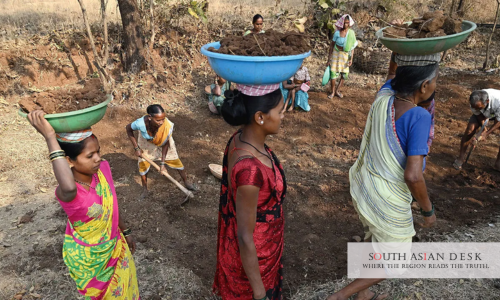
India rural jobs scheme reform marks one of the biggest changes to the country’s welfare architecture in two decades, replacing the Mahatma Gandhi National Rural Employment Guarantee Act, better known as MGNREGA, with a new framework called the Viksit Bharat Guarantee for Rozgar and Ajeevika Mission (Gramin), or VB-G RAM G.
The change matters because MGNREGA was not an ordinary welfare scheme. Introduced in 2005, it created a legal guarantee of rural wage work, offering at least 100 days of employment in a financial year to rural households whose adult members were willing to do unskilled manual labour.
The new VB-G RAM G framework keeps the idea of guaranteed rural work but changes its scale, structure and administration. Government material says the new Act replaces MGNREGA, raises the employment guarantee to 125 days, introduces a 60-day agricultural-season pause, changes the funding pattern and links employment more closely with rural infrastructure, livelihoods and climate-resilience works.
What Has Changed Under the India Rural Jobs Scheme?
The most visible change is the increase in guaranteed employment from 100 days to 125 days per rural household per financial year. On paper, this is a major expansion. For landless labourers, marginal farmers and rural households facing seasonal income gaps, 25 additional days of wage work could make a meaningful difference.
But the overhaul is not just an increase in days. It also changes when work can be provided, who pays for it, how workers are verified and what types of assets are created.
Under the new framework, work can be paused for up to 60 days during peak agricultural sowing and harvesting seasons. The government’s stated rationale is that public works should not compete with farming for labour at crucial points in the agricultural calendar. In theory, this helps farmers find workers during busy periods. In practice, critics argue that it could weaken the bargaining power of landless labourers precisely when demand for labour rises.
The funding structure is also changing. MGNREGA was largely funded by the Centre, especially wage payments. Under VB-G RAM G, the general funding pattern is expected to shift to a 60:40 Centre-state ratio, with different arrangements for northeastern, Himalayan and certain Union Territory categories. States and activists have questioned whether this will reduce the scheme’s ability to respond to actual demand on the ground.
Why MGNREGA Was So Important
MGNREGA became one of the world’s largest public employment programmes because it combined welfare with a rights-based design. Its core promise was simple: if a rural household demanded work, the state had to provide it within a fixed period or pay unemployment allowance.
That made MGNREGA different from discretionary welfare. It functioned as a safety net during droughts, crop failures, economic slowdowns and migration shocks. It also gave rural workers a fallback option, which could indirectly improve bargaining power in local labour markets.
The programme was particularly important for women. In many parts of rural India, MGNREGA created paid work closer to home, allowing women to participate in the labour force without migrating or depending entirely on private agricultural employment. Its social audit requirements also gave village communities a formal tool to inspect works and spending.
The new framework inherits this legacy, but its success will depend on whether the 125-day promise remains genuinely demand-driven or becomes limited by budget ceilings, digital checks and state-level financial capacity.
What VB-G RAM G Promises
The government says the new rural employment framework is meant to modernise workfare. It links rural jobs to a wider development agenda, including water security, rural infrastructure, livelihood assets and climate adaptation.
A notified interim list reportedly includes 318 permissible development works under the new framework. These cover natural resource management, irrigation, rural connectivity, community infrastructure, livelihood-supporting assets, climate resilience and disaster preparedness. The framework also places the Viksit Gram Panchayat Plan at the centre of local planning, with an emphasis on bottom-up development and convergence across schemes.
This is the government’s strongest argument for the overhaul. MGNREGA was often criticised for poor asset quality, delayed payments, weak local planning, duplicate records and leakages. By using digital tools, biometric authentication, GIS-based planning and dashboard monitoring, the new framework aims to make rural employment more measurable and asset-oriented.
The government has also linked the new scheme to broader rural development goals. Instead of treating workfare only as temporary wage support, VB-G RAM G attempts to connect labour days with productive village assets such as water bodies, local roads, storage, fisheries infrastructure, afforestation, flood-control works and climate-resilient public assets.
The Budget Question
A major question is whether the money matches the promise. VB-G RAM G has reportedly been allocated Rs95,692 crore in the 2026 budget, accounting for about 40 percent of the Department of Rural Development’s outlay.
That sounds large, but rural employment spending depends heavily on demand. If more households seek work, especially during distress years, the government must either expand funding or restrict actual work availability. This is where critics see the core risk.
Under MGNREGA, the principle was that work demand should drive spending. If VB-G RAM G relies more on pre-set allocations, state shares and performance-linked releases, the legal guarantee could become harder to realise in poorer or fiscally weaker states. A 125-day entitlement may look generous on paper, but the real test is how many households actually receive that work.
The Seasonal Pause Debate
The 60-day agricultural pause is one of the most controversial parts of the overhaul. The government says the pause will stop public works from pulling labour away from farms during sowing and harvest periods.
Supporters may see this as practical coordination between public employment and agriculture. Many farmers complain that public works can raise local labour costs or reduce labour availability during peak farm work.
But worker groups see it differently. For landless labourers, agricultural seasons are not always secure income periods. Crop failures, localised floods, droughts or mechanisation can leave workers without enough private employment. If public works are suspended during these periods, workers may have fewer options and weaker bargaining power.
The effect will vary by region. In irrigated, labour-intensive agricultural belts, the pause may support farm operations. In poorer or rain-fed areas, it could reduce the safety-net function of the rural jobs programme.
Digital Verification and Exclusion Risks
The new framework also places heavy emphasis on e-KYC, biometric attendance, digital payments and verification. This is meant to reduce ghost beneficiaries and wage leakages.
However, digital welfare systems can create exclusion when connectivity is weak or biometric tools fail. Mandatory e-KYC, facial recognition and biometric attendance may become difficult in remote areas where workers struggle with internet access, authentication errors or administrative delays.
This is not a small issue. Rural workers who depend on daily wages cannot afford long verification disputes. If a worker is wrongly marked absent, if a job card is not renewed in time, or if wage payment is blocked because of a technical mismatch, the legal promise of work loses force.
The policy challenge is to prevent fraud without punishing the poorest workers for weak digital infrastructure.
What Rural Workers Should Watch
For workers, the most important issues are job card validity, e-KYC completion, wage rates, payment timelines and local work availability.
Existing job cards are expected to remain relevant during the transition, but workers may need verification or renewal under the new framework. Wage payments are expected to move through direct benefit transfer, and delayed payments are meant to attract compensation. Whether that compensation is actually paid will be important.
Workers should also watch how their state implements the seasonal pause. If public works are unavailable for 60 days, the timing of that pause will matter. A poorly timed suspension could hurt workers in areas where agricultural employment is irregular.
Gram Panchayats will also matter. If local planning is strong, the scheme can create useful assets. If planning is weak, the new framework may become more centralised and less responsive to village-level needs.
Why This Is Politically Sensitive
The MGNREGA overhaul is politically sensitive because it changes a programme associated with social rights, rural income security and the legacy of welfare politics in India. For supporters of the government, VB-G RAM G is a modernised, development-focused version of an old scheme. For critics, it risks weakening a demand-driven right to work by adding funding constraints, digital hurdles and seasonal restrictions.
Both readings may contain some truth. MGNREGA had real problems, including delays, corruption risks and uneven asset quality. But it also gave rural households a rare statutory claim on the state. The new system will be judged by whether it improves delivery without diluting that claim.
The Bottom Line
India’s rural jobs scheme overhaul is not merely a name change. It raises the employment guarantee to 125 days, expands the menu of rural works, introduces stronger digital monitoring and attempts to link workfare with long-term village development.
But the reform also introduces serious questions. Can states afford the new funding burden? Will the 60-day agricultural pause help farmers or hurt labourers? Will e-KYC reduce fraud or exclude genuine workers? Will the new scheme remain demand-driven, or will it become constrained by allocations?
The answer will not be found in the law’s headline promise. It will be found in village worksites, wage-payment records, job-card renewals and the number of rural households that actually receive work when they need it most
Published in SouthAsianDesk, July 5, 2026
Follow SouthAsianDesk on X, Instagram and Facebook for insights on business and current affairs from across South Asia.