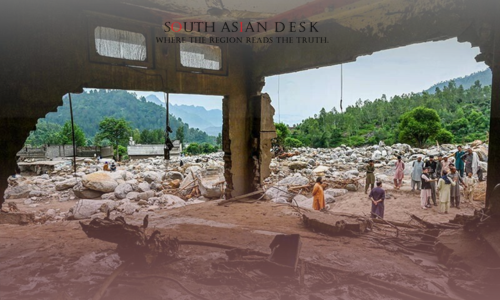
The relentless flash floods in Pakistan have left a trail of devastation across Khyber Pakhtunkhwa, shattering the dreams of countless children by destroying their schools. In remote villages, where education is a beacon of hope, families now face the anguish of seeing their children’s futures buried under rubble and mud. The loss of these vital institutions has struck a deep chord, leaving communities to grapple with both immediate grief and long-term uncertainty.
KP Flash Floods Leave Schools in Ruins
The torrential monsoon rains, which have battered Khyber Pakhtunkhwa since June 2025, have unleashed catastrophic flash floods, claiming lives, homes, and critical infrastructure. Among the hardest hit are the province’s schools, with 61 government institutions completely destroyed. Of these, 52 are primary schools, seven are middle schools, and two are high schools. These numbers reflect not just structural losses but the shattering of safe spaces where children once learned and laughed.
The destruction spans multiple districts, with Dir Lower bearing the brunt, losing 17 primary schools to the raging waters. Shangla follows with eight schools wiped out, including primary and middle levels. Haripur reports seven schools gone, comprising five primary, one middle, and one high school. Mohmand has seen 10 schools destroyed, eight of them primary, while Battagram accounts for five, predominantly primary. Abbottabad mourns the loss of four schools, Swat three, Mansehra two, and both Buner and Chitral Upper one each. These figures paint a stark picture of communities stripped of their educational foundations, leaving parents and children in despair.
Beyond total destruction, an additional 414 government schools have suffered partial damage, disrupting classes and forcing urgent repairs. Swat leads with 122 affected schools, including 88 primary, 13 middle, 13 high, and eight higher secondary. Abbottabad reports 67 damaged schools, Shangla 72, and Dir Lower 69, with most being primary institutions. Haripur, Buner, Mohmand, Battagram, Mansehra, Dir Upper, and Bajaur also face significant partial damages, ranging from one to 29 schools per district. These injuries to the education system threaten to delay learning for thousands, compounding the emotional toll on families already reeling from the floods.
The human cost within the education community deepens the tragedy. In Buner alone, four teachers and one non-teaching staff member lost their lives, while three teachers were injured. Most heartbreakingly, four students perished in flood-related incidents. These losses ripple through tight-knit communities, where teachers and pupils are not just educators and learners but neighbours and friends. The grief is palpable, as families mourn loved ones while confronting the daunting task of rebuilding their lives.
The flash floods have also exposed the fragility of infrastructure in Khyber Pakhtunkhwa’s mountainous terrain. Schools, often built near rivers or in low-lying areas, were no match for the torrents of water and boulders that swept through. The destruction of roads and bridges has further isolated communities, making it difficult for aid and repair teams to reach affected areas. Parents now fear for their children’s education, as makeshift solutions like tents or temporary classrooms struggle to replace the stability of permanent structures.
Local authorities have responded with urgency, deploying rescue teams and heavy machinery to clear debris and restore access. The provincial government has declared disaster zones in the hardest-hit districts, including Buner, Bajaur, Swat, Shangla, Mansehra, and Battagram. Relief efforts are underway, with promises of compensation for affected families and plans to rebuild schools. Yet, the scale of the disaster, coupled with forecasts of more heavy rains, casts a shadow over recovery efforts. The emotional weight of this crisis lingers, as communities rally to support one another while mourning their losses.
The flash floods in Pakistan 2025 have not only claimed lives and homes but have also stolen the promise of education from countless children. As Khyber Pakhtunkhwa rebuilds, the resilience of its people shines through, but the road ahead is long. The destruction of schools serves as a painful reminder of the region’s vulnerability to natural disasters, urging collective action to protect future generations from the devastation of flash floods.
Published in SouthAsianDesk, August 18th, 2025
Follow SouthAsianDesk on X, Instagram and Facebook for insights on business and current affairs from across South Asia.