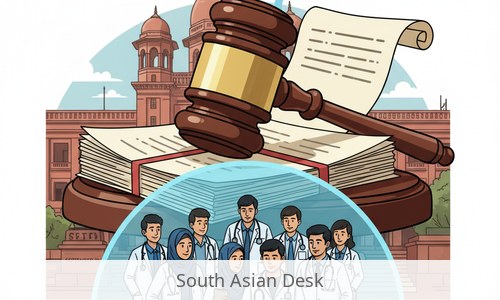
Pakistan court Afghan medical students: On September 11, 2026, the Lahore High Court issued a temporary suspension of the directive to expel Afghan medical students, a decision welcomed by Afghan officials as a critical reprieve for students facing uncertain futures. The ruling comes amid heightened tensions in Afghan-Pakistani relations and underscores the precarious status of Afghan refugees in Pakistan.
Pakistan court Afghan medical students: Court’s Ruling
The Lahore High Court’s order halts the Pakistan Medical and Dental Council’s (PMDC) directive to expel Afghan students from medical universities. The PMDC had previously ordered institutions to stop admitting Afghan students and expel those already enrolled, citing unspecified regulatory concerns. The court’s temporary suspension allows students to continue their education while legal challenges proceed.
Pakistan’s Foreign Ministry clarified that Afghan students holding valid visas are permitted to remain in the country. This statement followed reports of a potential blanket ban on Afghan students, which sparked fears of mass expulsions. The ministry emphasized that visa compliance remains a key criterion for continued enrollment.
Reactions from Afghan Officials
Afghan Ambassador to Pakistan Sardar Ahmad Shakeeb described the court’s decision as a “positive development for Afghan students.” He noted that the ruling provides temporary stability for thousands of students pursuing medical degrees in Pakistan, many of whom have been in the country for years.
The broader context of Afghan students’ rights in Pakistan highlights ongoing challenges. Since the Taliban’s takeover in 2021, Afghan refugees have faced shifting policies and reduced access to education. The court’s intervention reflects both legal and diplomatic efforts to address these issues.
Implications for Afghan Students
The ruling by the Pakistan court Afghan medical students offers immediate relief but does not resolve long-term uncertainties. Afghan students in Pakistan face a complex landscape of visa regulations, institutional policies, and geopolitical dynamics. While the court’s decision prevents mass expulsions, the PMDC’s original directive raises questions about the sustainability of their educational opportunities.
For many students, the ruling is a lifeline. Medical education in Pakistan is highly regarded, and thousands of Afghan students have enrolled in Pakistani universities. However, the threat of expulsion has created anxiety, with some students contemplating leaving the country or abandoning their studies.
Historical Context of Afghan Students in Pakistan
The presence of Afghan students in Pakistani institutions dates back to the early 2000s, following the U.S.-led invasion of Afghanistan. During this period, Pakistan became a hub for Afghan refugees seeking education, healthcare, and employment. Over time, the number of Afghan students in Pakistani medical schools grew significantly, with many institutions reporting enrollment figures in the thousands. This trend continued even after the Taliban’s return to power in 2021, though it was accompanied by increased scrutiny of refugee policies.
The current crisis reflects a broader pattern of policy instability. Since the Taliban’s resurgence, Pakistan has periodically tightened restrictions on Afghan refugees, citing security concerns and resource allocation. These measures have often been met with resistance from Afghan diplomatic representatives and international human rights organizations, who argue that such policies exacerbate humanitarian challenges.
Geopolitical Tensions and Regional Dynamics
The PMDC’s directive to expel Afghan students must be understood within the context of deteriorating Afghan-Pakistani relations. Pakistan has long been critical of the Taliban’s governance, particularly its policies on women’s rights and regional security. This tension has led to periodic crackdowns on Afghan refugees, including restrictions on access to education and employment.
The court’s intervention, however, signals a potential shift in how such disputes are resolved. By invoking judicial oversight, the Lahore High Court has provided a mechanism for addressing grievances that might otherwise be left to bureaucratic discretion. This approach aligns with broader regional trends, where courts in South Asia have increasingly played a role in mediating cross-border disputes and protecting minority rights.
Long-Term Uncertainties and Future Prospects
While the court’s ruling provides temporary reprieve, the underlying issues remain unresolved. The PMDC’s directive highlights a lack of clear regulatory frameworks governing the enrollment of foreign students, particularly those from conflict-affected regions. Without comprehensive policy reforms, similar disputes are likely to recur, creating ongoing instability for Afghan students and their families.
For Afghan students, the stakes are high. A medical degree from a Pakistani university is often seen as a pathway to professional opportunities in both countries. However, the threat of expulsion has forced many to navigate a precarious existence, balancing their academic pursuits with the fear of sudden deportation.
Broader Regional and International Implications
The situation also has implications for regional stability and international humanitarian efforts. Pakistan’s treatment of Afghan refugees has long been a point of contention with global organizations, including the United Nations and the International Organization for Migration (IOM). The current crisis could further strain Pakistan’s relationship with these bodies, particularly if the expulsions proceed despite the court’s intervention.
Moreover, the ruling underscores the need for coordinated regional policies on refugee education. South Asian countries, including India and Bangladesh, have also grappled with similar challenges, though their approaches have varied. A unified framework for managing refugee education could help mitigate such crises in the future.
Follow SouthAsianDesk on X, Instagram and Facebook for insights on business and current affairs from across South Asia.
The wider context of this developing story also includes Lahore High Court ruling and Afghan students education Pakistan.