KATHMANDU, Nepal (South Asian Desk) – Nepal’s Commission for the Investigation of Abuse of Authority (CIAA) charged 55 individuals and a Chinese construction company with corruption on Sunday, alleging they colluded to Pokhara airport corruption at inflated costs by $75 million (£59 million). The case targets five former ministers and executives from China CAMC Engineering in a scandal tied to a Belt and Road Initiative (BRI) project. The probe, triggered by a 2023 parliamentary review, highlights procurement breaches and quality lapses at the airport, which opened in January 2023.
This Pokhara airport corruption case strikes at the heart of Nepal‘s fiscal vulnerabilities, as the nation grapples with repaying a $216 million (£170 million) Chinese loan amid stagnant tourism revenue from the underused facility. In South Asia, where BRI projects fuel infrastructure booms but breed debt traps, the scandal amplifies calls for transparent foreign investments. It underscores how elite collusion can derail development, burdening taxpayers in landlocked economies like Nepal’s and raising alarms for neighbours such as Pakistan and Sri Lanka facing similar China-funded ventures.
Nepal Chinese Firm Corruption Charges Expose Elite Network
The CIAA filed the charges at a special court in Kathmandu, seeking recovery of NRs 8.36 billion ($62.5 million; £49 million). Ganesh Bahadur Adhikari, CIAA assistant spokesperson, stated the defendants misused funds through unnatural cost hikes from an initial $169.69 million (£133 million) estimate to $244 million (£192 million) including VAT and contingencies. “The public servants involved knowingly increased the cost estimate,” Adhikari said in a statement.
China CAMC Engineering, a subsidiary of state-owned Sinomach, faces accusations of bad faith bidding. An information officer for the CIAA noted in a release: “The contractor acted with bad intentions, increased the cost estimate unnaturally without reasonable cause, and forced other defendants to compete to gain illegal benefits.” The firm bid $305.12 million (£240 million), 85% above the original figure, yet secured the contract under restricted bidding linked to the 2016 China Exim Bank loan.
Investigators claim $74.34 million (£58.5 million) of the $224.72 million (£177 million) paid to CAMC stemmed from artificial inflation. Procurement laws were violated by limiting bids to Chinese firms, sidelining open competition. Construction ran from August 2018 to December 2022, with payments disbursed despite red flags on quality control.
Key Figures Implicated in the Probe
Among the charged are former finance minister Dr Ram Sharan Mahat, accused of approving the inflated $215.96 million (£169.5 million) estimate on July 30, 2014. Former tourism minister Bhim Prasad Acharya allegedly directed the Civil Aviation Authority of Nepal (CAAN) on April 6, 2014, to favour the Chinese contractor and later endorsed the Exim Bank loan on October 31, 2014.
Other defendants include ex-minister Ram Kumar Shrestha, charged with abusing authority to rubber-stamp decisions; Post Bahadur Bogati (deceased, represented by his wife Ram Maya Bogati); and Deepak Chandra Amatya. Ten former secretaries, including Somlal Prasad Sharma, face counts for facilitating the hikes. CAAN officials like Triratna Maharjan, Ratish Chandra Lal Suman, and Pradeep Adhikari are implicated in oversight failures. CAMC executives Wang Bo and Liu Shengcheng head the corporate defendants.
The 33-page charge sheet details how bilateral talks between Nepali officials and CAMC bypassed standard valuation by a local consultant, which pegged costs at $145 million (£114 million). Parliamentary scrutiny post-2023 flagged these issues, leading to the CIAA’s months-long investigation.
China Nepal Airport Scandal Ties to Broader BRI Concerns
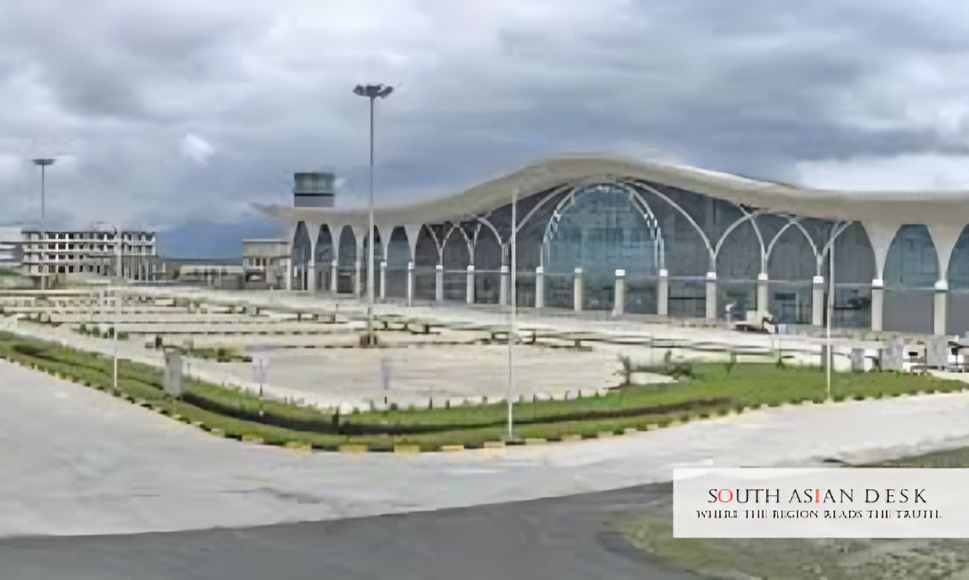
The Pokhara airport, Nepal’s second international gateway, symbolises ambitious BRI expansion but now epitomises the China Nepal airport scandal. Funded as a turnkey project, it aimed to boost tourism in the Himalayan hub, yet handles few flights, generating minimal revenue. Nepal must service the loan amid economic strain, with interest compounding the burden.
This BRI Nepal corruption episode mirrors regional patterns. In Pakistan, CPEC projects face graft probes; in Sri Lanka, Hambantota port debt led to a 99-year lease to China. Experts note such scandals erode trust in foreign aid, as inflated bids drain public coffers. A 2023 report by The New York Times first exposed CAMC’s cost padding and lax quality checks, prioritising profits over standards, findings now validated by the CIAA.
South Asian watchers see the case as a litmus test for accountability. With Nepal’s youth protesting corruption, sparking government upheaval in September 2025, the charges signal a crackdown. Yet, enforcement remains tricky; non-resident defendants like CAMC officials may ignore summons, prompting public notices.
Background: From Loan to Launch
The project originated in 2014 under the KP Oli government, with Cabinet approval for the Exim Bank loan. A 2016 agreement locked in CAMC via restricted tender, citing BRI synergies. Construction began in 2018, delayed by COVID-19, and concluded in 2022. Inaugurated by Oli on January 1, 2023, the airport boasts modern terminals but idles due to low traffic handling under 10 international flights weekly.
Early warnings emerged in a 2023 parliamentary committee report, which in April 2025 detailed “irregularities and corruption.” The CIAA probe followed, unearthing systemic graft from estimation to payment. No evidence of structural flaws has surfaced, but compromised oversight raises safety queries.
What’s Next for the Pokhara Airport Corruption Saga
The special court will summon defendants, with hearings potentially spanning months. If convicted, fines and recoveries could claw back billions, though extraditing foreign executives poses hurdles. Nepal’s government pledges deeper BRI audits, while CAMC has not commented publicly.
As proceedings unfold, the Pokhara airport corruption revelations may reshape South Asia’s approach to Chinese partnerships, demanding ironclad safeguards against graft.
Published in SouthAsianDesk, December 9th, 2025
Follow SouthAsianDesk on X, Instagram, and Facebook for insights on business and current affairs from across South Asia.