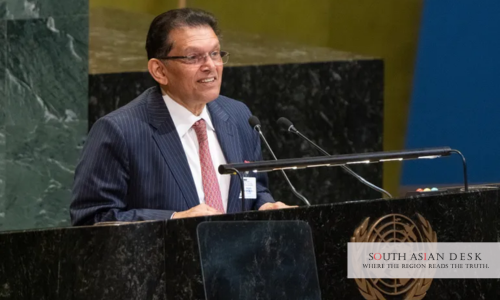
Bangladesh’s Foreign Minister Khalilur Rahman was elected the UN General Assembly President for its 81st session on Tuesday, June 2, 2026, in New York, defeating Cyprus’s Andreas Kakouris by eight votes in a closely contested secret ballot, the country’s first such honor in nearly four decades.
Bangladesh UN General Assembly president wins by a margin of eight votes
In a secret-ballot election witnessed by 190 UN member states, Mr Rahman received 99 votes against Mr Kakouris’s 91, with no abstentions or invalid ballots recorded. The result was announced at UN Headquarters in New York on Tuesday evening following completion of the vote count.
The presidency of the General Assembly rotates among the United Nations’ five regional groups; the 81st session was allocated to the Asia-Pacific group, which nominated Mr Rahman through the established procedure for equitable geographical representation. He will formally assume office when the 81st session opens on Tuesday, September 8, 2026, and serve a one-year term.
The victory was welcomed by Bangladeshi Prime Minister Tarique Rahman, who described the result as a reflection of the country’s growing contribution and standing within the international community.
A veteran diplomat with four decades of multilateral experience
Mr Rahman, born in 1954, is among Bangladesh’s most experienced multilateral figures. He joined the Bangladesh Foreign Service in 1979 and, two decades later, moved to the United Nations Secretariat, joining the UN Conference on Trade and Development (UNCTAD) in Geneva in 1999 as a special adviser. He subsequently held senior positions across the UN’s New York and Geneva offices over the following 25 years, contributing to major UN flagship publications and engaging in a wide range of multilateral processes. Most recently, he served as Bangladesh’s National Security Adviser and High Representative on the Rohingya Issue before his appointment as Foreign Minister in February 2026.
Accepting the election, Mr Rahman pledged to approach the role “with humility and respect” at a moment when confidence in the multilateral system was under considerable strain. He told member states that the UN was entering its ninth decade facing extraordinary pressure, with public trust in the organisation’s capacity to deliver on its commitments being tested across several fronts simultaneously.
“As your president, I will dedicate myself to rebuilding trust, nurturing consensus, and opening space for good faith negotiations,” he told the Assembly, committing to outcomes that belonged to all member states rather than to any single bloc.
Six priorities to guide the 81st session
Mr Rahman outlined six broad priorities for his presidency: advancing peace and security; accelerating progress on the 2030 Agenda and the Sustainable Development Goals (SDGs); climate action and environmental protection; promotion of human rights; responsible governance of emerging technologies including artificial intelligence; and comprehensive UN reform.
Citing Bangladesh’s standing as one of the UN’s leading troop-contributing nations, he pledged to support conflict prevention, peacebuilding and the protection of civilians. He also committed to addressing development financing gaps, advancing implementation of the Global Digital Compact and strengthening the UN’s institutional effectiveness at a time of growing strain on multilateral structures.
His overarching presidential theme, “Restoring Trust, Managing Transformation: A United Nations that Delivers for All”, was warmly received by Secretary-General António Guterres, who described it as a meaningful call to action for a global problem-solving system in urgent need of renewal.
A world body under immense pressure
The election unfolded against a backdrop of significant stress within the multilateral system. Outgoing General Assembly President Annalena Baerbock told member states following the vote that the UN was facing “not only headwinds, but immense pressure,” with the defence of the UN Charter having become, in her words, a daily necessity rather than a procedural assumption. She cautioned that conditions were unlikely to ease during the coming year.
Secretary-General Guterres, congratulating the incoming president, drew a similarly sober picture of the international landscape, one marked by unresolved conflicts, deepening inequality, climate disruption, and slowing progress on the SDGs, compounded by declining humanitarian and development funding. He warned that key international institutions remained structured around a post-Second World War order that no longer reflected today’s realities.
Mr Rahman’s term will also coincide with one of the most consequential events on the UN calendar: the selection of a successor to Secretary-General Guterres, whose term concludes on Thursday, December 31, 2026. The General Assembly will play a central procedural role in that process.
Background
The Presidency of the UN General Assembly is a one-year, non-renewable position that rotates among the five regional groups of member states — Africa, Asia-Pacific, Eastern Europe, Latin America and the Caribbean, and Western Europe and Others. Each group holds the presidency in turn.
This is only Bangladesh’s second time in the role. The country last held the presidency in 1986–87, when then-Foreign Minister Humayun Rasheed Chowdhury presided over the 41st session. The four-decade gap underscores the significance of the achievement for Dhaka’s diplomatic community. Bangladesh’s campaign for the current cycle was spearheaded by Mr Rahman himself alongside State Minister for Foreign Affairs Shama Obaed Islam and Prime Minister Tarique Rahman’s Adviser on Foreign Affairs, Humaiun Kobir, backed throughout by Bangladesh’s diplomatic missions worldwide. A milestone in the campaign came on Wednesday, May 13, 2026, when Mr Rahman participated in an interactive dialogue convened by the outgoing president, presenting his vision to member states in a two-and-a-half-hour session.
What’s next
As the Bangladesh UN General Assembly president-elect prepares to assume the chair on Tuesday, September 8, 2026, his first significant test will arrive at the high-level General Debate, which opens on Tuesday, September 22, at UN Headquarters in New York, drawing heads of state and government from all 193 member states. The debate is expected to be dominated by ongoing global conflicts, the state of SDG implementation and the UN’s structural reform agenda under the UN80 initiative. The Secretary-General succession process, which must be resolved before the close of 2026, will cast a long shadow over proceedings from the very outset of the 81st session.
Published in SouthAsianDesk, June 5, 2026
Follow SouthAsianDesk on X, Instagram and Facebook for insights on business and current affairs from across South Asia.