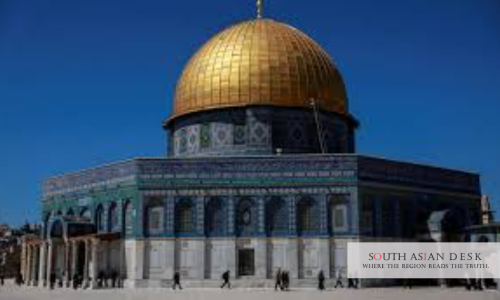
The Al-Aqsa Mosque incursions carried out by extremist Israeli settlers have once again taken center stage in regional diplomacy, with Pakistan’s Deputy Prime Minister and Foreign Minister Ishaq Dar leading a strong rebuke at a ministerial conference in Amman, Jordan. Speaking on Wednesday, Dar declared that Israel has no sovereignty over East Jerusalem or its holy sites, framing the repeated incursions as a direct threat to regional peace and to the sentiments of Muslims worldwide.
Pakistan Rejects Any Claim to East Jerusalem Sovereignty
Addressing the conference, Dar said Israel’s actions as the occupying power in Palestine continue to threaten the sanctity and historical character of Jerusalem’s holy sites. He argued that these actions undermine international law, disregard United Nations resolutions, and erode the prospects for a just and lasting peace.
On the question of East Jerusalem sovereignty, Dar was unambiguous. He stressed that Israel holds no legal claim over occupied East Jerusalem or its Islamic and Christian holy sites, adding that any measures aimed at altering their character or status are null and void, carrying no legal effect whatsoever.
Extremist Israeli Settlers Blamed for Al-Aqsa Mosque Incursions
Pakistan condemned, in the strongest possible terms, the continued incursions into Al-Aqsa Mosque by extremist Israeli settlers, which Dar said were encouraged by senior Israeli ministers and carried out under the protection of occupying forces. He warned that by deliberately undermining the religious and historical status of Jerusalem, Israel risks dragging followers of multiple faiths into a wider conflict, a scenario he insisted the international community cannot allow to unfold.
Al-Aqsa Mosque, Islam’s third-holiest site, sits in East Jerusalem, territory Israel captured in 1967 and later annexed. The compound remains a central symbol of Palestinian identity and a recurring flashpoint. Under longstanding arrangements, Jewish visitors may enter the compound but are not permitted to pray there. While Israel maintains it is committed to preserving this status quo, Palestinians and Muslim-majority nations, including Pakistan, argue it is steadily being eroded.
Jordan’s Role in Safeguarding the Holy Sites
Dar reaffirmed Pakistan’s recognition of the Jerusalem Endowment and Al-Aqsa Affairs Department, affiliated with Jordan’s Ministry of Awqaf and Islamic Affairs, as the sole legal authority overseeing the administration of Al-Aqsa Mosque. He also appreciated Jordan’s historic and special role in protecting the Islamic and Christian holy sites in Jerusalem during a separate meeting with his Jordanian counterpart, Ayman Safadi, where the deteriorating situation in the occupied West Bank was also discussed.
The two ministers welcomed growing momentum in Pakistan-Jordan relations and agreed to deepen cooperation across political, defence, economic, educational and cultural domains.
Concerns Over Settlement Expansion and the Gaza Peace Plan
Beyond the Al-Aqsa Mosque incursions, Dar voiced Pakistan’s deep concern over the continuous expansion of illegal Israeli settlements and the ongoing oppression of the Palestinian people, calling these policies a further entrenchment of unlawful occupation.
Turning to Gaza, Dar described the humanitarian situation as extremely fragile. He noted that while the ceasefire and the Gaza Peace Plan have brought some improvements, roughly 59 percent of the population still faces food insecurity and health crises. He further revealed that more than 1,100 Palestinians have been killed since the ceasefire took effect, a figure he said calls into question the full and faithful implementation of the plan.
Dar urged Arab and Islamic countries to act with unity and resolve, calling for an immediate end to violations against Al-Aqsa Mosque, preservation of Jerusalem’s legal status quo, and unrestricted access to the Old City for worshippers. He also called for collective rejection of Israeli settlement activity, annexation attempts, forced displacements and demographic changes in Palestinian territory, alongside full implementation of UNSC Resolution 2803.
Sidelines Diplomacy in Amman
On the sidelines of the ministerial meeting, Dar held bilateral talks with the foreign ministers of Turkiye, Egypt, Algeria and Somalia, covering bilateral relations and regional developments. He also took part in a meeting of the R-4 Group, comprising Egypt, Pakistan, Saudi Arabia and Turkiye, where ministers reaffirmed support for Palestinian self-determination and the establishment of an independent Palestinian state along the June 4, 1967 borders, with East Jerusalem as its capital.
Pakistan’s participation in the conference, according to the Foreign Office, reflects its principled and consistent support for the Palestinian cause and its firm rejection of any attempt to alter the status of Jerusalem’s holy sites.
A Recurring Flashpoint in the Region
The latest condemnation is not an isolated statement. Pakistan and other Muslim-majority countries have repeatedly denounced incursions by extremist Israeli settlers into Al-Aqsa Mosque, and in June, Pakistan joined eight other Muslim nations in categorically rejecting any attempt to change the historical and legal status quo in Jerusalem. As tensions in the occupied West Bank and East Jerusalem continue to simmer, the Al-Aqsa Mosque incursions are likely to remain a defining issue in regional diplomacy for the foreseeable future.
Published in SouthAsianDesk, August 6th, 2026
Follow SouthAsianDesk on X, Instagram and Facebook for insights on business and current affairs from across South Asia.