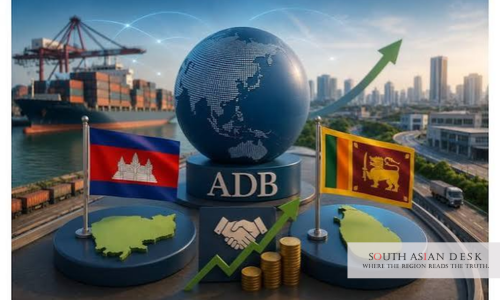
The Asian Development Bank has announced a new ADB $450 million package aimed at protecting vulnerable households and strengthening two economies as the conflict in the Middle East pushes up costs and adds uncertainty across Asia and the Pacific. The funding, confirmed on 30 July 2026, is split between Cambodia and Sri Lanka and combines short-term relief with longer-term economic reform.
ADB President Masato Kanda said the institution is moving quickly to shield households from a conflict unfolding thousands of kilometers away, noting that more than one million struggling families in Cambodia will receive direct assistance while Sri Lanka is supported in creating jobs, attracting investment, and expanding trade. The goal, according to Kanda, is to help both countries withstand current pressures and come out stronger from any future shock.
Why the Middle East Conflict Is Affecting Asia
The Middle East conflict impact Asia is being felt well beyond the region itself. Rising energy prices, disrupted shipping routes, and general market uncertainty tend to hit developing economies hardest, particularly those still recovering from earlier economic shocks. Cambodia and Sri Lanka, both of which have faced fiscal strain in recent years, are especially exposed to these external pressures. By stepping in now, ADB is attempting to prevent temporary cost increases from turning into lasting setbacks for low-income households and small businesses.
Breaking Down the ADB $450 Million Package
The package pairs immediate crisis response with structural reform, and it is built around two separate loans.
Cambodia: Rapid Intervention for Stabilization of the Economy
A $250 million loan will fund Cambodia’s RISE Program Cambodia initiative, formally known as the Rapid Intervention for Stabilization of the Economy Program. The financing will support temporary, targeted fiscal measures, protect planned social spending in the 2026 national budget, and promote clean energy technologies.
More than one million poor households registered under the government’s IDPoor system are expected to receive income support, including at least 350,000 households headed by women. The program also includes debt relief and support for agricultural inputs in rural communities, where the effects of rising costs are often felt most acutely.
ADB’s loan will be complemented by additional financing from the Asian Infrastructure Investment Bank, worth up to $250 million, and the Japan International Cooperation Agency, worth up to $188 million. Combined, the total financing behind the RISE Program could reach $688 million.
Sri Lanka: Trade, Investment, and Industry Development
The second component is a $200 million policy-based loan supporting Sri Lanka trade investment reforms under the country’s Trade, Investment, and Industry Development Program. Of that amount, $100 million is additional financing intended to help Sri Lanka absorb economic pressures created by the Middle East conflict.
The reforms are designed to modernize trade systems, improve the competitiveness of small and medium-sized enterprises, and draw investment into economic zones. By helping local enterprises expand, export, and connect with regional and global supply chains, the program aims to create jobs and support private sector growth. Diversifying exports and strengthening competitiveness are also expected to make Sri Lanka’s economy more resilient to external shocks going forward.
A Coordinated Approach to Cambodia Sri Lanka Economic Support
What sets this package apart is the way it links immediate relief to longer-term reform. Rather than offering short-term cash assistance alone, ADB has structured its Cambodia Sri Lanka economic support around measures that address both current hardship and future stability. In Cambodia, that means combining household income support with clean energy promotion and rural assistance. In Sri Lanka, it means pairing emergency financing with trade modernization and private sector development.
This dual approach reflects a broader pattern in ADB’s crisis response strategy, which has typically paired urgent funding with policy reforms meant to build resilience against future disruptions, rather than simply cushioning the immediate blow.
What Comes Next
With the loans confirmed, implementation will now shift to national governments and their partners. Cambodia’s IDPoor-registered households are expected to begin receiving support as part of the 2026 national budget cycle, while Sri Lanka’s trade and investment reforms will roll out as part of an ongoing multi-year program.
For both countries, the success of the package will likely depend on how efficiently funds reach intended households and how quickly reforms translate into real gains for exporters and small businesses. ADB, founded in 1966 and owned by 69 members, has positioned this response as part of its wider mission to support sustainable and resilient growth across Asia and the Pacific, particularly as external shocks like the Middle East conflict continue to test the region’s economic stability.
Published in SouthAsianDesk, August 6th, 2026
Follow SouthAsianDesk on X, Instagram and Facebook for insights on business and current affairs from across South Asia.